Hiring is just the first step. Can Singapore keep workers with disabilities in their jobs?
SINGAPORE – After interning at a hydroponic farm for three months, 19-year-old Muhammad Nafiz Sulaiman, who has autism, was not offered a full-time job.
He could do tasks like planting and watering well, but his employer felt he did not take enough initiative at work, said his mother, Siti Zulaiha Mohd Erfan, 46.
She believed the problem was one of communication. Nafiz finds it hard to start conversations, and his supervisors could have grown tired of having to tell him what to do next.
Nafiz had completed a horticulture course in school and had support from a job coach. Yet, he still struggled to hold down a job, reflecting the challenges of staying employed among persons with disabilities (PWDs) in Singapore.
As at 2025, only about one in four employed residents with disabilities worked for the same employer for at least one year, according to Ministry of Manpower data released for the first time in July.
Though there are no clear international benchmarks for retention rates of PWDs, it is crucial to start tracking such figures more comprehensively to establish Singapore’s own baseline and track progress.
More granular data could bring clarity in understanding why PWDs leave their jobs, or if retention varies across disability groups and industries. In Japan, for instance, the retention rate of employees with disabilities is categorised by intellectual, physical, mental or developmental disabilities.
Singapore national disability agency SG Enable acknowledged that this figure “sits below the overall workforce”. Between 85% and 89% of local employees stay with the same employer for at least a year, according to figures from the Singapore National Employers Federation.
“(The statistic) tells us that few employed persons with disabilities are staying with one employer long enough to build a sustainable career,” said the SG Enable spokesperson.

Siti Zulaiha Mohd Erfan with her son, Muhammad Nafiz Sulaiman, a 19-year-old with autism.
PHOTO: COURTESY OF SITI ZULAIHA MOHD ERFAN
Workplace retention was a pressing concern among the plans of a government task force that announced new support measures for PWDs on Oct 4.
Much of the focus has been on getting more PWDs into the workforce since the last Enabling Masterplan in 2022, which set a clear goal for 40% of residents with disabilities to be employed by 2030.
There has been steady progress. The employment rate rose from 28.2% in 2018/2019 to 34.7% in 2024/2025.
But there is no equivalent goal or tracking data for retention, which is a longer-term marker of how well PWDs find their place at work and in society.
Employment figures tell only one part of the story. A person who frequently moves between jobs may count as employed but struggle to reach financial stability or career progression.
When asked for a goal for the retention rate, SG Enable did not give a number, saying it would continue to monitor outcomes, including retention, as the new measures are implemented.
From principle to practice
The low retention rate raises a deeper question of whether Singapore workplaces are truly ready to integrate PWDs.
Hiring someone with a disability may signal a company’s commitment to inclusion. But keeping the person employed often requires changing the way rank-and-file employees work, communicate and relate to one another.
National Institute of Education associate professor Wong Meng Ee, who researches disability sociology, said the real test of inclusion is when people have to adjust to having colleagues with disabilities.
“That is where the tension lies, (when moving) from principle to practice,” said Wong, who has visual impairment.
When a job coach’s support ends or an understanding supervisor leaves, some PWDs may feel apprehensive about interacting with managers who may not understand their needs, said Ron Loh, assistant chief executive officer (services) of local charity SPD.
The National Council of Social Service’s Public Attitudes Study, which was conducted in 2019 and 2023, showed that the proportion of respondents who had positive attitudes towards PWDs at the workplace fell from 59.6% in 2019 to 50.6% in 2023.
No specific reasons were identified for the drop, but one expert said it could be due to stressful workplace environments and a lack of understanding of accommodations.
Some PWDs may need accommodations, such as screen readers for the visually impaired or extra breaks for neurodivergent individuals who experience sensory overload.
Without these, employers may misunderstand that they cannot do the job, said Max Soh, research and policy manager at the Disabled People’s Association (DPA).
For example, Nafiz could have benefited from having a daily schedule as people with autism usually work well with clear instructions, but not all employers understand this, said Zulaiha.
Other factors include the limited duration of wage support. Soh cited SG Enable’s Place-and-Train programme, which offered employers 90 per cent of salary support from the Government for up to a year to place and train PWDs.
A DPA report in 2024 found that some workers were let go when the subsidies ended, raising concerns that such schemes may inadvertently encourage short-term hiring without leading to sustained employment, said Soh.
Getting buy-in
The disability task force’s measures aim to address some gaps.
Of significance is SG Enable’s new Employment Support Office, which plans to provide longer-term support beyond initial job placement.
It will also help employers identify suitable roles and redesign jobs, and develop hiring guides for sectors with strong potential to hire PWDs, such as retail trade and finance and insurance services.
Financial support for employers like the Enabling Employment Credit will be expanded.
Firms will also get more flexibility to support PWDs’ needs, with new grants promising to offset costs of customised in-house training, and hiring professionals to support employees with moderate needs.
Having more job support generally leads to greater retention for PWDs.
About 60% to 70% of SPD’s clients in its employment programmes are still in their jobs at the one-year mark. The charity helps in securing workplace accommodations and redesigning jobs, and facilitates discussions between PWDs and supervisors or colleagues, said Loh.
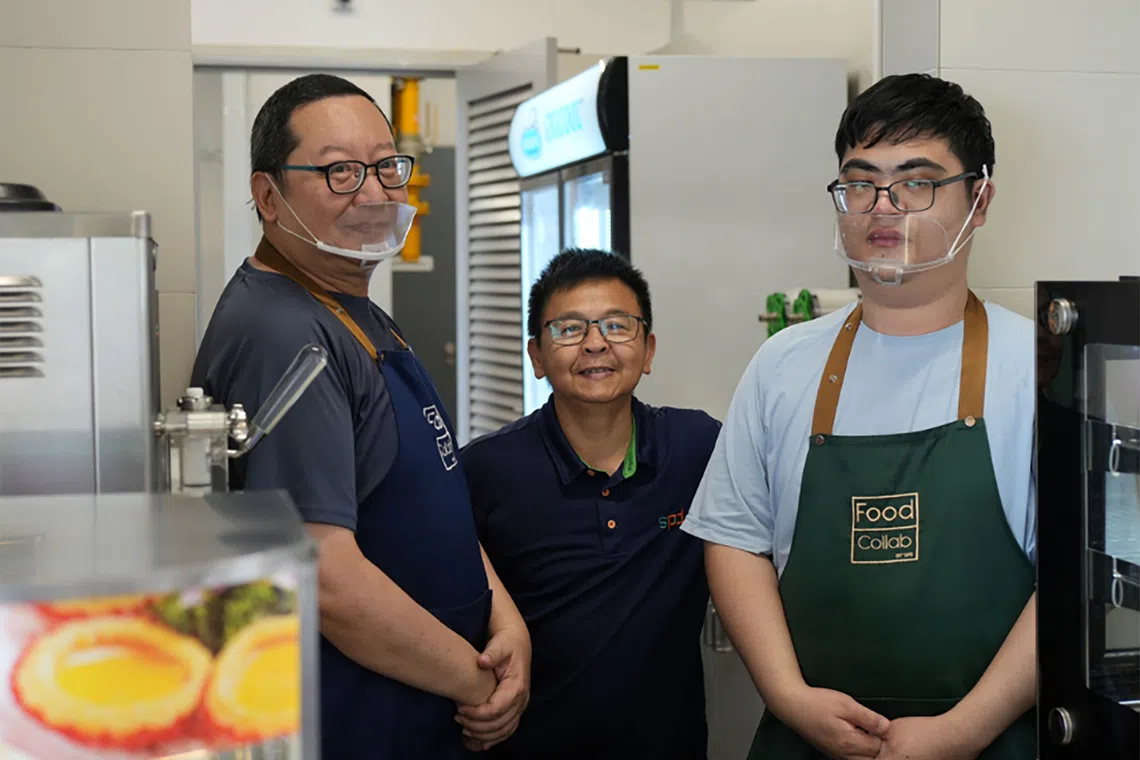
Edmund Ho (left), who has cognitive and speech impairment, and Low Kah Gin (right), who has autism spectrum disorder, work at Yusof Ishak Secondary School’s canteen under SPD’s employment programme. With them is SPD staff and operations supervisor Foo Boon How.
PHOTO: SPD
But all these can go only so far if colleagues remain reluctant to work alongside PWDs. Experts said employers must prepare staff at every level to understand disabilities, navigate difficulties in interactions and make reasonable adjustments.
The key is to help employees move beyond “tokenism”, where inclusive hiring is deemed as charity. PWDs must be seen as actual contributors, said Lyn Lee, author of the bestseller Tiny Rice Grains, which explores diversity, equity and inclusion in workplaces.
A company that has made strides towards inclusivity is United Overseas Bank (UOB). Besides providing step-by-step visual instructions for employees with autism, it also trains other employees to support them.
The bank started hiring employees with disabilities in 2013, first for its Scan Hub and recently also for its Wholesale Operational Readiness Centre.
PWDs also must be more confident in communicating their needs, said SPD’s Loh. In 2025, the charity set up a support group for employed PWDs to learn how to navigate the workplace.
Nafiz was upset when he was not offered a full-time job. He is now undergoing training to join other industries, while his mother hopes employers can better understand PWDs like him.
But the real test of inclusion is not whether someone like Nafiz gets hired. It is whether he can stay in one and build a future in it.
KioskNews shows a cleaned-up reading view extracted from the publisher’s page — the original always lives on their site, not ours.