With rare earths, Taiwan looks beyond the ‘red supply chain’
The nation has meaningful refining and recycling expertise but has not yet demonstrated a complete, economically sustainable rare-earth supply chain
By Romain Blachier / Contributing reporter


At National Cheng Kung University, researchers began with magnets from discarded electric-vehicle motors supplied by a local recycler. They dissolved a one-gram sample and tested how to separate dysprosium, a valuable rare-earth metal, from neodymium and praseodymium.
A 2022 paper in Materials, by Chen Wei-sheng (陳偉聖), Jian Guo-cai (簡國財) and Lee Cheng-han (李政翰), demonstrated selective extraction. It also identified unfinished work, including multistage processing and regenerating the extraction liquid. The experiment established a technical foundation, without claiming an industrial business.
The government wants to turn such expertise into a more secure source of industrial materials. Minister of Economic Affairs Kung Ming-hsin (龔明鑫) announced in February a pilot production line within three years. Officials have separately set a 2030 goal of producing domestically half of an anticipated annual rare-earth requirement of about 2,000 tonnes.
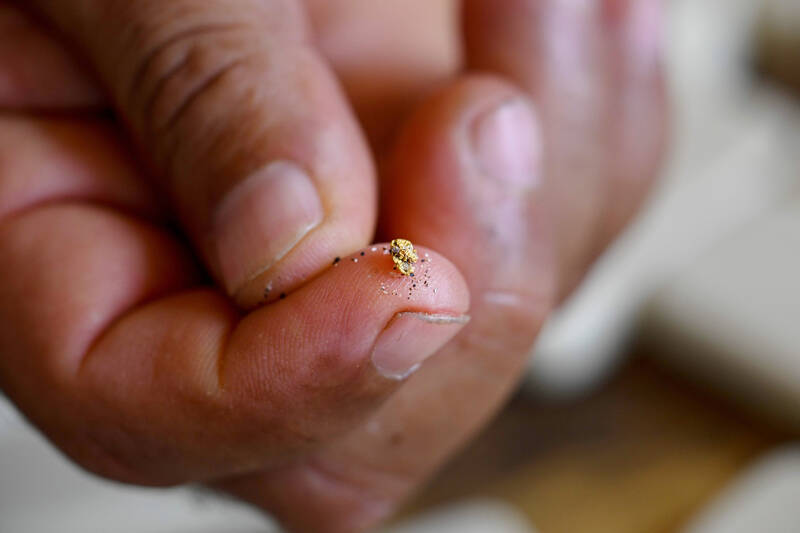
A man in June shows a small piece of gold extracted from an artisanal gold mine in Las Brisas de Cuyuni, Venezuela.
Photo: AFP
Taiwan’s opening in a “non-red” (less dependent on China) supply chain, lies in specialized refining and recycling. Imported feedstock, a kind of raw material, could supplement recovered magnets. The commercial task is to turn that material into consistent products manufacturers want to buy.
FROM SEPARATION TO SALE
China’s dominance makes that work urgent. It accounted for 91 percent of refined magnet rare earths and 94 percent of sintered permanent-magnet production in 2024, according to the International Energy Agency (IEA).
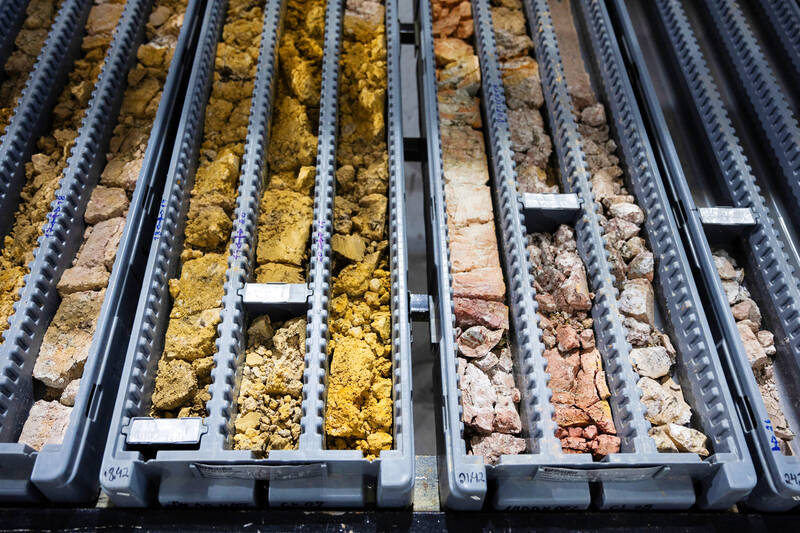
Samples are displayed in June at a rare earth research and processing center in Pocos de Caldas, Brazil.
Photo: Reuters
The Industrial Technology Research Institute (ITRI) has reported progress beyond separating individual elements. The institute told the Central News Agency (CNA) in November last year that researchers could produce rare-earth oxides and metals at 99.9 percent purity from resources containing about 5 percent rare earths. They had also formulated neodymium-iron-boron alloy and were testing materials with companies and universities.
ITRI planned technology transfer to industry this year. It also reported adapting waste-acid and wastewater-recycling techniques to reduce the processing burden. Continuous operation would still have to establish consistent quality and environmental performance at an acceptable cost.
An oxide, a metal and a finished magnet serve different customers. A purity figure alone cannot establish whether the output suits a particular application. Buyers need the appropriate composition and consistent performance, as well as sufficient volume.
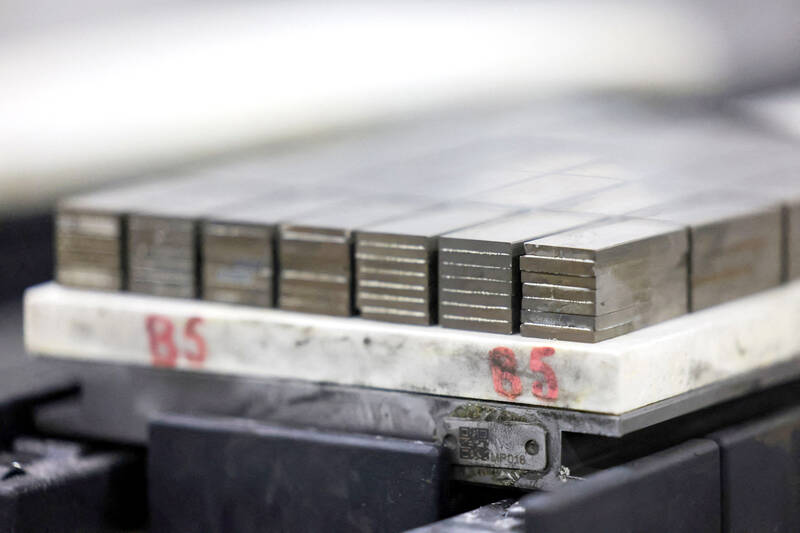
Neodymium iron boron (NdFeB) magnets in July sit on display during the grand opening of a rare-earth magnet manufacturing facility in Sumter, South Carolina, US.
Photo: Reuters
Taiwan already has magnet manufacturers. Taigene Metal (台全金屬) describes a longstanding business producing rare-earth and ferrite magnets, with a factory in Taoyuan. Such manufacturers offer potential customers for local refiners, provided the new material meets their specifications.
Leo Chang (張永撙), vice president of UWin Nanotech, draws a similar distinction. His company’s precious-metal recovery technologies operate commercially. Its rare-earth recycling applications remain under development.
“From our perspective, Taiwan’s main constraint is not necessarily technical capability, but rather feedstock availability and overall economics,” he told the Taipei Times.
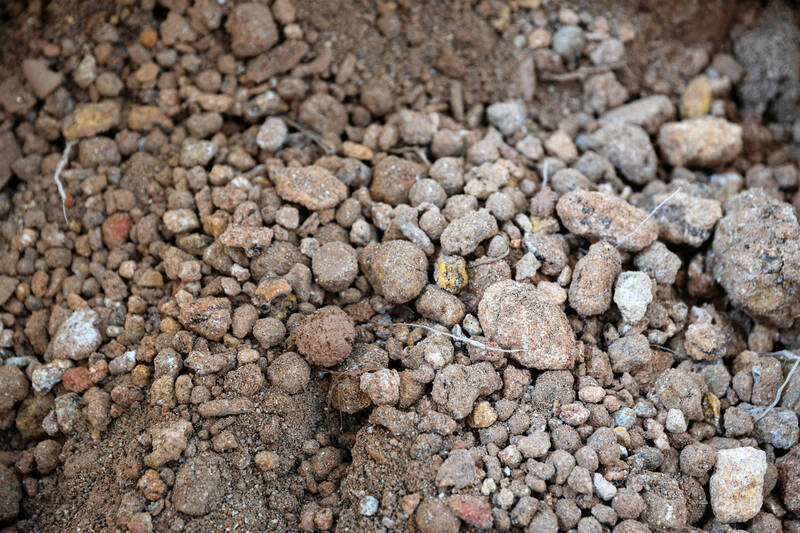
A sample of rare earth materials is displayed in June at the rare earth research and processing center in Pocos de Caldas, Brazil.
Photo: Reuters
His proposed starting point is concentrated, valuable waste such as end-of-life permanent magnets. Recovering rare earths indiscriminately from discarded electronics would incur substantial collection and dismantling costs.
CAN THIS FEED THE PLANTS?
Published economic research supports examining each waste stream separately. An AIChE Journal study this year by Chris Laliwala of Carnegie Mellon University and colleagues modeled recovery from discarded permanent magnets. Electric-vehicle and hybrid-vehicle magnets could support profitable recovery under the study’s assumptions. Its hard-disk-drive case could not, partly because available feedstock was insufficient.
Those US-based calculations cannot establish Taiwanese costs. They show why a recycler needs a realistic collection forecast before choosing a processing line. A large electronics industry does not automatically provide enough accessible, suitable magnets.
The government’s search for primary material continues alongside recycling. Kung in July said officials would visit California and Colorado next month to assess deposits. The purpose was to establish whether those resources matched Taiwan’s requirements. He also described contacts with Australia and Canada. These were sourcing assessments, not confirmed deliveries.
Taiwan could therefore combine selected recycled material with imported feedstock. The right combination depends on which elements customers need and the form in which they purchase them. An aggregate tonnage target cannot answer those questions.
Public policy already extends beyond the laboratory. The Industrial Development Administration last month told CNA that the government was supporting upstream refining and downstream applications. Research subsidies would help diversify material sources and develop substitutes or technologies requiring smaller quantities.
The Resource Circulation Promotion Act (資源循環推動法), promulgated in June, adds a demand-side instrument. Article 32 requires public bodies to prioritize designated environmental and circular products and services. Product categories and assessment procedures depend on implementing rules.
Chang argues that public purchasing could attract private investment by creating demand for recovered materials. Subsidies may also help overcome limited scale. The law supplies a framework; manufacturers and public purchasers still need contracts covering suitable products.
A ROLE BEYOND TAIWAN
Chang sees an export opportunity in the processing itself. Taiwan could supply equipment and engineering to regional recycling facilities near the waste, instead of importing large quantities of discarded products.
“In this way, Taiwan could become a technology and processing partner rather than simply a destination for imported waste,” he said.
That could generate business abroad. Securing materials for Taiwanese factories would require additional supply agreements: selling equipment overseas does not itself reserve the resulting output for Taiwan.
Kristy Hsu (徐遵慈), of the Chung-Hua Institution for Economic Research, proposes a framework for such cooperation in an essay she supplied in response to questions. Her contribution to the Center for Strategic and International Studies’ Taiwan and the Pacific links Australia’s resources with Taiwan’s manufacturing capabilities and US technology, capital and markets.
She calls for permanent coordination and a trusted supplier network, extending the existing Taiwan-US economic dialogue. Her proposal addresses how partners could organize cooperation; it does not document an operating rare-earth venture.
ITRI declined an interview for this article. The economics ministry had not answered questions about the pilot’s products and timetable. Public sources reviewed do not establish its current saleable output, a complete commercial financing package or committed buyers.
Taiwan has a credible technical opening. Its success will depend on connecting specialized refiners to existing manufacturers and overseas suppliers. For a machinery company, the practical result would be repeat deliveries of the right material at an agreed price. That is the industrial capacity the pilot must help build.
Romain Blachier is an associate researcher at the Fondation Jean-Jaures, president of the Association France-Formosa, a lecturer in geopolitics and a renewable-energy professional.
KioskNews shows a cleaned-up reading view extracted from the publisher’s page — the original always lives on their site, not ours.