Lights go out at Russia’s Novaya Gazeta, after years of defiant reporting
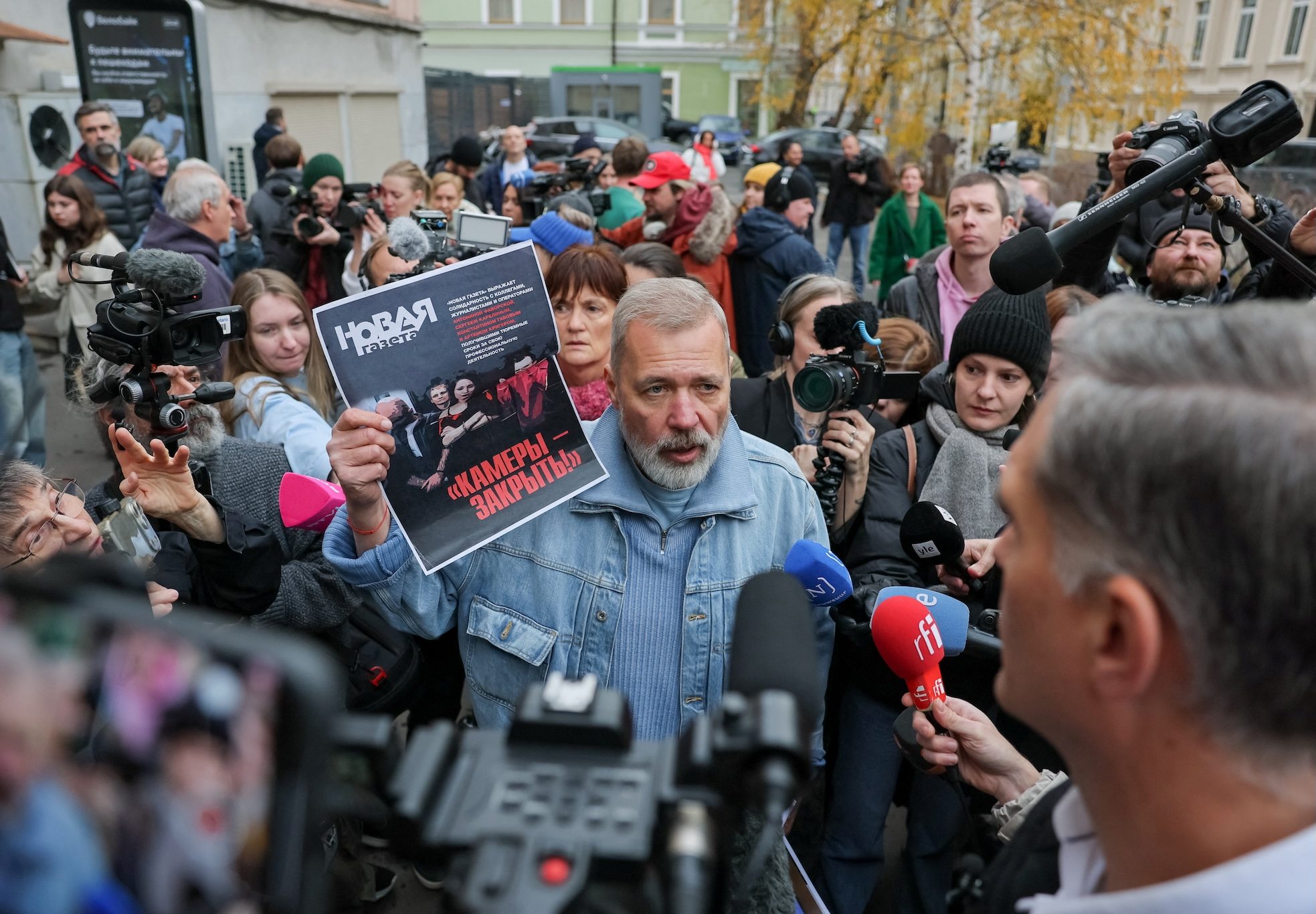
PRESS FREEDOM. Dmitry Muratov, former editor-in-chief of the Russian newspaper Novaya Gazeta, holds a poster in support of jailed reporters outside the outlet's office as the newspaper shuts down, citing what it describes as a relentless campaign by the authorities, in Moscow, Russia, on November 9, 2026.
Ramil Sitdikov/Reuters
'We are currently at a point where the section of the Russian constitution that guarantees political and civil rights has effectively ceased to function,' says Novaya Gazeta co-founder Dmitry Muratov, a co-winner of the 2021 Nobel Peace Prize
AT A GLANCE
- Russian investigative newspaper Novaya Gazeta ceased operations on November 9 due to state pressure, marking the end of a significant independent news outlet.
- Co-founder Dmitry Muratov emphasized the importance of free speech and human rights, criticizing the Kremlin for suppressing dissent and blaming it for the ongoing war in Ukraine.
This is AI-generated. Read the article for full context. Report any errors.
MOSCOW, Russia – Russian investigative newspaper Novaya Gazeta wound up its operations on Monday, November 9, and quit its central Moscow office, bowing to what it said was a campaign of state pressure that had made it impossible to carry on reporting.
Its co-founder Dmitry Muratov, addressing journalists who gathered to witness the newspaper’s closure, issued an impassioned plea for free speech and human rights in wartime Russia.
“Those in our country who advocate for peace have been denied the right to read what they choose, as we see happening today,” he said.
“We are currently at a point where the section of the Russian constitution that guarantees political and civil rights has effectively ceased to function.”
The closure marks the end of one of Russia’s most influential independent news outlets.
Kremlin spokesman Dmitry Peskov said it was part of a “rotational process” in a fiercely competitive media environment.
Paper known for courage of reporters
The newspaper, renowned for fearless reporting that led to six of its journalists being murdered over the years, was founded by Muratov and the last Soviet leader Mikhail Gorbachev, using money from Gorbachev’s 1990 Nobel Peace Prize.
Inspired by Gorbachev’s vision of “glasnost,” or openness, it became one of Russia’s most influential newspapers and defenders of democracy, with investigations into corruption and critical coverage of politics.
After President Vladimir Putin launched a full-scale war with Ukraine in 2022 and Russia imposed tight censorship laws, the paper halted its print edition but continued to publish online, becoming a refuge for independent journalists who chose to remain in the country.
But it announced late last month that it would have to close after it was designated a “foreign agent” and ordered to vacate its offices, and banks stopped processing reader donations on which it relied for financial survival.
Muratov, a co-winner of the 2021 Nobel Peace Prize, said people needed to understand that it was the Kremlin that was to blame for waging the war and suppressing free speech.
“We cannot blame the citizens themselves for this — especially the wonderful, truly remarkable younger generation. I urge you to distinguish between the Russian authorities and the Russian people,” he said.
He called for a broader ceasefire in Ukraine following a six-day truce in one area brokered by US first lady Melania Trump in late October.
Muratov also urged the release of what he said were around 4,000 political prisoners in Russia.
The Kremlin defends the need for censorship laws, denies there are any political prisoners and says that Russia is taking necessary action at a time of war to prosecute people engaged in subversive activity.
It was unclear whether the newspaper would attempt to regroup and publish in another form. In a long article on its website, describing its final weeks, journalist Irina Vorobyova was quoted as saying its spirit would survive like a “good virus.”
“Not even a nuclear explosion could destroy it. It will continue in everyone who was part of it,” she said. – Rappler.com
KioskNews shows a cleaned-up reading view extracted from the publisher’s page — the original always lives on their site, not ours.