Device placed under breastbone delivers life-saving shocks to restore heart rhythm
SINGAPORE – At 19, Coeus Lee was hardly someone you would expect to suffer a cardiac arrest.
Yet, CCTV footage from his camp’s medical centre caught the undergraduate from the National University of Singapore, who turned 20 on Sept 12, collapsing moments after he walked through the door.
“I went to the medical centre to do my ORD FFI, the compulsory final medical check-up before I was deemed to have completed my national service,” Lee said.
When he came to, he did not realise that he had had a cardiac arrest.
“I was disoriented and missing my two front teeth. I thought I just had a bad fall, hit my head and blacked out,” he said.
Seow Swee Chong, a senior consultant with the Department of Cardiology at the National University Heart Centre, Singapore, told The Straits Times that Lee was fortunate that there were medics on hand to render emergency life-saving treatment.
“He survived without significant neurological impairment,” Seow said.
Lee was sent to Woodlands Hospital, the closest hospital to his camp, but was referred to the National University Hospital for specialist care.
To reduce Lee’s risk of another sudden cardiac arrest, Seow and his team decided to implant an extravascular implantable cardioverter-defibrillator (EV-ICD) – a new generation of defibrillators – under his breastbone, directly outside the heart.
The surgery was carried out about 1½ weeks later.
Lee’s young age made him a suitable candidate, making him one of the first patients in Singapore to receive the device.
It uses a lead, a thin wire placed outside the heart and veins, to deliver life-saving shocks and send tiny electrical pulses to the heart muscle.
“The lead goes under his breastbone (or sternum), with the main battery box placed under the skin near the left armpit. By doing so, the heart now sits behind the wire and the box. This allows the device to send painless electrical pulses like a pacemaker or, whenever there is the possibility of an arrest, stronger electric shocks to fix abnormal rhythms,” Seow said.
The battery box is about the size of the face of an Apple smartwatch.
“The part where we make the space under the breastbone is pretty painful. So that’s why we carry it out under general anaesthesia. Technically, it is not a difficult procedure, and it takes about an hour. The patient is usually discharged in a day with medication for pain management,” Seow said.
Lee said: “The first day was the worst, in terms of the pain, but as the days progressed, it got significantly better.”
Seow said Lee’s young age also made it a bit difficult to work through his muscles, compared with those of an older patient.
“I did not use any cutting tools to make my way through the sternum to be near the heart. Rather, I used my finger to pave the way, which is safer as it will not damage anything along the way,” he added.
More than 3,000 people suffer from out-of-hospital cardiac arrests each year across all ages, with close to four in five occurring in public or residential places.
However, according to the Ministry of Health, sudden cardiac death among those under the age of 35 is rare in Singapore, accounting for less than 3 per cent of all such deaths.
When sudden cardiac arrest strikes seemingly healthy young men, it is rarely caused by the standard lifestyle-related blocked arteries.
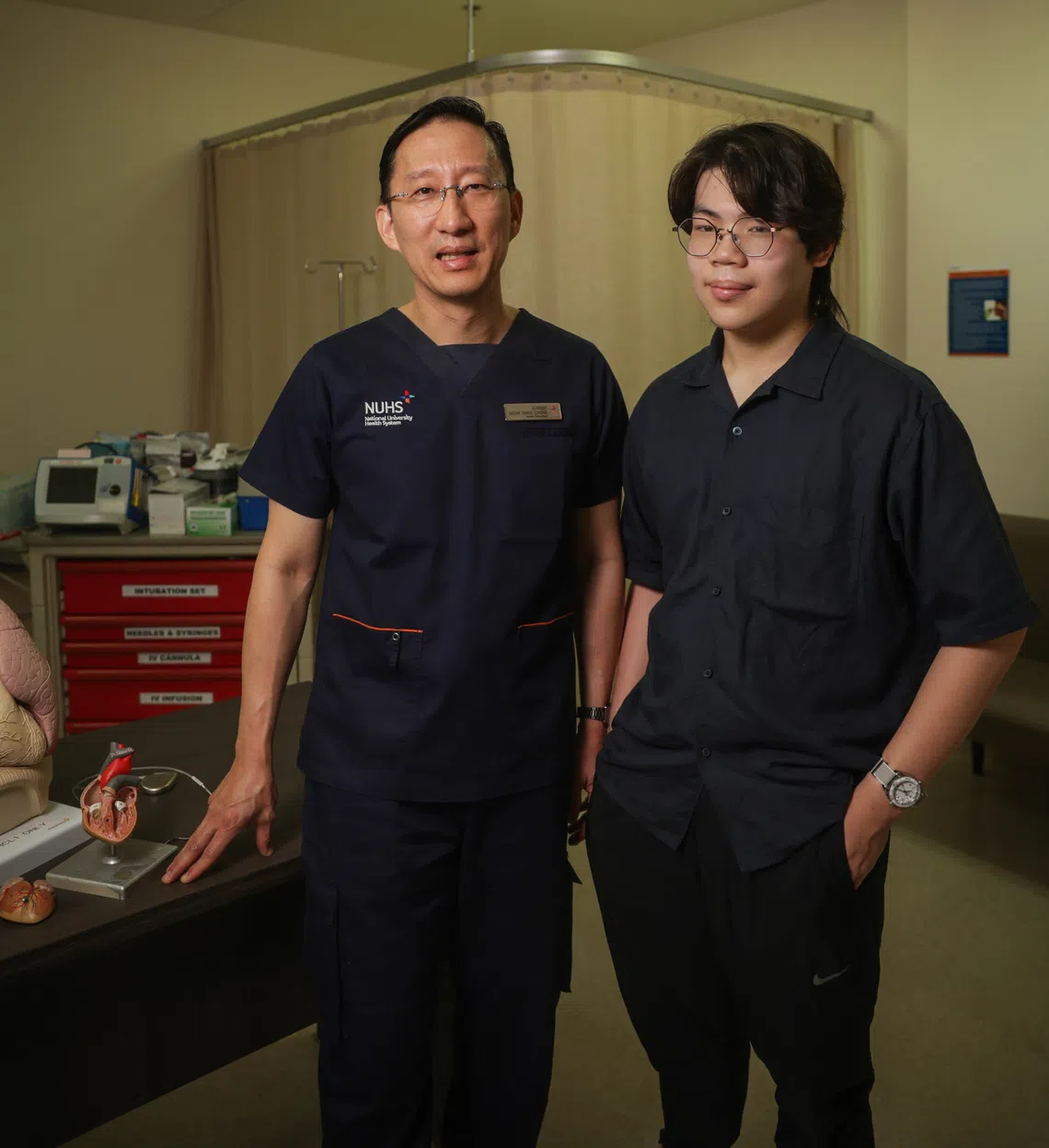
Coeus Lee is under the care of Adjunct Associate Professor Swee Chong Seow (left), a senior consultant with the National University Heart Centre.
ST PHOTO: GIN TAY
Instead, it is usually triggered by undiagnosed conditions such as a heart muscle disorder, an electrical problem, an infection weakening the heart muscle, or a congenital abnormality of the arteries.
Lee, however, said there was no history of congenital heart disease in his family.
Published studies estimate the incidence of sudden cardiac death among young athletes and active young adults to be approximately one to three cases for every 100,000 people annually.
Better fit for younger patients
Seow said the EV-ICD given to Lee was a “significant advancement in cardiac rhythm management”.
“Instead of placing the lead inside the heart and blood vessels, it is positioned beneath the breastbone, but outside the heart and vascular system. At the same time, it is near enough to detect irregularities and is able to rectify the situation,” he said.
In the traditional ICD, the box sits under the skin in the upper chest, and the lead runs through a blood vessel to attach to the inside of the heart.
Seow said: “This wire will last between 15 and 20 years before it breaks. When that happens, we can leave the old wire there and put in a new one, or take the old one out first. Either way, there are risks.
“If we were to leave the old one in, the wires could knock against each other, causing inappropriate shocks. The additional wire across the heart valve may also cause it to leak and might choke the vein.”
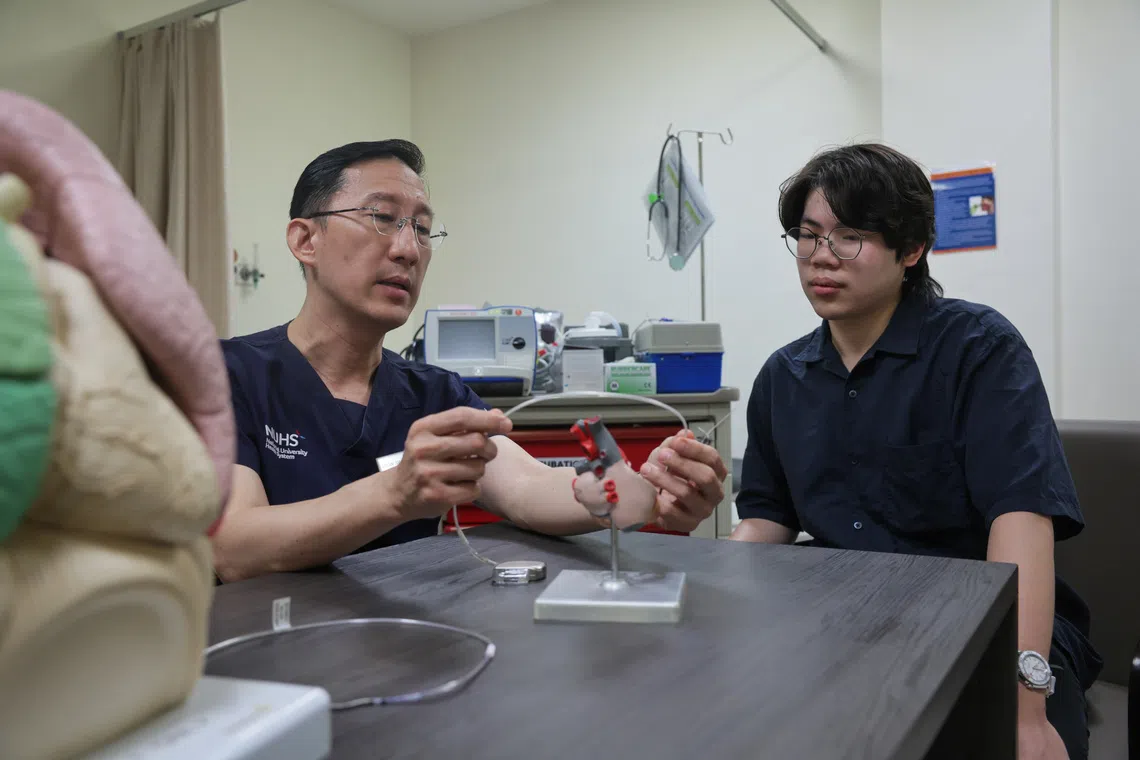
Adjunct Associate Professor Swee Chong Seow said the EV-ICD given to Coeus Lee was a “significant advancement in cardiac rhythm management”.
ST PHOTO: GIN TAY
He said the old wire also cannot be removed from the vein without risks because it is usually in the vein for years, so it gets encased by the tissues of the walls of the vein, and removing it “requires quite a bit of work”.
“We would need to separate the wire from the tissues and there is always the risk of complications,” Seow added.
The EV-ICD would be the right fit for a young person like Lee, as changing a lead that is outside the heart would not result in such complications after 15 to 20 years.
With the EV-ICD implanted in him, Lee, who used to play ice hockey and basketball when he was growing up overseas, can no longer do so competitively.
“The clashes could and would cause trauma to the site where the defibrillator sits. For my peace of mind and safety, I guess I will have to comply,” Lee said.
KioskNews shows a cleaned-up reading view extracted from the publisher’s page — the original always lives on their site, not ours.