Stunning lighting and beautiful shapes undermined by lack of choreographic depth in Triptych
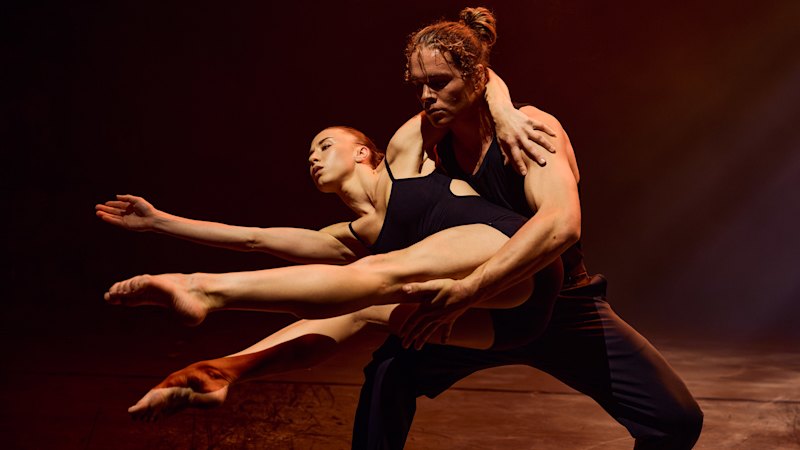
In the most true-blue modern dance biography you’ll ever read, Lewis Major describes himself as an enterprising sheep shearer-turned-award-winning-choreographer. “He is the only dance artist he’s ever heard of,” his biography quips, “who can reverse parallel park a tractor”.
I was slightly crestfallen that there were no sheep or tractors for Triptych, the Opera House season of Lewis Major Projects. Despite the name, Triptych contains four segments from three award-winning works, teasingly named Prologue, Epilogue: Act 1, Unfolding, and Epilogue: Act 2, performed by four statuesque dancers.
Major was mentored by British choreographer Russell Maliphant and lighting designer Michael Hulls. Here, he trips the light fantastic by pairing with award-winning lighting designer Fausto Brusamolino for Prologue and Unfolding — with the lighting emerging as Triptych’s five-star gem.
Pivoting light beams, shining pyramids, oscillating particles, and swinging lasers all comprise a magical lighting design toolkit: encasing the dancers, slicing the air, and pulsing across the floor. Time is slowed and sped as light peels through the performance space, before that space melts into a headlong rush down a dizzying floor conveyor belt of light rays. This is no gaudy laser festival – the lighting is mostly white-toned on a black backdrop – but so vivid that it exhibits its own puckish personality, announcing itself as the fifth stage presence alongside Major’s dancers.
The choreography itself leans heavily on lighting to create complexity and sculpt the dancers’ bodies. Prologue is the most successful: three dancers in black strike commanding poses as futuristic light prisms move up and down around them. The mood is austere, like a pantheon of marble gods.
Unfolding’s lighting is even more kinetic — in one scene, a dancer seems balanced like a gymnast on a spinning beam of light — but the choreography bloats. An intimate closing vignette, with the dancers stripping to their underwear, strains for a vulnerability it never earns.
Epilogue: Act 1 begins with enigmatic body painting before progressing to a duet. The score is a keening sacred music lament by A Filetta, the all-male group specialising in Corsican polyphony, a 15th-century singing tradition nearly lost beyond recovery in the 1970s, only to resurrect as a hallmark of the Corsican separatist movement. The ancient music’s profundity outpaces the duet, which – hindered by uncertain grips and laboured weight transfers – seems immature in comparison. It’s as if the choreography is trying a shortcut by borrowing the music’s numinous gravitas, but without finding a movement language equal to the music’s historical and spiritual weight.
Epilogue: Act 2 relies on theatrical use of ochre-coloured powder to give visual interest to a slow series of spins. This may evoke deja vu for Sydney dance watchers familiar with Bangarra Dance Theatre: the effect feels familiar rather than revelatory.
While the dancers are strong and the shapes beautiful, Triptych – with its stately pace and repeated lingering poses – never quite achieves mature choreographic depth. In the end, its lighting does much of the heavy lifting.
KioskNews shows a cleaned-up reading view extracted from the publisher’s page — the original always lives on their site, not ours.