Is India the mother of democracy? History, politics behind the claim
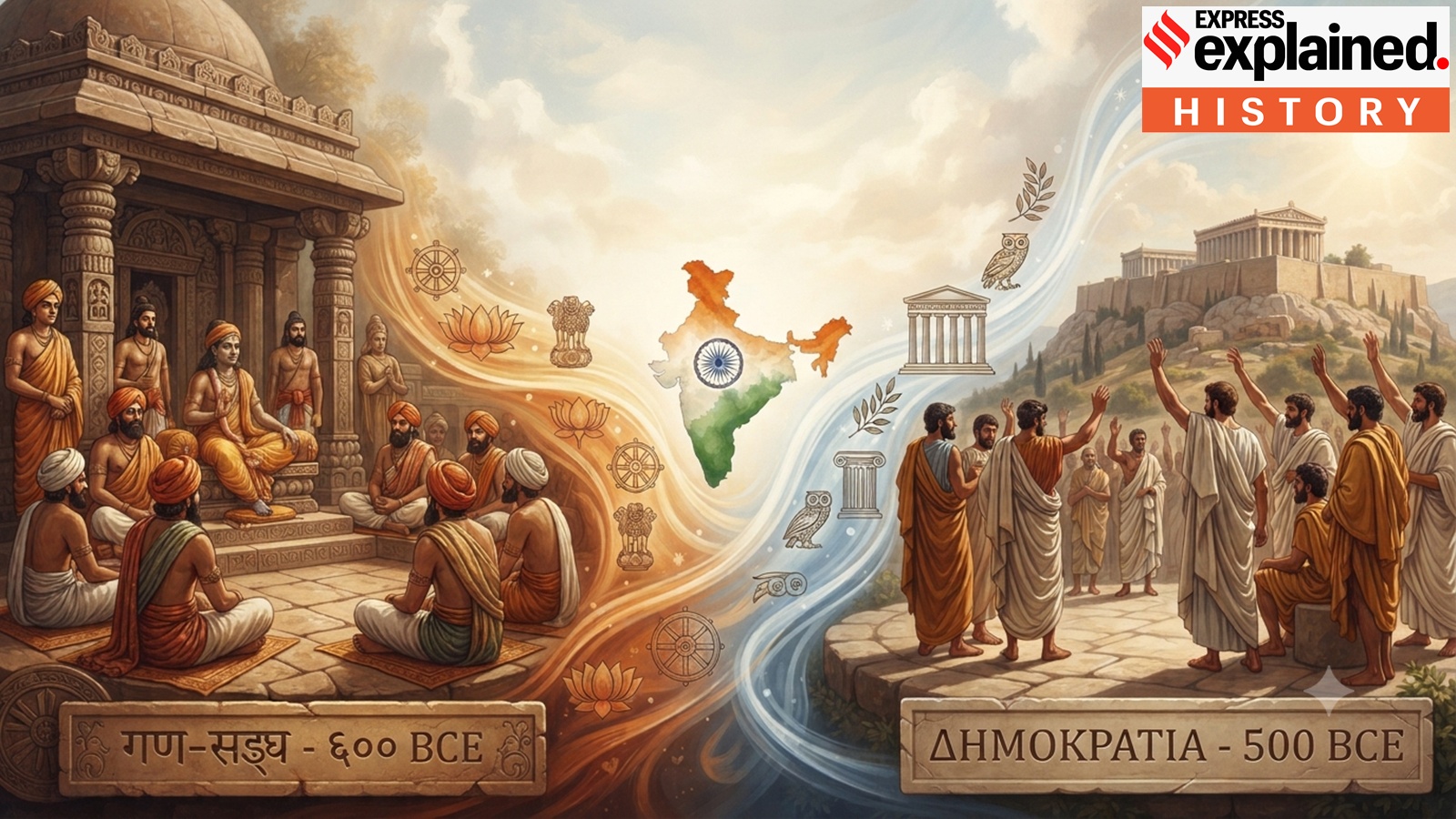
India has often claimed that it is the world’s oldest democracy, and in the strong version, it is “the mother of democracy.” On Constitution Day, it is worth examining the historical basis of this claim, its importance, merits, and consequences.
Democracy means rule of the people. But its literal meaning raises several important questions. Who are the “people”? What is to be “ruled”? And how is the “rule of the people” over “what” is ruled going to be realised?
If we take the example of India and other democracies today, the answer to these questions are likely to be as follows: the “people” are all citizens of a nation state, that is to be ruled via some form of representative government, which derives its legitimacy from popular will expressed in elections in which a subset of the “people” comprising all adult citizens (aka universal adult suffrage) take part.
This idea of democracy, however, is very modern. The elements of what we call democracy today were assembled only in the 20th century. The nation-state is a 17th-century phenomenon. Representation via voting got truly assimilated into the theory and practice of democracy only from the late 18th century onwards with American independence. And the final piece of the assemblage, universal adult suffrage, is a 20th century phenomenon. That said, despite its modern appearance, democracy itself is also very ancient.
Origins of ‘democracy’
The term democracy is derived from the Greek word demokratia, a term used from the middle of the 5th century BCE to denote the political systems in some Greek city states of which Athens was the prime example.
Athenian demokratia foreshadowed democracies as we understand them today but was not the same. It had some form of representation; the agendas of the Assembly that consisted of all members of the demos comprising male citizens over 18 years of age was set by the Council of Five Hundred.
The council in turn was chosen by lots (not votes) from each of 139 division or denes of Athens. Within the Assembly, decisions were taken by voting via show of hands and the majority view of those present and voting prevailed. The power of the Assembly was curtailed by court (Dikasteria). Jurors chosen by lots from a pool of citizens over 30 years of age.
Story continues below this ad
Athenian demokratia was snuffed out when Athens got conquered, first by Macedonia and then by the Romans in 146 BCE.
Why India’s claim of being the world’s oldest democracy matters?
The history of democracy is far too complicated to be traced in a straight line from Athens to America and then beyond. Nevertheless, there is no doubt that democracy in the West, that is, in the United States and Northern Europe, was inspired, informed, and often legitimised by the Athenian example. This was part and parcel of the heritage of the so-called European renaissance.
In the context of colonialism and India, the linking of democracy with western civilisation has also served to convey the impression that Indian democracy was a gift of colonial modernity. In other words, the success of Indian democracy is in someways a success of the British empire’s “civilising mission.”
It is against this background that the claim that India is the mother of democracy has charge. It undercuts the boast that democracy is a western implant or gift to India. It suggests that India could have and would have become modern democracy on its own terms even without western intervention.
Story continues below this ad
The basis of the Indian claims on democracy
The claim that India is the world’s oldest democracy comes from the quite remarkable existence and persistence of various gana-sanghas in northern and western South Asia from about 600 BCE onwards until the mid-first millennium CE.
As Romila Thapar has explained, the terms gana-sangha or gana-rajya has the “connotation of gana, referring to those who claim to be of equal status, and sangha meaning an assembly, or rajya, referring to governance.” In early South Asia, the gana-sanghas occupied the periphery of the kingdoms concentrated in the Gangetic Plains. They could also be found in the terai region and in the foothills of the Himalaya, in north-west India, Punjab, Sindh, and in central and western India.
According to Buddhist sources, which are prime sources for learning about gana- sanghas, prominent gana-sanghas included Vajji and Malla, which were mahajanpadas or confederations of clans; as well as the Sakyas, Koliyas, Bulis, Kalamas, Moriyas, and Bhaggas, to name a few.
These gana-sanghas were governed by an assembly that comprised the head of families belonging to a clan or clan chiefs in a confederacy through an assembly, of which they alone were members.
Story continues below this ad
How did the assembly function? The gana sangha had an assembly located in the main city of the polity. It was presided by a head. This office was not hereditary, even if these chiefs would at times be referred to as “Raja.” Matters for discussion were placed before assembly, discussed, and if a unanimous decision could not be reached it would be put to vote.
Advisors, a treasurer and a commander of the soldiers would assist the Raja. The sanghas also had an elaborate judicial procedure, with a suspect having to face a hierarchy of seven officials. It seems that the gana sanghas were more amenable to individualism and unorthodox opinions than kingdoms. After all, both Mahavira and Buddha grew up in gana-sanghas. The former belonged to the Jnatrika clan which was part of the Vrijji confederacy and the latter grew up in Kapilavastu, the town of the Sakya clan.
The idea that gana sanghas show that India is the world’s oldest democracy came from, as Upinder Singh has highlighted, nationalist historians of the late colonial period who glorified these polities.
It is also worth noting that the official Hindi and Sanskrit name for the Republic of India is “Bharatiya Ganrajya.” In so doing, the newly constituted democratic republic understood itself as a legatee or successor of ancient gana-sanghas of early India.
Story continues below this ad
How democratic were gana-sanghas?
How accurate is the idea that gana sangha is a democracy? As is obvious, gana sanghas cannot be understood as a democracy if measured against the modern understanding of the ideal. However, neither does Athens measure as democracy against the modern yardstick.
So, if Athenian demokratia can be considered as the beginning of democracy, the why not the gana-sangha? After all, both Greek city-state and gana sanghas have broad similarities in their mode of government. Both involved assemblies that entailed discussion and voting in which the principle of majority prevailed. Both had some form of mechanism to dispense justice. And both excluded from their ambit a large number of people as “democracy” was limited to adult males or heads of clans.
There were a few differences between the two as well, with the Athenian system having a more elaborate governing mechanism that required greater involvement of adult males in government. But the difference between Athenian demokratia and gana sangha seems to be one of kind and not type. And if the difference between the two is of type, then gana sanghas may have actually appeared to be slightly earlier, from around 600 BCE, than Athenian/ancient Greek versions which appeared around 500 BCE.
Does this make India the world’s oldest democracy?
The existence of gana sanghas gives good reasons to throw water on the hegemonic claim that democracy is a uniquely western idea. But that does not mean that India can be called the world’s oldest democracy or the mother of democracy either. Why?
Story continues below this ad
Forms of government that are based on collective deliberation involving most members of a community can and have appeared across the world even before 6th century BCE. In fact, scholars have argued that prior to the advent of agriculture when human beings started to settle in fixed communities, hunting and gathering societies were more likely to have governed themselves by some principles of democracy.
In the same vein, there is little evidence to suggest that iterations of democracy around the world, and especially the ancient Greek version, was inspired by gana sanghas.
By these considerations, calling India the world’s oldest democracy or the mother of democracy, because ancient gana sanghas that had no idea that they were part of India as we understand it today, would be as unjust as calling Athens or Ancient Greek city states the cradle of democracy.
Gaurav Garg is an assistant professor of history at Ashoka University, Sonipat.
KioskNews shows a cleaned-up reading view extracted from the publisher’s page — the original always lives on their site, not ours.