Rare bowmouth guitarfish recorded in Singapore waters after 30-year absence
SINGAPORE – The bowmouth guitarfish – a pet cause for billionaire Jeff Bezos and Hollywood actor Leonardo DiCaprio because it is critically endangered across the world – has been officially detected in Singapore waters after an absence of nearly 30 years.
Lee Kong Chian Natural History Museum, the only museum of its kind in Singapore, recently published a report of the sighting.
“We were ecstatic,” Maryam Kolakkodan, a research assistant at the National University of Singapore’s department of biological sciences who co-authored the Aug 31 report, told The Straits Times.
She recounted how the footage obtained from the social media user who posted the video captured the creature’s faint silhouette.
On Oct 29, 2022, anglers at Bedok Jetty had seen and filmed one of these creatures, estimated to be between 1.5m and 2m in length.
After cruising in the water for three to five minutes, the solitary fish swam away. This observation was documented by Kolakkodan along with her co-authors, marine biologist Zeehan Jaafar and Lin Jiayuan, co-founder of the Ichthyological Society of Singapore.
This is the first formal record of the bowmouth guitarfish since now-defunct Chinese-language newspaper Lianhe Wanbao reported in 1995 that a 1.83m-long specimen weighing about 40kg was caught in a shrimp net in the sea off Marine Parade.
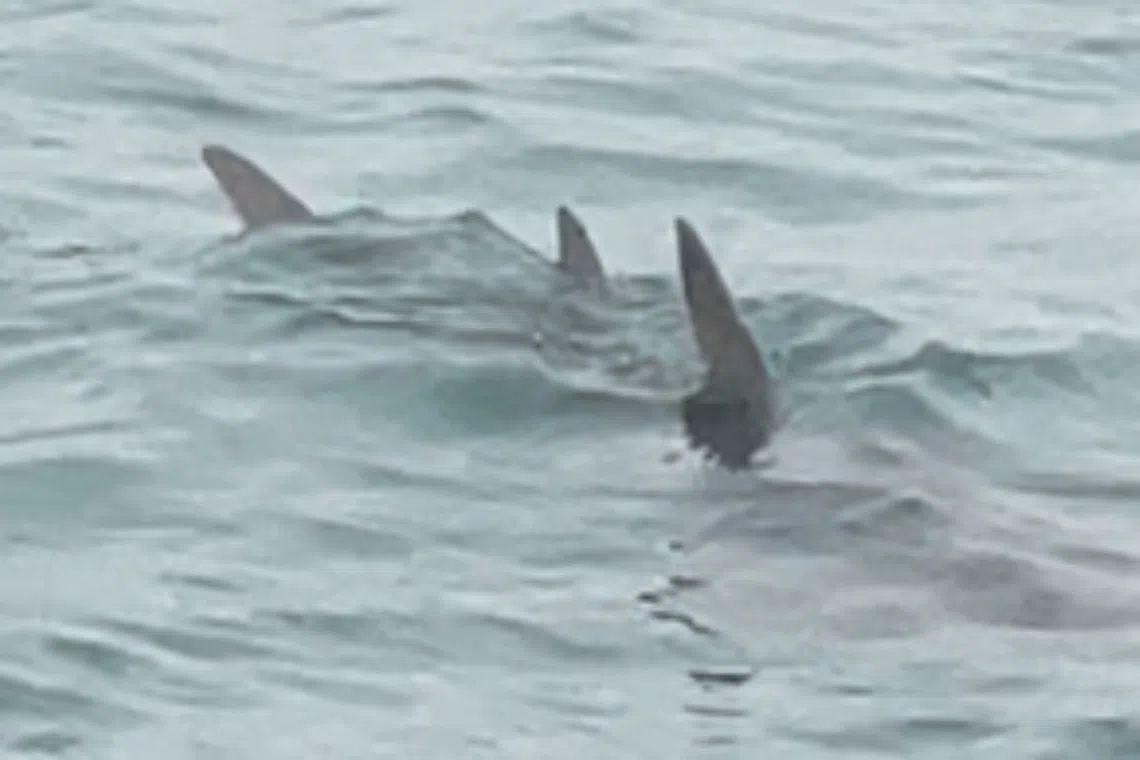
The bowmouth guitarfish has been officially detected in Singapore waters after an absence of nearly 30 years.
PHOTO: LISA OSHIAFI
The species is often dubbed the shark ray as it has a sleek, shark-like body, prominent dorsal fins and ray-like pectoral fins.
Among the world’s jawed animals with backbones, it ranks as the most genetically unique lineage facing an extreme risk of extinction. This is driven by wildlife trafficking, overfishing, habitat degradation and other threats.
A 2024 paper said the extinction of the bowmouth guitarfish could result in the loss of 88 million years of evolutionary history, as it is the only surviving species of the genus Rhina, a lineage of rays.
Internationally, the bowmouth guitarfish has received increasing conservation attention and is currently the focus of global protection and rewilding efforts by initiatives such as Shark Ray 360 and the Phoenix Species Project. The latter is backed by Jeff Bezos and Leonardo DiCaprio.
In June, the Singapore Oceanarium partnered the Taiwanese authorities to release a bowmouth guitarfish into its ancestral waters off Taiwan, making the oceanarium the first facility to breed, raise and release the animal.
The Aug 31 record shows that Singapore’s busy waters remain a corridor for critically endangered species such as the bowmouth guitarfish, Kolakkodan said.
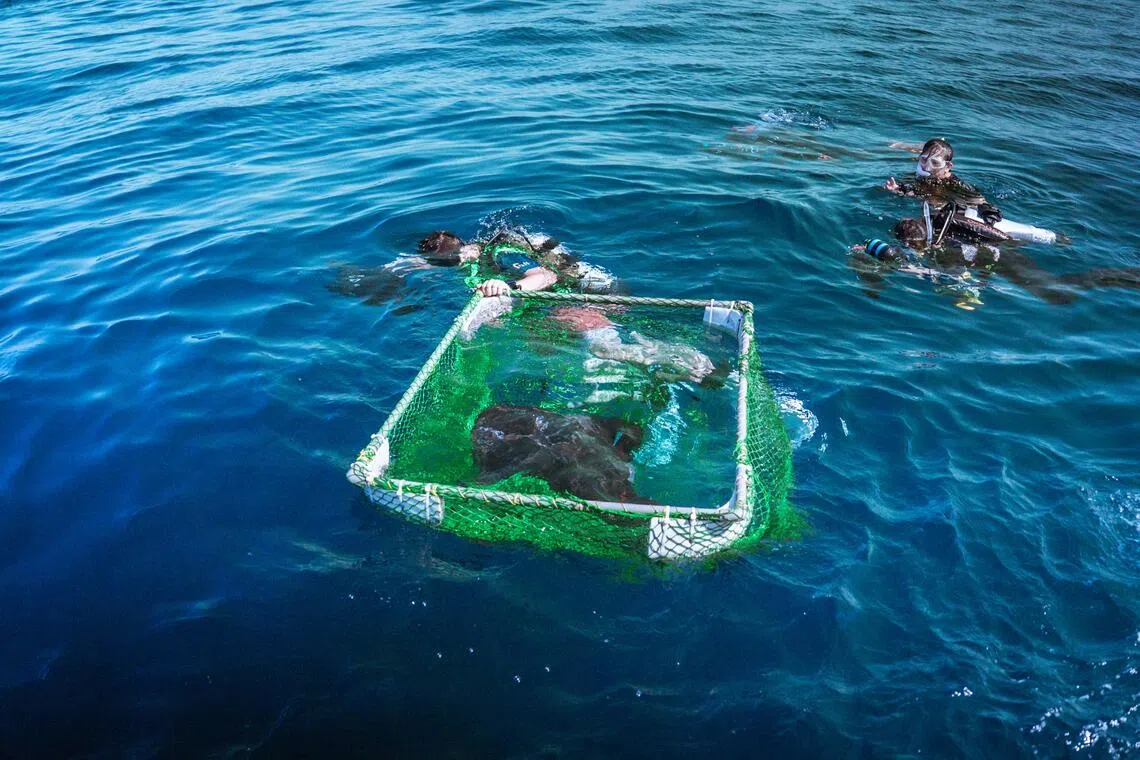
The first captive-bred bowmouth guitarfish released into the waters off Taiwan.
PHOTO: SINGAPORE OCEANARIUM
According to satellite-tagging efforts by the rewilding collective ReShark, bowmouth guitarfishes are known to travel more than 100km from their original locations, she added.
“Other studies have documented occurrences of this species in the open ocean, away from coastal waters,” Kolakkodan said. “These findings reiterate the interconnectivity of the seas and the importance of international collaboration. Protection across the distribution range will likely be a more effective conservation strategy than fragmented protection in singular areas alone for a transboundary species such as the bowmouth guitarfish.”
The Bedok Jetty record is part of a broader research project funded by Mandai Nature. It aims to understand the distribution of sharks and rays within the territorial waters of Singapore, as well as the impact of recreational fishing on these threatened animals.
Kolakkodan, who is analysing the project’s data, said: “Observations of angler catches over the years tell us that Singapore’s nearshore waters house a rich diversity of threatened marine taxa (a group of animals), including sharks and rays.”
Since 2022, the bowmouth guitarfish has apparently been spotted again in Singapore waters.
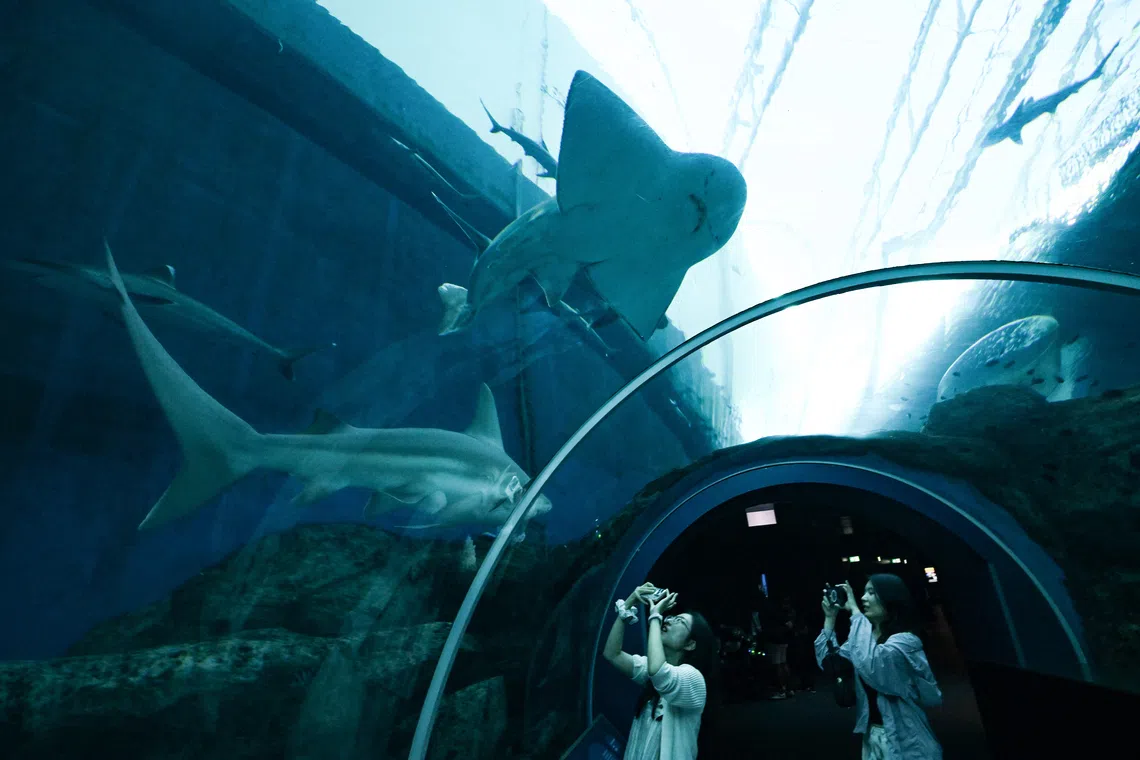
Bowmouth guitarfish at the Singapore Oceanarium on April 21.
ST PHOTO: LIM YAOHUI
Zeehan Jafaar, a senior lecturer at the NUS department of biological sciences, said that the team was alerted in August to a May 24 sighting of the marine animal.
That day, the fish was hooked by anglers fishing from a vessel and later released. The more recent sighting has not yet been officially recorded.
“Important sightings such as this are often shared by members of the public and are valuable in furthering our understanding of local biodiversity,” said Jaafar.
The team is seeking avid anglers for focus group interviews to share their experiences and thoughts on how to sustainably fish sharks and rays here.
Lin, who has been fishing for nearly two decades, said it was satisfying to formalise recent records of the species, citing other social media footage that the fish had been around over the past decade.
The Nanyang Technological University bioengineering student said: “Its presence in our waters warrants future research on this species, whether it is resident or whether it’s passing by and stopped for food, to better aid in conservation for both this species and marine fauna of Singapore.”
Members of the public who come across large marine animals in Singapore, such as dolphins, dugongs, turtles, sharks and rays, can report their sightings at public submission database MegMaLS at this website.
KioskNews shows a cleaned-up reading view extracted from the publisher’s page — the original always lives on their site, not ours.