Who was Periyar? Remembering the ‘atheist who profaned the gods’
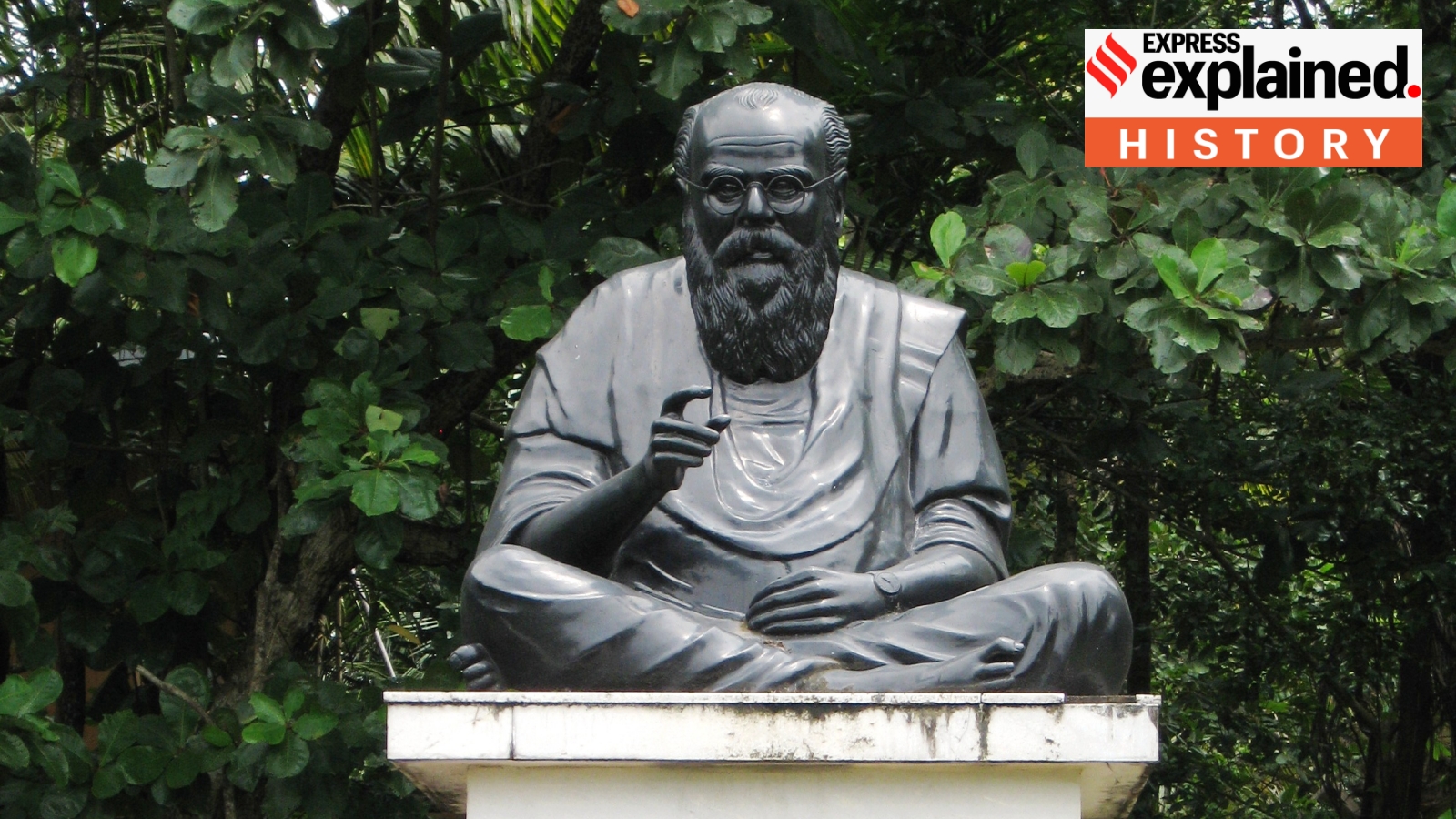
E V Ramasamy (1879-1973), popularly known as “Periyar” (the Great One), was a rationalist, radical social reformer and a central figure of the Dravidian movement. His ideas challenged caste, religious orthodoxy and the subordination of women. In The Cambridge Companion to Periyar (2025), A R Venkatachalapathy and Karthick Ram Manoharan note: “One of the most honoured figures in the state of Tamil Nadu, arguably home to the highest number of temples in India, is an atheist who profaned the gods.”
In September 2021, then Tamil Nadu Chief Minister M K Stalin announced that Periyar’s birth anniversary, September 17, would be observed every year as “Social Justice Day”.
Periyar and the Congress years
Periyar was born in Erode in western Tamil Nadu to a Balija Naidu family, a Kannada-speaking, upwardly mobile community engaged in trade in the region. He married at 19. “Along with caste and religion, marriage would also be an institution that Periyar relentlessly attacked in his public life, criticizing it for the enslavement of women and distracting individuals from pursuing the common good,” write Venkatachalapathy and Manoharan.
He developed an early interest in municipal politics before turning to the Indian National Congress. He began observing the party in 1907 and attending its meetings. After the First World War, he joined the Non-Cooperation Movement and, following Gandhi’s call, actively promoted khadi. His campaigns for prohibition led to his arrest in 1922.
In 1924, Periyar became president of the Tamil Nadu Congress Committee. Yet even as a Congress activist, he demanded proportional representation for different communities in political offices and pressed the party to take a stronger stand against caste.
That year, he also took a leadership role in the Vaikom Satyagraha, which sought to secure the rights of lower castes to use public roads around the Sri Mahadeva Temple in the princely state of Travancore. Venkatachalapathy and Manoharan write, “This was the first major political protest in Periyar’s life where he confronted caste-based injustices.”
Around the same time, he clashed with fellow Congressmen over the Cheranmadevi Gurukulam controversy. At the traditional school founded by Congressman V V S Aiyar, Brahmin students received preferential treatment, while others faced discrimination. “The Cheranmadevi experience greatly coloured his views about the hypocrisy of the Congress and its Brahmin leaders towards caste,” the authors note.
Story continues below this ad
Periyar continued to demand proportional representation in political bodies. Frustrated by the Congress’s lack of action on these demands, he quit the party in late 1925 and soon after launched the Self-Respect Movement (SRM).
A movement for self-respect
Periyar founded the SRM with S Ramanathan, an erudite socialist. The movement was rooted in three key principles — self-respect, socialism and rationalism — and pursued three major goals: equality, the annihilation of caste and the liberation of women.
From the beginning, the SRM was conceived as a mass movement aimed at ordinary people, rather than an intellectual project. Periyar’s speeches and writings were delivered in direct, colloquial Tamil. “A performer, his long and rambling speeches were laced with humour, satire, and, often, profanity,” write Venkatachalapathy and Manoharan.
They add that another aspect that made Periyar unique was that he did not assume an egalitarian Tamil culture or past to counterpose against the Aryan-Brahminical tradition. “If he was critical of the Sanskrit texts of the Ramayana and the Manusmriti for what he argued were casteist aspects, he was also critical of canonical Tamil texts such as Thirukkural and Silappathikaram for what he claimed were their patriarchal aspects.”
Story continues below this ad
Where Periyar differed from Gandhi
A crucial episode in the early 1930s that reveals Periyar’s approach to caste and his support for Dalits was the Poona Pact of 1932. In the run-up to the pact, he strongly supported B R Ambedkar’s demand for separate electorates for the Depressed Classes. On this issue, Periyar broke with Gandhi, sharply criticising his opposition to separate electorates and firmly backing Ambedkar.
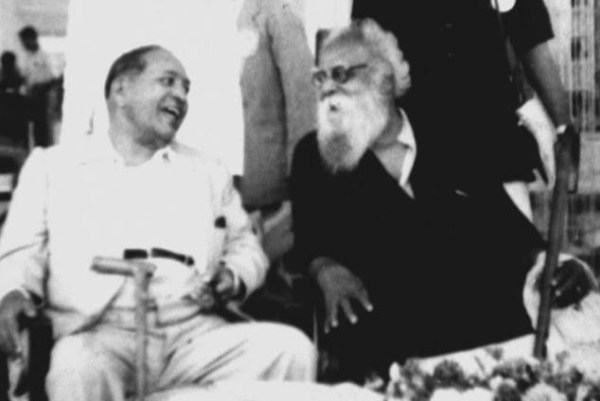 In the run-up to the Poona Pact of 1932, Periyar strongly supported B R Ambedkar’s demand for separate electorates for the Depressed Classes. Photo: Wikimedia Commons
The two also differed fundamentally on religion. Gandhi believed religion could be used positively and that Hinduism could be reformed. Periyar, by contrast, argued that Hinduism had to be destroyed for social progress to be possible. He maintained this position throughout his life and campaigned for atheism. While he occasionally spoke positively of Islam and Christianity, he also criticised both in different contexts. “The one religion he was most sympathetic to was Buddhism,” write Venkatachalapathy and Manoharan, adding, “that too because he saw it as a non-religion and as an atheist philosophy. Religion, Periyar believed, made brutes of humans.”
Periyar and the Justice Party
The 1930s was also the period when Periyar moved closer to the Justice Party, founded in 1917 as the South Indian Liberal Federation. The party was the main face of non-Brahmin constitutional politics. Recognising the lack of popular leaders in its ranks, the party approached Periyar in 1938 to take over its leadership. He was elected in absentia while in jail for participating in the anti-Hindi agitations that year.
It was also in 1938 that he was formally conferred the title ‘Periyar’ at the Tamil Nadu Women’s Conference. Venkatachalapathy and Manoharan write, “And it was apt, given Periyar’s concern for women’s liberation. Periyar viewed women as the first oppressed caste in history, and there were many occasions when he said that fighting the oppression of women was his first priority.” His calls for the abolition of marriage, advocacy of contraception and support for their sexual freedom were also highly unconventional for the time.
The Dravida Nadu question
Story continues below this ad
In the 1940s, Periyar wrote extensively in favour of the secession of Dravida Nadu from India. Initially imagined as a confederation of south Indian states, Dravida Nadu later became shorthand for a separate Tamil Nadu. In 1944, the Justice Party, which he headed, was dismantled and reconstituted as the Dravidar Kazhagam (DK), which focused on social reform as well as the demand for Dravida Nadu.
Unlike the Muslim League, however, the DK did not launch major agitations for separation. “Periyar spoke of Dravida Nadu to counter Hindi imposition and what he dubbed as the Brahmin-Baniya rule of New Delhi. He had no action plan for separation,” write Venkatachalapathy and Manoharan.
“Even though he continues to be reviled as a secessionist, it is evident that Periyar’s rhetoric was intended only as shock treatment to hasten social reform, to assert linguistic rights, and to demand autonomy for the south Indian states within India,” they add.
A life of contradictions
In the 1950s and early 1960s, Periyar continued to campaign against caste and religion, while also criticising Indian nationalism and the Constitution. He argued that the Constitution protected religion and caste and alleged that it strengthened the Centre at the expense of the states.
Story continues below this ad
Periyar died on December 24, 1973, aged 94. Venkatachalapathy and Manoharan write, “In his long public career, Periyar’s political affiliations and activities varied over time, sometimes even being diametrically opposed.” He began as a Congress leader, later called the party an evil to be eradicated, and campaigned for it again towards the end of his life. He supported Gandhi’s movement for prohibition, but later called for the prohibition of Gandhism itself. Yet after Gandhi’s assassination, he also proposed that India be renamed ‘Gandhi Naadu’.
Whatever the contradictions in Periyar’s politics, his challenge to caste and social hierarchy was relentless.
KioskNews shows a cleaned-up reading view extracted from the publisher’s page — the original always lives on their site, not ours.