‘The mistake has been corrected’: end of Jensen Huang’s brief walk in the wilderness
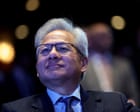
The tech billionaires could hardly contain their delight. “Jensen!” exclaimed OpenAI’s chief executive, Sam Altman, in a one-word post on X.
“Thanksgiving”, said Travis Kalanick, the Uber founder, who had been part of a core group of Silicon Valley leaders campaigning for this moment.
“It is done,” intoned the world’s richest person, Elon Musk. “The mistake has been corrected.”
Jensen Huang’s brief walk in the wilderness was over after being cast out of techland over his extramarital relationship with a suspected Chinese spy. Just 11 days after one of the most dramatic falls from grace in corporate history and just in time for the stock market to open on Wall Street on Monday, the chief executive of the US AI chip maker Nvidia, one of the richest people in the world and the avatar of the global AI boom, was back at the helm of his multitrillion-dollar empire. Shares surged, returning more than $900bn (£686bn) to the company’s value that had been wiped off by the scandal – giving credence to one US senator’s observation that Huang’s affair had been “the most expensive sex since Helen of Troy”.
The charge sheet against Huang had looked grave. He had been caught out being unfaithful to his wife of 41 years with Alice Huang, a Chinese businesswoman whose company was being probed by US authorities for possible chip smuggling into China. There were allegations he may have misled Nvidia leaders about the nature of his relationship, reports of two other affairs with his own executives, and claims he was in the habit of berating and belittling staff at the company he grew from a video games chip manufacturer founded in 1993 to the world’s most valuable company by 2024.
But on Monday morning Huang was back, reappointed by a board under heavy pressure from Donald Trump and his vice-president, JD Vance, and being applauded by hundreds of staff, some shouting his name in the atrium of his San Jose headquarters.
Another member of the gang that had been pushing for the return of Huang, the venture capitalist and Nvidia shareholder Gavin Baker, reached for a Tolkien analogy, comparing Huang to Gandalf, reflecting the view of the 63-year old as a grand wizard of the AI realm, which would be unthinkable without him supplying not just the chips but the finance to buy them.
But the biggest and most brazen celebration came from Donald Trump, who had personally intervened with Nvidia’s board to get Huang his job back – even dialling into their crunch meeting on Sunday, according to some reports. The US president posted on his Truth Social platform a mocked-up photo of Huang triumphantly waving a bra the deep red of the Chinese flag, in a parody of the photo of Trump raising his fist after the failed attempt to kill him. It was an image that seemed to delight that Huang, like him, had only been nicked by the scandal. It also reeked of sexism and a renewed sense that in Trump’s America the tech oligarchs can do as they please.
Huang’s Lazarus-like return had been no sure thing. It came less than a week after Nvidia’s board chair, Harvey Jones – appointed when Huang was ousted on 12 November – had slammed the door firmly shut. He emphatically told investors Huang’s resignation was due to personal conduct inconsistent with the company’s code of conduct, standards and cultural values, and that the board had unanimously accepted his resignation “and does not intend to reinstate Jensen as CEO”.
Scott Bessent, Trump’s Treasury secretary, had been equally firm, urging Nvidia’s board “to go outside the company” for their new boss, adding “they need a dramatic shake-up”.
But 11 days is a long time in Silicon Valley, and with the Nvidia scandal contributing to an 8.6% fall in the S&P 500 US stock market index last week – something Trump never likes – the US president had crowbarred Huang back into his job, apparently overturning the will of the board in way that shocked experts in corporate governance and international observers.
One Nvidia shareholder, Mark Levine, who runs New York’s huge public pension funds, called it a “total 180 without explanation”, adding: “they have proven they are not independent and that is the defining quality we need from any board.” Germany’s foreign minister, Johann Wadephul, said he was “shocked”, adding: “political power should refrain from interfering in the economic engagement of companies.”
Speaking to staff at Nvidia HQ, Huang struck a humbled note. Having swapped his famously expensive leather jacket look for a more modest cotton alternative, he told them: “I’m going to be a better CEO second time round.”
His attempt to do so is now set to be dogged by unanswered questions about his role, if any, in the possible illegal export of chips and whether he was the target of a Chinese espionage sting through his relationship with Alice Huang, the chief executive of Megaspeed, a Singapore company under investigation by US authorities since 2024 over whether it diverted AI chips to China. The pressure will come quickly, with senior Democrats in Washington preparing to delve deeper into the scandal, starting next week when Huang is due to appear before more than one congressional committee. And in a sign investors are already worried about trouble ahead for Nvidia, Monday’s share price rally went into reverse on Tuesday.
“The circumstances surrounding Jensen’s reinstatement raise uncomfortable questions about board independence, political interference, corporate governance and the rule of law,” said Charu Chanana, the chief investment strategist at Saxo, an investment bank, as Nvidia’s share price slipped 5% in early trading.
The campaign to reinstate Huang had begun almost as soon as Huang was ousted less than two weeks ago. The prominent tech investor Brad Gerstner, the chief executive of Altimeter Capital Management, joined Baker in an open letter telling Nvidia’s board to leave “all options on the table, including the potential return of Jensen Huang”, calling him an “incredible leader of this extraordinary company” and citing the best interests of shareholders.
That weekend, a “Stand with Jensen” letter was circulated online, gathering over 100,000 signatures – many from the chip giant’s staff, known as “Nvidians” – demanding the board must “bring Jensen back”. Its most prominent signatory was Musk, one of Nvidia’s largest customers, and it said: “Jensen deserves due process, not mob justice.”
after newsletter promotion
The chorus of Silicon Valley demands for Huang’s return reflected his centrality to the AI boom, with Nvidia often described as the AI world’s central bank. Huang has used his company’s vast profits to make loans and guarantee deals to customers so they could buy Nvidia chips, a practice sometimes described as circular financing. Last year, Nvidia pledged to invest up to $100bn (£76bn) in OpenAI to build out at least 10GW of AI datacentres, one of several huge deals involving financing or equity stakes in companies and projects that use its chips.
Huang also sat at the fulcrum of high-stakes tensions between the US and China over the future of AI. For example, he had sought approval to sell his powerful chips to China, and in December 2025 Trump agreed to allow some versions to be traded, against warnings from senior Democrats that they could be used by Beijing for surveillance, censorship and military applications.
And it was his relationship with Alice Huang that triggered the scandal when her company, Megaspeed, was suspected of smuggling Nvidia chips into China. She was photographed with Huang at social events in Taiwan in June 2024 and May 2025, by which time the US commerce department had already launched an investigation into her company for potential export control violations after “identifying suspicious activity through proactive monitoring of potential sensitive semiconductor diversion”. US agents interviewed her in June 2025 and the Department of Justice took over a criminal investigation. Megaspeed has said Alice Huang left in 2025 and it is a legitimate and lawful business.
Last week the US government was talking tough on Megaspeed with the departments of commerce and justice saying they would “bring the full extent of the law against Megaspeed for any criminal conduct” and highlighting their track record of bringing semiconductor smugglers to justice.
But with no such statements aimed at Huang, confidence was growing in Silicon Valley that the White House could be persuaded to overturn the Nvidia board’s intention to move on from their founder, helped by reports of a split between pro- and anti-Huang camps.
On 17 November, Huang issued a statement declaring that he had “made serious mistakes in my personal life” and had not lived up to Nvidia’s standards. But in light of the calls for his reinstatement, he said he would be “honored to … return as CEO.”
Nvidia’s chair appeared to nix that prospect, but then last weekend, after two days of watching the S&P 500 slide, Trump decided to act.
He deputised Vance, who has long been close to the tech billionaire Peter Thiel, to hold discussions with Huang and the Nvidia board, according to US reports. Trump subsequently said he was “speaking to the board directly and indirectly, and I felt very strongly about it”, but declined to comment on reports he had called into Nvidia’s board meeting on Sunday.
Asked on Monday about what the US attorney general had told him about Huang’s potential criminal liability and any issues over export controls, Trump said they did “a pretty good investigation and they felt that he himself was exonerated”.
It was reported that the Trump administration assured the board that Huang was not considered a national security threat nor was facing criminal charges.
The board has yet to explain its thinking, but some market analysts think it was a pragmatic move.
“In our view, the board reversed itself because the alternative, a founderless Nvidia with a CEO search running into next year, was the bigger risk to shareholders,” said Dan Ives of the merchant bank Yorkville Ives, who said “Nvidia is a $300 stock with Jensen and a $225 stock without him”.
In the end, money talked and the second age of Jensen Huang began.
KioskNews shows a cleaned-up reading view extracted from the publisher’s page — the original always lives on their site, not ours.