Need help getting out of a chair? It could be an early sign of frailty
SINGAPORE – Needing additional effort to get up from a chair or out of a car could be an early sign of frailty, even if someone is still in their 30s or 40s.
“It is a very important sign that, actually, you are losing your muscles and muscle strength,” said Samuel Chew, senior consultant with Changi General Hospital’s (CGH) geriatric medicine department.
Tan Tock Seng Hospital (TTSH) geriatric medicine senior consultant Lim Jun Pei said in older people, this could manifest as difficulty in carrying out normal daily activities, such as climbing stairs or carrying a bag of rice, or the need for assistance to walk across a room.
Frailty is when the body cannot get through and recover from illnesses and injuries on its own, making it more vulnerable. As it worsens, frailty can be disabling. But it can be reversed, particularly if caught early.
Rachel Ngo – director at the Health Promotion Board’s (HPB) physical activity and healthy ageing division – said that while many might view such physical decline as an inevitable part of ageing, steps can be taken to slow or reverse it.
One way to do so is by doing more muscle-strengthening exercises, she said, with Chew noting that consistency is key.
Frailty is a key concern in Singapore, which attained super-aged status in 2026 as more than one in five citizens is aged 65 or older. Other issues include sarcopenia, or age-related muscle loss, which affects a third of all Singaporeans aged 60 or older.
Four experts came together to talk about how to help Singaporeans age well during an In Perspective roundtable discussion hosted by The Straits Times on Oct 6.
Joining CGH’s Chew, Lim from TTSH and Ngo from HPB was Soh Swee Ping, chief of the active ageing division at the Agency for Integrated Care (AIC).
The theme was “Ageing Well: Designing a Good Life in Super-Aged Singapore”. Moderated by ST senior correspondent Joyce Teo, the hour-long session was held at SPH Media’s in-house multimedia facility Studio+65.
To help the Republic better handle the transition to a super-aged society, $3.5 billion has been set aside for initiatives under the Age Well SG national programme, which aims to help seniors stay active and live more independently.
This includes expanding the network of Active Ageing Centres (AACs), which keep seniors active with programmes ranging from physical exercises to volunteering opportunities.
Ngo said beyond just cardiovascular activities such as walking, seniors should also do muscle-strengthening exercises at least twice weekly, according to the Singapore Physical Activity Guidelines developed by HPB and Sport Singapore.
However, many do not, she noted, pointing to findings from the latest National Population Health Survey.
It found that while 83.5% of those aged between 60 and 74 had sufficient physical activity, only 36.8% had sufficient muscle-strengthening activity. “It is about closing this gap, and the barriers for seniors can be quite real,” said Ngo.
For example, some may not have the confidence to perform the exercises correctly or may stop exercising entirely after experiencing muscle soreness, she said.
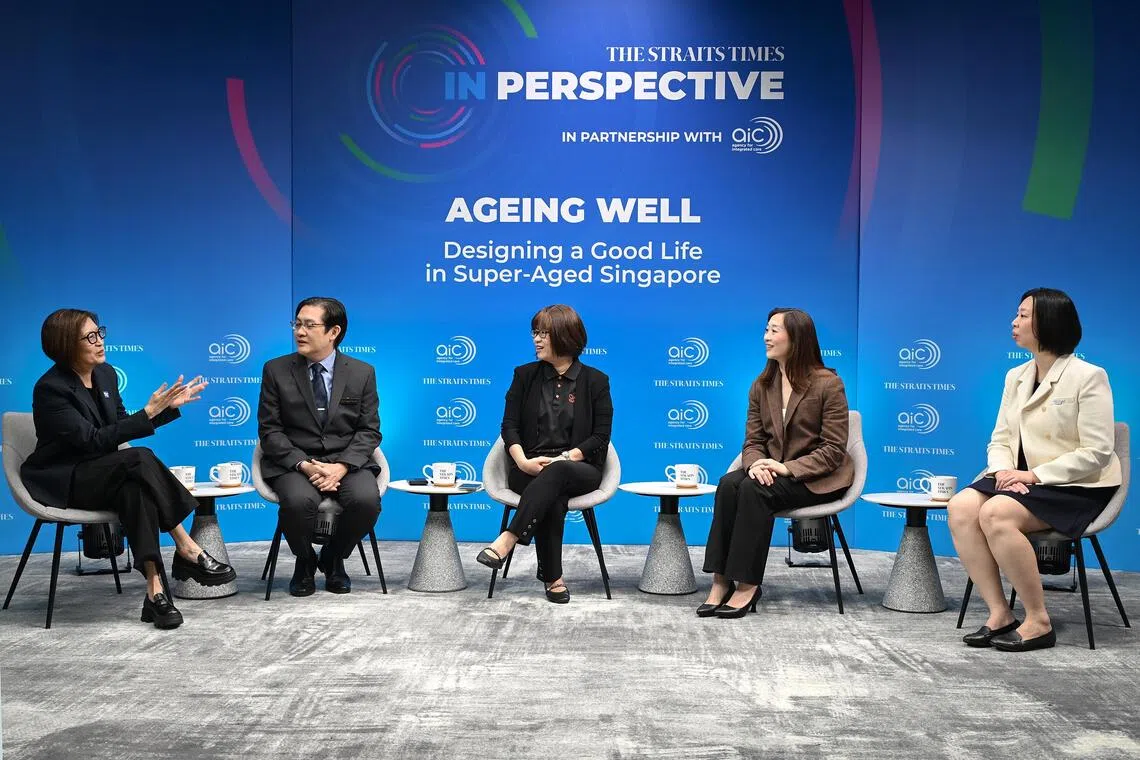
(From left) ST senior correspondent Joyce Teo, CGH senior consultant in geriatric medicine Samuel Chew, AIC chief of the active ageing division Soh Swee Ping, HPB director of the physical activity and healthy ageing division Rachel Ngo and TTSH senior consultant in geriatric medicine Lim Jun Pei at the discussion on Oct 6.
ST PHOTO: DESMOND WEE
Seniors should be doing the right type of exercises at the right intensity, and doing them consistently, she added.
Being hospitalised and then having to rest after being discharged can set off a vicious circle, said Chew, who is also an adjunct associate professor of medicine at the NUS Yong Loo Lin School of Medicine.
This prolonged period of physical inactivity can lead to a loss of muscle mass, which can in turn lead to a decrease in appetite and undernutrition, he added, noting that this in turn leads to further muscle loss and then frailty. “To prevent and break this vicious circle, there’s a need for us to identify individuals at risk of undernutrition, as well as with poor muscle health, and to institute targeted nutritional and muscle health interventions during hospital admissions, as well as after discharge,” he said.
TTSH’s Lim noted that the social isolation some seniors face can lead to cognitive decline.
Making social interaction easier for seniors
AIC’s Soh pointed to the role that AACs – currently numbering more than 260 islandwide – can play in making social interaction more convenient.
To make such centres even more accessible, small adjustments to neighbourhoods can make them more age-friendly, such as providing seats along the pathways to the AACs where seniors can rest temporarily under shade, as well as railings for them to hold on to while walking, she said.
Such senior-friendly infrastructure is being incorporated as part of Singapore’s Age Well Neighbourhoods, where towns with more seniors are being enhanced to help the elderly age live independently in their communities.
Soh acknowledged that for those facing social isolation, encouraging them to visit such centres may not be simple. “The first step is to befriend them, give them the confidence that they can come out, then take them to the AACs, where they have activities that they can enjoy,” she said.
She noted that these centres also provide other services supporting the health of seniors. These include hosting community health posts, where seniors can get basic health services and chronic disease support without needing to go to a hospital or polyclinic.
“It’s really not just about the AACs, but the whole ecosystem,” said Soh, noting that such an ecosystem can help seniors stay active and get their healthcare needs met in the community.
Ultimately, ageing well is not a matter of luck, said ST’s Teo, wrapping up the discussion.
“It’s about the daily choices we make starting today. Because, let’s be honest, nobody wants to reach 75 only to find out their knee is the boss of their daily schedule.”

In Perspective is a research-led content programme by SPH Media that combines insight-driven storytelling with expert perspectives on key issues shaping society.
KioskNews shows a cleaned-up reading view extracted from the publisher’s page — the original always lives on their site, not ours.