US visa holders are fed up and leaving tech jobs
By Francesca Maglione and Alicia A. Caldwell / Bloomberg


Yash Sharma decided last month that he has had enough of the US. The 36-year-old Google software engineer from India says halfway through US President Donald Trump’s second term, the constant rule changes around visas for highly skilled immigrants, the unknowns they create and the slim odds of him becoming a citizen have all become too much.
Sharma, who has had an H-1B visa for six years, says it has become hard to focus at work. And while he loves his life in San Francisco and working at the epicenter of tech and artificial intelligence (AI), he feels like he has run out of options to gain permanent residency and build a life here.
The US feels like a “golden prison,” Sharma said. He plans to move to the UK next month, even though he does not have a job there, because he was offered a visa with a clear path to staying in the country for the long term.
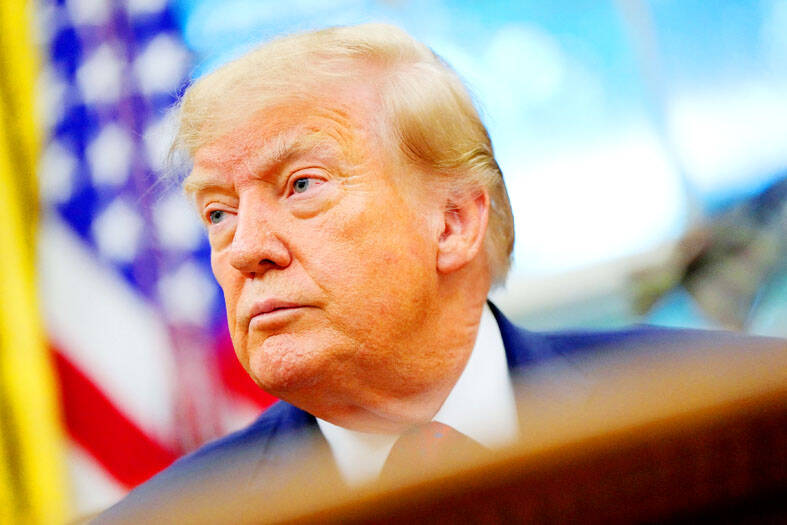
US President Donald Trump is pictured at the White House in Washington on Nov. 5.
Photo: Reuters
This month’s midterm elections delivered a rebuke of Trump’s immigration crackdown, helping Democrats win control of US Congress and prompting the president to acknowledge that his administration might have been “too tough” in deporting people who had jobs.
However, less acknowledged has been the administration’s reshaping of visa rules that for years have channeled graduates and highly skilled employees into the workforce. The newly empowered opposition would not have an easy time reversing Trump’s rule changes, which have effectively dismantled an immigration system that helped make the US a destination for the world’s best engineers and researchers.
Some of the biggest US companies are giving up on the idea anything would change soon. Payments company Flywire Corp is weighing whether to put more hiring and development work overseas, while Microsoft Corp, Adobe Inc and a handful of IT outsourcing firms have been barred from a key green-card sponsorship program as federal officials probe their practices.
The Trump administration says workers and employers have abused the immigration system for years, moving it away from its origins as a way to get highly specialized talent into the country on a temporary basis into a sprawling behemoth that has resulted in lower pay for Americans.
Trump’s appointment this month of Stephen Miller as chief of staff gives the longtime advocate of reducing all forms of immigration greater authority, while investigations into employers’ green-card sponsorships, announced last month by Vice President J.D. Vance, have added to the pressure.
“It’s a quiet dismantling of employment-based immigration,” Vialto Law immigration attorney and partner Angelo Paparelli said.
There is a growing sense that the friction and unpredictability are the new normal for the US immigration system. That is changing assumptions about the future of the US economy and forcing businesses to plan for a world in which they might not be able to bring top talent to work in their US headquarters.
Sharma says he has felt discouraged about the chances he would ever be able to convert his temporary visa into permanent residency given a huge backlog for Indian nationals. He has not left the country in a year and a half, concerned he might not be able to get back in. That has meant missing out on family visits, work conferences and trips with friends.
He sought another path to permanent residency and more stability by applying for an “extraordinary ability” visa, given to people with standout talent in their field, but was rejected after months of waiting.
The uncertainly led Sharma to consider a life outside the US. He applied for a Global Talent visa from the UK and was approved, allowing him to move to the UK without a job and begin looking for work. He says the US election results have not dissuaded him from the plan.
“I’ve seen various administrations, and to me it’s clear that there will be no actual change to the law,” he said. And even if things returned to how they were before, the difficulty of getting permanent residency would still weigh on him. “That normal still sucks,” he said.
Trump’s broad immigration crackdown started almost immediately after he took office. After campaigning on a pledge to end illegal immigration, the dragnet expanded to include narrowing paths for legal immigration, adding new regulations and steep fees.
By September last year, the popular H-1B visa program for high-skilled foreign workers became a focus, first with a presidential proclamation requiring a US$100,000 payment for certain prospective job candidates outside the US. In August, despite a court order blocking that original payment, the administration moved to impose a separate US$103,000 fee for new H-1B visa applications.
Many of Trump’s policy changes are facing legal challenges, but the chaos and confusion are difficult for companies and workers to navigate.
“It creates this profound instability for the entire immigration ecosystem,” American Immigration Lawyers Association supervisory policy and practice counsel Kate Angustia said. “We are creating a brain drain.”
KioskNews shows a cleaned-up reading view extracted from the publisher’s page — the original always lives on their site, not ours.