Why the Celtics are getting a bargain on Payton Pritchard's two-year, $44.2 million contract extension
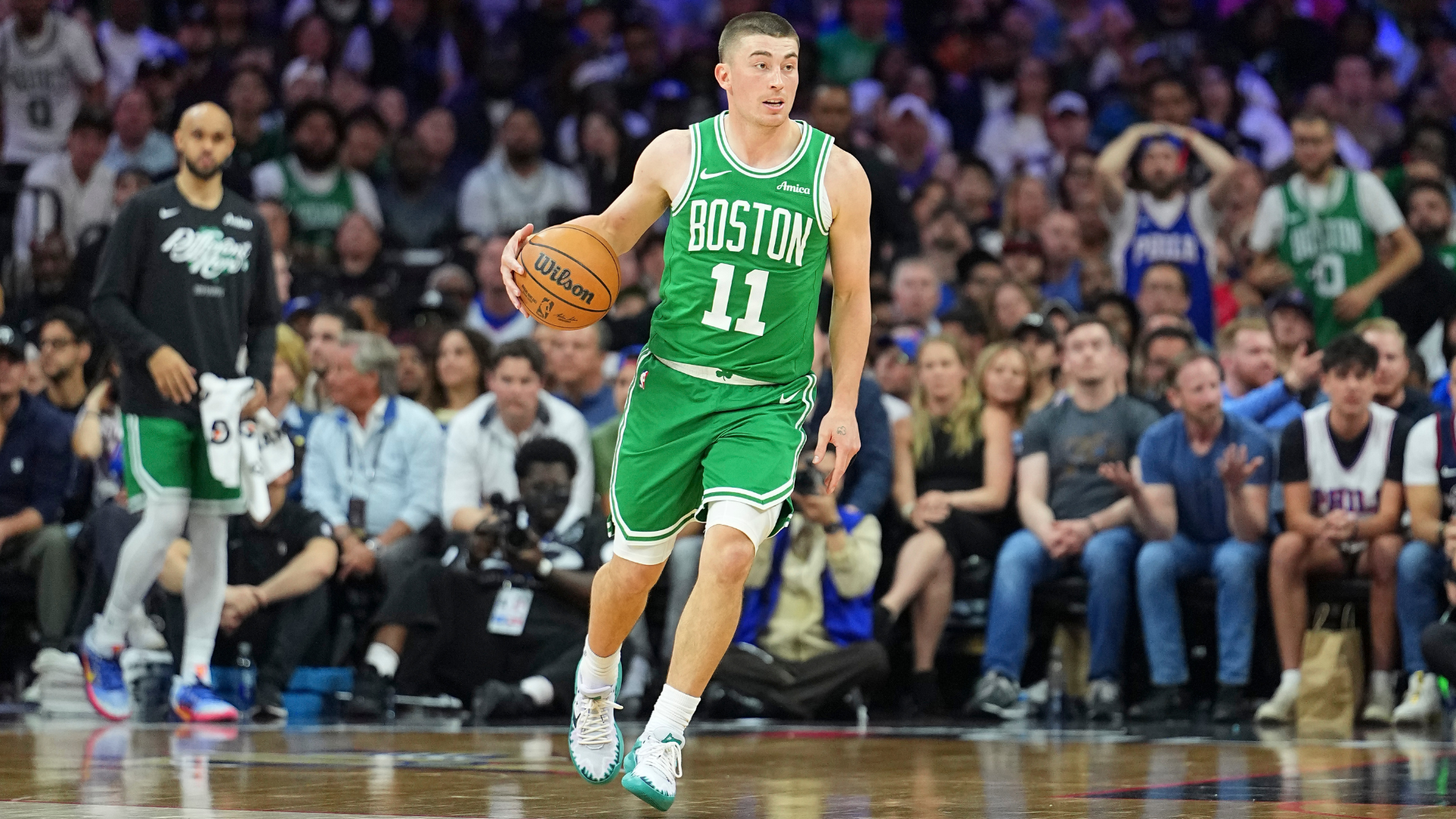
With an NBA championship and Sixth Man of the Year Award already under his belt, Pritchard is set for an even bigger role in Boston this season

• 4 min read
Upward mobility in the NBA contractual market is pretty rare. A player's financial destiny is often tied to where he is drafted. Where that player is drafted frequently determines the opportunities he gets early in his career, which in turn determines his rookie extension, what he's eligible for on his next deal and so on. One team-friendly contract tends to beget several, and nowhere is that truer right now than it is for Payton Pritchard.
On Tuesday, he and the Boston Celtics agreed to a two-year, $44.2 million contract extension, according to ESPN. All told, that will guarantee him around $85 million in NBA earnings through the first 10 seasons of his career. That is by no means a bad outcome, on paper, for the No. 26 pick in the 2020 NBA Draft. Just consider it in comparison to the No. 4 pick, Patrick Williams, who has locked in over $130 million in career earnings thus far.
Williams has, at no point, been a better NBA player than Pritchard. He is now a fringe rotation player for the Chicago Bulls, a lottery team. But he was a high draft pick with great physical tools that tend to get players paid. He played for a Chicago team that, through its own poor management, had few other players worth paying, so the Bulls were free to give him a bloated contract, betting on improvement that hasn't really come.
Pritchard has dealt under almost the exact opposite circumstances. He landed on a loaded Celtics team that couldn't find him consistent minutes. Things got bad enough around the 2023 trade deadline that Pritchard reportedly wanted to be dealt. Without much of a resume after three years, the Celtics locked him into a four-year, $30 million rookie extension that guaranteed him life-changing wealth, but still represented a pittance compared to what he was actually worth. He won Sixth Man of the Year and a championship before that extension even kicked in.
Normally, a standard veteran extension can give a player a 40% raise in the final season of their current deal. This is why those early contracts matter. If a team believes in you when you're young, it makes you eligible to extend for more when you get older. Yet Pritchard's deal is so low that he's actually capped at a different figure: 140% of the estimated average player salary in the first year of his extension. He could therefore only extend for around $67 million over three years. He wound up taking the shorter, two-year equivalent of that deal with a mutual option that gives the sides flexibility to tear up the contract and renegotiate something a bit bigger in the 2029 offseason.
That deal, by most analytical measures, is a pretty significant bargain.
Could Pritchard be even better in an increased role?
Stephen Noh of Sporting News built a tool that determines a player's projected value using the DPM all-in-one metric. It projects Pritchard to be worth around $28 million next year and going forward. This deal keeps him in Boston for an average of $22 million per year.
These projections are based on who Pritchard has already been. It's worth wondering, now that Jaylen Brown has been traded, who Pritchard might soon become. As Yahoo's Tom Haberstroh noted after the Brown trade, Pritchard's usage rate went up nearly nine percentage points when he played without Brown a year ago... and his true shooting improved by four percentage points in those minutes. The Celtics went 32-5 in games in which Pritchard's usage reached or exceeded 22% last season.
Pritchard has never been a full-time starter. There's a chance he will be this season, and if he is, he's suddenly on a roster equipped to give him shots and minutes he's never had before. Some, like Haberstroh, have even suggested he's primed for a Jalen Brunson-esque leap as a small guard finally being given the freedom to spread his wings. While such notions are probably a bit optimistic, it's not unreasonable to believe Pritchard is headed for his most productive NBA season.
And if he is, the Celtics will still have three years of cost control on a severely undervalued player through this extension. If they elect to renegotiate his deal through the mutual option in 2029, they'll have the leverage to yet again do so in a team-friendly manner. After all, mutual options require both parties to opt out. If the Celtics simply want Pritchard to play out the 2029-30 season on this deal, they can make him do so.
Every team in the NBA would rather have high picks than lower ones. The top of the draft is typically where superstars are found, and even if those superstars cost more, they're a prerequisite for championship contention. The Celtics know that. Look at all of the success they had with Brown and Jayson Tatum.
But the Pritchard contract is an example of just how much surplus value nailing a pick later on in the draft can generate. Those are the players who tend to be undervalued on their second contract, which trickles down to their third and fourth deals as well.
In an NBA increasingly obsessed with maximizing every last cent, success stories like Boston's with Pritchard are becoming nearly as essential to genuine championship contention as landing stars always have been.
KioskNews shows a cleaned-up reading view extracted from the publisher’s page — the original always lives on their site, not ours.