John Wayne’s 119-Minute Western Thriller 'The Searchers' Is a Start-to-Finish Masterpiece

Anthony Crislip has always loved movies and television, and has been published in outlets such as SlashFilm and Ultimate Classic Rock. While working as a film programmer or judge at a film festival, he has striven to develop interest in underseen films. He is a particular fan of digging deep into forgotten corners of film history.
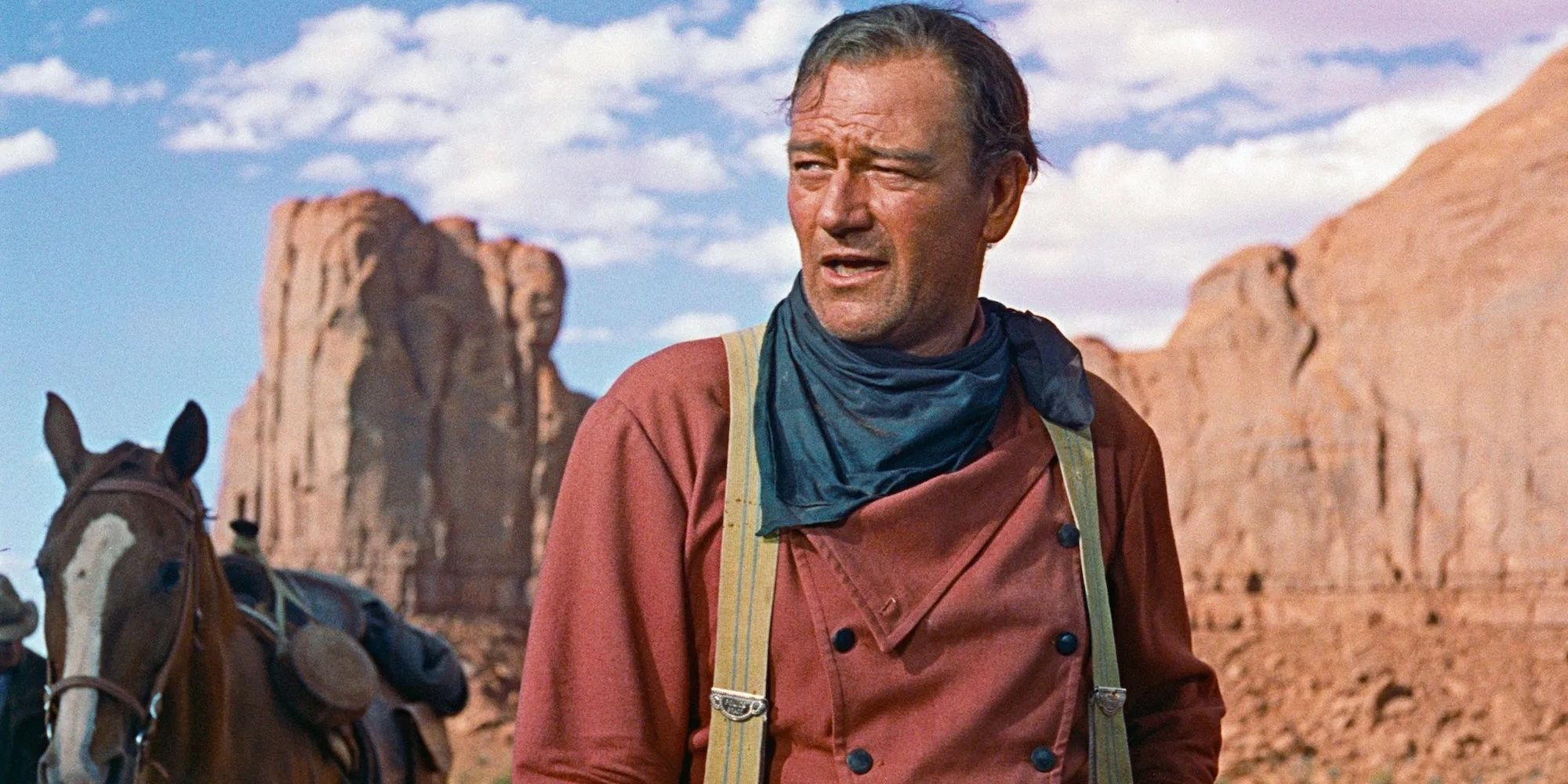
Few movies have as long a trail of imitators and influence as 1956’s The Searchers. Based on Alan Le May’s novel of the same name, it’s a Western film from the Hollywood director most closely associated with the genre, John Ford, starring the face of the Hollywood Western, John Wayne. The movie might have been received somewhat tepidly as a stirring adventure film in its day, but it came to be seen as a foundational text for the New Hollywood school of filmmakers, casting a shadow over movies as diverse as Taxi Driver, Star Wars, and Paris, Texas. As a story of obsession, vengeance, and what it means to live in a society, it struck an uneasy chord for those directors, becoming something of an obsession in itself, and gave John Wayne possibly the darkest role he ever played, with his genial smile and rough monosyllabic manner of speaking twisted by John Ford.
As in Le May’s novel, the story is set in Texas just after the Civil War. In one of the most famous opening shots of all time, Martha Edwards (Dorothy Jordan) steps out of her front door to perceive a mysterious figure in the distance, her estranged brother-in-law, Confederate veteran Ethan (Wayne). While warmly accepted by the family, there is tension, marked by the harshness of the landscape (the movie was shot in Ford’s beloved Monument Valley, a location of nine of his films) and the impending threat of the Comanche tribe. After being guilted into working a recon mission with his mixed-race nephew Martin (Jeffrey Hunter), he returns to the homestead to see it’s been burned down, with everybody in it killed — except for Debbie (Lana Wood as a child; sister Natalie Wood as a teen), who has been kidnapped. So begins the search.
John Wayne and John Ford Went Way Back

While John Wayne’s career is bigger than any one director, he had a handful of strong core collaborators that helped the actor build his identity and evolve artistically, even when part of his appeal was a salt-of-the-earth realism that didn’t suggest much in the way of artistry. John Ford, whom the actor met while working for Fox after a stint playing football at the University of Southern Carolina, was a fast friend and mentor. He let Wayne work in props and background on some silent films, like 1928’s Hangman’s House, and then gave him a decade in the world of low-rent Hollywood B-Westerns to establish himself, with the entry point being Raoul Walsh’s epic 1930 Western The Big Trail (on which he earned his name). After slumming it, Ford hired Wayne to play the Ringo Kid in his 1939 classic Stagecoach, and their names became deeply intertwined through decades of productions.
While the Ringo Kid was a youthful role, Ford was soon casting Wayne in deeper, more complex parts, while publicly dismissing the actor’s talents (even calling him “the big dummy,” according to Joseph McBride’s biography on the filmmaker). By 1949’s Cavalry Western She Wore A Yellow Ribbon, Wayne had graduated fully into older, authoritative roles, with a screen persona that was brash and beloved. When working with other directors, Wayne could play up the persona and audiences loved it. But Ford seemed to bring out other emotions, and The Searchers, a story that begins straightforwardly as a Western revenge thriller but soon becomes a study of the corrosive effects of the racism that built the West, demanded that from the actor.
John Wayne Revealed True Darkness In 'The Searchers'
As The Searchers’ narrative develops, and the movie grows into one of the best Westerns ever made, Ethan remains a mystery to his nephew Martin, who soon becomes the veteran’s sole ally in the quest to rescue Debbie. Years drag on as Martin’s sweetheart Laurie (Vera Miles) becomes engaged to another man. Leads are followed to nowhere, and the threat of the Comanche lingers on the land, with the chief Scar (Englishman Henry Brandon in redface) widely feared for his actions. Ethan’s hatred for the Comanche (and Native Americans at large) is presented casually but soon reveals itself as the primary engine of his soul, particularly in one brutal scene where he shoots out the eyes of a dead brave so his spirit is forced to “wander forever between the winds.” When he learns that Scar has taken Debbie as a wife, he announces his intention to kill her, as if to say that that has made her irredeemable in his eyes.
By presenting the hero of the film as an unapologetic and violent racist ready to kill his own kin, the movie challenges the preconception viewers might have had of John Wayne. For somebody like Martin Scorsese, whose films like Taxi Driver drew from Ethan’s racism and obsession with preserving Debbie for the characters played by Robert De Niro and Jodie Foster, that focus on harsh characters made an impact. Ethan is never outright called a racist — at the end of the day, he accomplishes his quest in his own brutal ways — but the movie makes it clear that he has the attitudes and behaviors of a man who can never truly be among a society: a time bomb and a blunt instrument to clear the way for civilization, whatever that might be.
KioskNews shows a cleaned-up reading view extracted from the publisher’s page — the original always lives on their site, not ours.