How Democratic sweep could slow AI growth in US – and help China’s ambitions
The Democratic Party’s sweeping midterm election victory and takeover of both houses of Congress could slow down the pace of artificial intelligence development in the US, with implications for both the global AI trade and the technology rivalry between Washington and Beijing, analysts said.
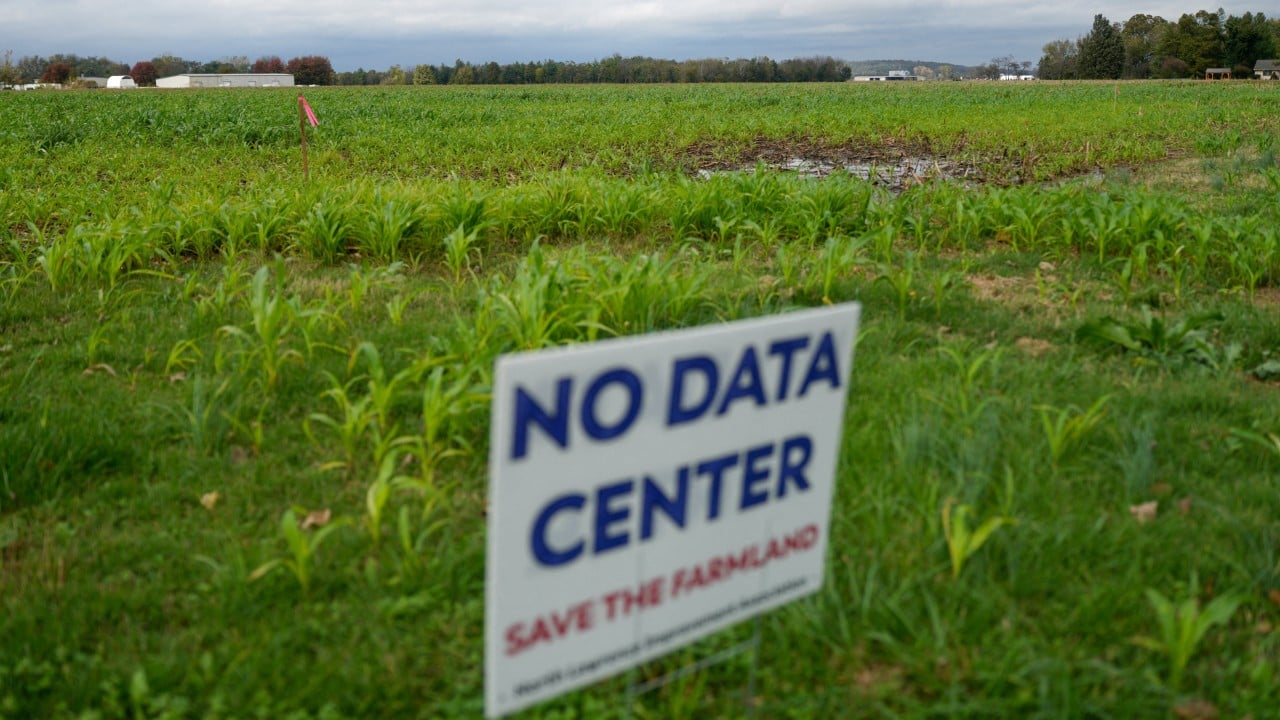
The assessment comes as concerns about AI and the data centres that power it proved to be a contributing factor in the backlash against the Republican Party and US President Donald Trump, a vocal supporter of the tech industry.
Nationwide exit polls conducted by NBC News showed that 56 per cent of voters considered AI and data centres a “crucial” or “major” factor in their congressional vote, with about 64 per cent of that group being Democrats.
While AI and data centres ranked behind issues such as cost of living and government corruption in salience, analysts said the technology had become politically significant in a short period of time.
In September, former researchers from frontier AI companies such as Anthropic issued dire warnings about the existential risks posed by advanced AI systems, spurring calls among some experts and industry executives for a global slowdown in AI development.
A slowdown in the US could be a win for China. The election results will not bring data centre construction in the US to a complete halt, but the pace will definitely slow
A Reuters/Ipsos poll conducted just before the election found that 42 per cent of voters viewed limiting the construction of AI data centres as very important or the most important issue for them.
“A slowdown in the US could be a win for China,” said Gary Ng Cheuk-yan, a senior economist at Natixis Corporate and Investment Bank. “[The election results] will not bring data centre construction [in the US] to a complete halt, but the pace will definitely slow.”
Control of Congress by the Democrats, who are generally more supportive of stricter scrutiny of data centres, was likely to introduce new constraints on US computing capacity, he added.
“This would keep [US] AI token prices high, giving China an opportunity to export cost-effective inference services, supported by abundant electricity supplies,” Ng said.
Amid growing concerns about AI safety, intensified by a recent string of “rogue” AI incidents and AI-powered cyberattacks, a Democratic-controlled Congress is also expected to pursue regulations that could directly slow frontier AI research and development.
In the Senate, incoming new faces such as Michigan’s Abdul El-Sayed have publicly called for a pause on AI development. During his election campaign, El-Sayed released a comprehensive AI policy platform that included a ban on recursive self-improvement, a technique being aggressively pursued by frontier AI companies globally that involves using AI to build even better AI systems.
Newly elected Democratic governors who scored major upsets, including Gina Hinojosa in Texas and Keisha Lance Bottoms in Georgia, campaigned on strong anti-data centre positions, pledging tighter oversight in response to growing public concerns about environmental impacts, higher electricity bills and quality-of-life issues.
SCMP Plus is a new premium news platform that gives you an
all-inclusive edge to stay ahead on China news.
To access our exclusive content you’ll need to subscribe.
Already a subscriber?
LOG IN
Texas is especially crucial to the AI data centre buildout in the US. Research firm SemiAnalysis said in a report on Monday that the state represented the “biggest risk” to the US data centre expansion, as it was expected to account for nearly 30 per cent of new computing capacity in 2028.
“A few months of lost time in that market can move the national number,” the report said, while adding that the election outcome was unlikely to affect US data centre capacity in 2027 given that most projects scheduled to come online next year were already under construction.
For US-China AI competition, the results could push US hyperscalers such as Amazon Web Services and Google to build new data centres outside the country, which could intensify competition between the two countries in third-country markets including Asia, Natixis’ Ng said.
By early morning Wednesday, US time, voters had approved almost every local-level data centre-related ballot measure across 13 states, including proposals to restrict development and recall pro-data centre politicians.
For investors, the key question was how much the new restrictions could delay data centre construction, raise associated costs and “materially change” the economics of the US AI buildout, according to Rui Ma, founder of the research firm Tech Buzz China.
“I think a lot of these moratoriums on data centre construction were widely anticipated,” she said. “People haven’t exactly been shy about voicing their opposition, and investors have certainly been aware of the risks.”
Michael Strobaek, global chief investment officer at Swiss private bank Lombard Odier, said Trump would still retain the power to veto some of the Democrats’ most aggressive measures, including any attempts to introduce a federal moratorium on data centres, beyond the spate of local-level measures now approved.
Rod Rosenstein, former US deputy attorney general and co-lead of the US congressional investigations practice at law firm Baker McKenzie, also underscored the significant executive power that Trump still wielded, including through executive orders.
Trump has called AI safety fears a “hoax” and emphasised the importance of winning the AI race with China, repeatedly saying in recent months that “whoever wins AI, wins”.
“Congress is likely to exercise influence through oversight hearings and legislation,” Rosenstein said. “[It] is unlikely to change Trump’s stance on any AI race with China.”
KioskNews shows a cleaned-up reading view extracted from the publisher’s page — the original always lives on their site, not ours.