Market correction manageable: SinoPac
By Crystal Hsu / Staff reporter


SinoPac Financial Holdings Co (永豐金控) yesterday said that a global stock market correction would weigh on its earnings this quarter, particularly trading and fee income, but the impact should remain manageable, as most of this year’s earnings have already been secured.
The financial holding company made the assessment after reporting record earnings for the first three quarters, driven by broad-based growth across its core businesses, even as a correction in technology stocks at home and abroad clouded the near-term outlook.
Net income jumped 79 percent year-on-year to a record NT$36.86 billion (US$1.12 billion) in the first three quarters, with earnings per share reaching NT$2.49.
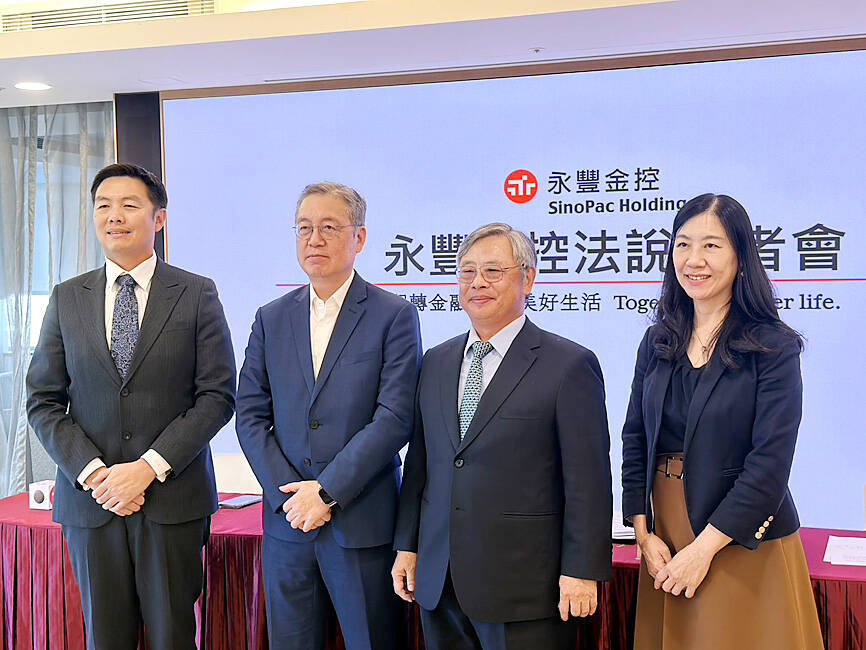
From left, SinoPac Securities Co president William Su, Bank SinoPac president Eric Chuang, SinoPac Financial Holdings Co president Stanley Chu and SinoPac Financial chief financial officer Kerry Hsu pose for a photograph in Taipei yesterday.
Photo: CNA
Lower funding costs and an expanding loan book lifted net interest income 41 percent, while stronger wealth management and securities brokerage businesses boosted net fee income 68 percent. Other net income rose 49 percent, reflecting brisk capital market activity and stronger gains from proprietary trading and venture capital investments, SinoPac Financial president Stanley Chu (朱士廷) told a news conference in Taipei.
The company expects the central bank to raise interest rates by 12.5 basis points next month and again in March next year, while the US Federal Reserve might deliver three 25-basis-point increases next month, and in January and March next year, Chu said.
Higher interest rates would benefit financial companies, but a decline in stock market turnover could dampen investor sentiment and weigh on brokerage and other market-related income, SinoPac Financial chief financial officer Kerry Hsu (許如玫) said.
Waning confidence in the artificial intelligence outlook is the biggest source of uncertainty for Taiwan’s stock market, SinoPac Securities Co (永豐金證券) president William Su (蘇威嘉) said.
Trading volume this quarter is expected to fall 10 percent from the previous quarter, putting pressure on brokerage revenue, Su said.
The TAIEX had previously been expected to reach the 45,000 to 50,000-point range toward the end of this year, but that milestone now appears more likely to be reached in the first or second quarter of next year, he said.
Average daily trading volume next year might be slightly below this year’s average of about NT$1.2 trillion, partly reflecting this year’s unusually active market, but should remain above the NT$1 trillion level, Su forecast.
SinoPac Securities would fully cooperate with measures proposed by the Financial Supervisory Commission to stabilize the market, including easing restrictions on securities lending and margin maintenance requirements, Su added.
The TAIEX tends to move in tandem with the US Philadelphia Semiconductor Index, also known as the SOX Index, Chu said.
The SOX Index’s forward price-to-earnings ratio for next year has fallen to about 12 times, below its historical range of 15 to 24 times, suggesting that semiconductor stocks have become relatively attractive, he said.
“Investors should stay rational during rallies and remain calm during downturns,” Chu said.
KioskNews shows a cleaned-up reading view extracted from the publisher’s page — the original always lives on their site, not ours.