Just sun, wind and time — Ng Kwan Hoong
SEPTEMBER 30 — I recently came across a sight that is becoming increasingly rare.
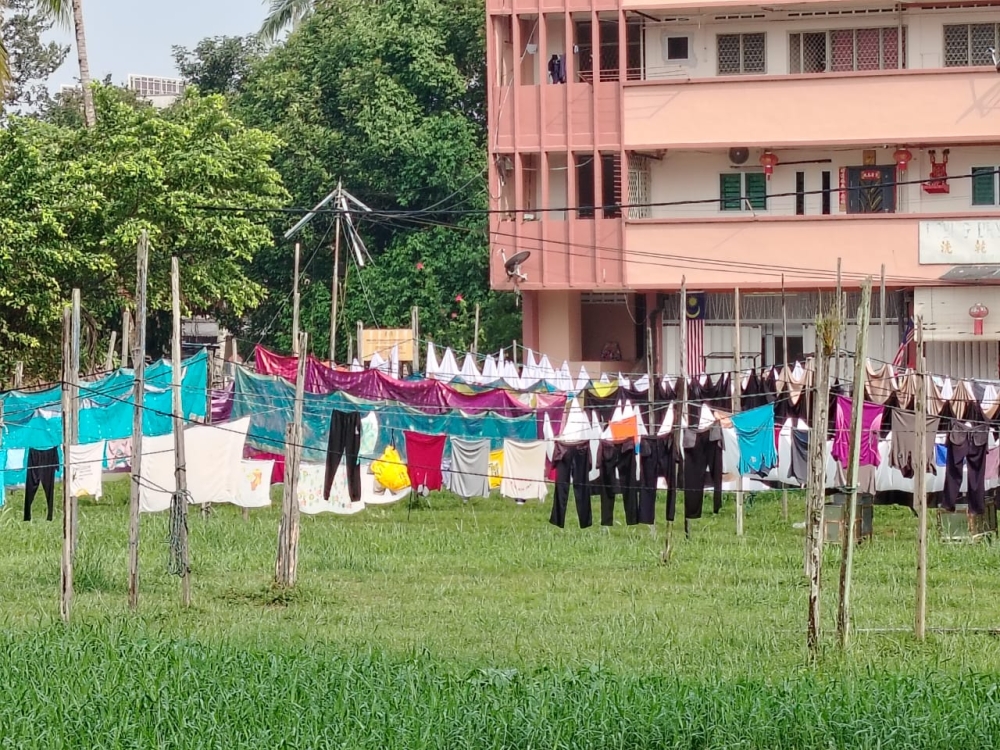
In an open field in Taiping, rows of freshly washed clothes hung from simple poles and clotheslines, moving gently in the afternoon breeze.
Towels, blankets, shirts, trousers and large pieces of cloth stretched beneath the open sky, drying naturally under the warm sunlight.
There were no tumble dryers humming in the background. Just sun, wind and time.
I stood there for a while, watching the clothes sway quietly, and found myself thinking about how differently we once approached something as ordinary as washing clothes.
For most of human history, laundry was among the most physically demanding household tasks.
Clothes had to be soaked, scrubbed, rinsed, wrung by hand and finally carried outside to dry.
The repeated work of scrubbing, wringing and carrying also built physical strength, exercising muscles in ways we rarely associate with doing the laundry today.
Long before washing machines became part of everyday life, rivers and streams served as natural washing places.
Families gathered by the water, washing clothes against stones or wooden boards while exchanging news, conversation and laughter.
What we now think of as a household chore was once woven naturally into the rhythm of community life.
Freshly washed clothes sway gently in the breeze, drying naturally beneath the warm afternoon sun. — Picture by Ng Kwan Hoong
There were also the dhobis, professional laundry workers whose occupation travelled from the Indian subcontinent to many parts of South-east Asia, including Malaya.
They washed, dried and ironed clothes for households that depended on their skill and hard work.
Their trade has largely disappeared, replaced by washing machines, laundries and twenty-four-hour self-service laundromats.
Yet watching those clothes drying beneath the Taiping sky, I realised that the dhobi represents something larger than a profession that has gradually faded from view.
He belonged to a time when ordinary work was carried out in partnership with nature. The sun was not simply something to endure. It was part of the process.
The wind was not an inconvenience. It helped finish the work.
Even time itself played an important role. Clothes dried when the weather allowed them to dry, not when a programme ended or a timer sounded.
Laundry followed the rhythms of daylight, sunshine and changing skies.
Modern technology has transformed this experience beyond recognition.
Washing machines have spared us hours of physical labour. Spin cycles remove much of the water before clothes even leave the drum.
Electric dryers finish the task regardless of whether it is raining or shining outside.
These advances have undoubtedly made life easier, particularly for busy families living in cities and high-rise apartments where outdoor drying is often impractical.
Few of us would willingly return to washing every piece of clothing by hand.
Yet watching those clothes in Taiping reminded me that progress does not always require us to leave everything behind.
Sometimes it simply changes our relationship with the world around us.
When we dry our clothes outdoors, we become quietly aware of the weather.
We notice whether the morning is bright, whether clouds are gathering, whether the wind is strong enough to hasten the drying or whether rain might arrive before evening.
Without consciously thinking about it, we begin paying attention to the natural rhythms that have always surrounded us.
Modern appliances have given us something valuable: freedom from much of the physical effort that once consumed an entire day.
But they have also made many everyday tasks wonderfully invisible.
We load the machine, press a button and return later when everything is finished. The washing is completed while we attend to other things, scarcely noticing the passing of time or the changing sky outside our windows.
There is nothing wrong with that. Technology should make our lives easier. That is precisely what good technology is meant to do.
The more interesting question, perhaps, is whether convenience should also disconnect us from the natural world that quietly sustains us.
Throughout my years in science and engineering, I have often been reminded that the most elegant solutions are not necessarily those that overpower nature, but those that work harmoniously with it.
A sailboat moves because it understands the wind rather than resisting it.
Solar panels harvest sunlight that arrives freely each day. Even the simple clothesline reminds us that some of the most effective technologies have always worked alongside nature rather than trying to replace it.
As I left the field in Taiping, the clothes were still moving gently in the breeze.
Before long they would be dry, just as they had been for generations before electric dryers, automated laundries and the convenience of modern appliances.
Watching them, I realised that Nature was quietly finishing the work.
Perhaps that is something worth remembering. Not because we should abandon the remarkable technologies that have improved our lives, but because progress is at its best when it helps us live more wisely with the world around us, rather than forgetting it was there in the first place.
Sometimes, all it takes is just sun, wind and time.
* Ng Kwan Hoong is an Emeritus Professor of Biomedical Imaging at the Faculty of Medicine, Universiti Malaya. A 2020 Merdeka Award recipient, he is a medical physicist by training but also enjoys writing, drawing, listening to classical music, and bridging the gap between older and younger generations. He may be reached at [email protected]
** This is the personal opinion of the writers or publication and does not necessarily represent the views of Malay Mail.
KioskNews shows a cleaned-up reading view extracted from the publisher’s page — the original always lives on their site, not ours.