An experimental tour-de-force: Entanglement between glass bead and light
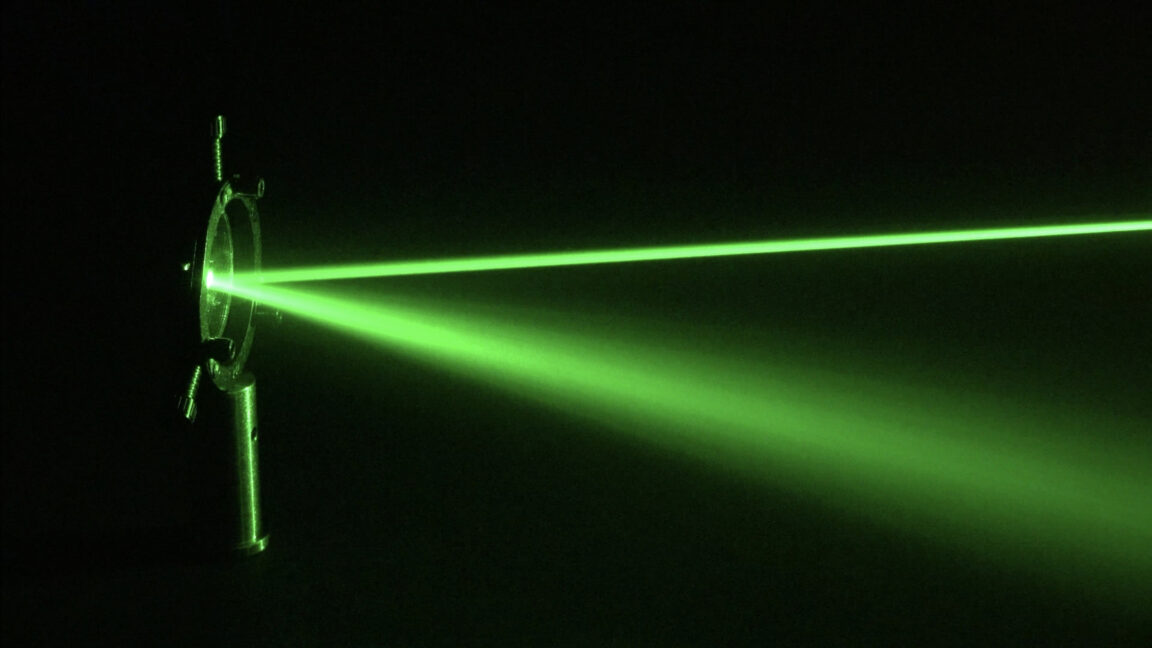
Writing about quantum entanglement is always a challenge. There are so many clichés to avoid: It’s mysterious, ghostly, spooky, and weird. Entanglement is none of those things, and yet it is also all of those things—a superposition of clichés, you might say. So, having gotten all of my clichés out of the way in the second sentence, let’s take a look at how a group of researchers managed to entangle a light beam with a glass bead, which is, frankly, quite an achievement.
Cliché-free entanglement
Quantum entanglement is nothing more or less than the idea that if two objects are linked, then their behavior will, in some ways, be correlated. To take a terrible example: My upper and lower arm are very strongly correlated in terms of relative position because they are connected at the elbow. No one is surprised by this because we can see that they are actually a single object called an arm.
Two photons can be, in a sense, joined together, meaning that they have correlations, too. In this case, we are (naively) surprised for three reasons. First, we think of photons as separate objects that cannot be joined—this is a mistake of understanding. Second, when we connect two photons, we only connect them in limited ways: The two photons may be wholly uncorrelated in terms of polarization, but strongly correlated in terms of energy.
Third and critically, the connections that turn two single photons into a single object can only be observed in the results of destructive measurements we make on the photons; we cannot see the connection otherwise. This last property (and to a lesser extent, the second) is unique to quantum mechanics and completely foreign to our everyday experience.
To make it obvious how far outside of our experience that last feature is, there is also no time delay in how this correlation works. Even though two entangled photons may be separated by the diameter of the Universe, a measurement of one photon has an immediate effect on a measurement of the other photon.
(No, this cannot be used for instant communication. No, I am not going to explain why—that’s why we have a comments section.)
What entanglement looks like in practice
Take a single photon that we, through some clever trickery, divide into two. Each new photon carries some of the energy of the original. The specific division of energy is unknown, so each photon is in a superposition of multiple energies—there is a string of probabilities that tells us the chance of finding that the photon has any particular energy. Yet, the sum of the energies of the two photons has to equal that of the original photon. When we measure the energy of one photon, we instantly set the energy of the second photon.
Now, you might be thinking this is just a trick: Each photon had the measured energy all along, we just never bothered to check. But if you make this assumption and start making predictions about measurement results, you will get the wrong answers.
Conclusion: The two photons have multiple energies before measurement and a single energy after measurement, and measuring one sets the energy of the second. This result upset a lot of people and generated all the loathsome clichés in the first sentence of the article.
If quantum mechanics is really like this, why don’t we see it everywhere? Good question. When the cage match between competing theories is over, I will be happy to tell you about the answer.
In the meantime, the common point between competing theories is that the bigger something is, the more it interacts (you can read ‘interact’ as a form of measurement) with the rest of the world, which destroys these correlations as quickly as they are initiated. That is why quantum entanglement between a light field and a large bead of glass is so unusual. Under normal circumstances, the bead’s size would wash out the entanglement before it could be measured.
Entangling a bead and a light beam
The researchers used laser light to suspend and cool a glass bead using optical tweezers. The laser light is confined between a pair of mirrors, called an optical cavity, with the bead located at the center of the cavity. The optical cavity acts to strongly define the light fields. Essentially, the distance between the two mirrors sets the phase and frequency of the light fields and creates a series of fixed locations between the mirrors where there are high and low light intensities—this is called a standing wave pattern, which you can also see on a guitar string.
The standing wave pattern means that the interaction between the bead and the light field is also very well-defined as long as the bead doesn’t move very much, which is another reason to cool the bead.
Cooling in this instance has a very special meaning. The bead is trapped within the laser beam, but the trap is more akin to holding the bead with elastic bands than in metal tweezers. The bead will vibrate back and forth within the laser beam. In that sense, the bead is hot. To cool the bead, the vibration has to be slowed until it is as still as possible (it can never be completely still). This is achieved by slightly reducing the laser frequency to a redder color, such that the bead is always giving up energy to the light field via the Doppler effect. The light that scatters from the bead always gains a little energy from the bead in the process.
Once cooled, the laser light has to give the bead a bit of a kick in just the right way to entangle the two. This is done by slightly increasing the frequency of the laser (meaning a bluer color). Now, the same Doppler shift that was removing energy is adding it.
In summary, we have two laser beams, one cooling and one heating. But the cooling beam can only cool if the bead is moving more than its absolute minimum, which the heating beam ensures happens. That means that the two light fields are correlated with each other via the motion of the bead. And that means the light fields are entangled with the bead. But how do we measure that?
A small amount of light leaks from one of the mirrors, where it is freed from the constraints of the optical cavity. This allows for tiny fluctuations in phase and amplitude, which are correlated to the movement of the bead. Since both light fields leak from the cavity, the correlation between the two can be measured, which lets us observe the entanglement of the light fields with the bead.
This experiment was no easy thing. The measurements are quite noisy and rely on having a great model of the whole system, allowing entangled and non-entangled states to be distinguished. But it is also the first measurement of its kind, so we should expect that things will get better.
Even though I am very much an “is this useful?” kind of person, I still appreciate results like this for being a technical tour de force and for showing that quantum mechanics is really everywhere. The researchers, though, do see applications. In quantum communications, light is the way to move quantum information. But storing light is difficult. This mechanical system allows information to be stored locally as a memory. And, since it is a fully artificial system, we can design it to have exactly the properties we want, which, to my mind, makes it quite promising.
Science, 2026, DOI: 10.1126/science.aeh1375

Chris writes for Ars Technica's science section. A physicist by day and science writer by night, he specializes in quantum physics and optics. He Lives and works in Eindhoven, the Netherlands.
KioskNews shows a cleaned-up reading view extracted from the publisher’s page — the original always lives on their site, not ours.