Survivors battle loss one year after deadly Hong Kong blaze
Yip Ka-kui survived Hong Kong’s deadliest fire in decades, but he lost his home and his wife. Their half-melted wedding rings are among the few traces that remain of their lives.
A year after the devastating fire on Nov. 26 last year killed 168 people in a Hong Kong housing estate, survivors and bereaved families are struggling with their loss.
Survivors spoke about their experiences of the world’s deadliest residential building blaze since 1980:
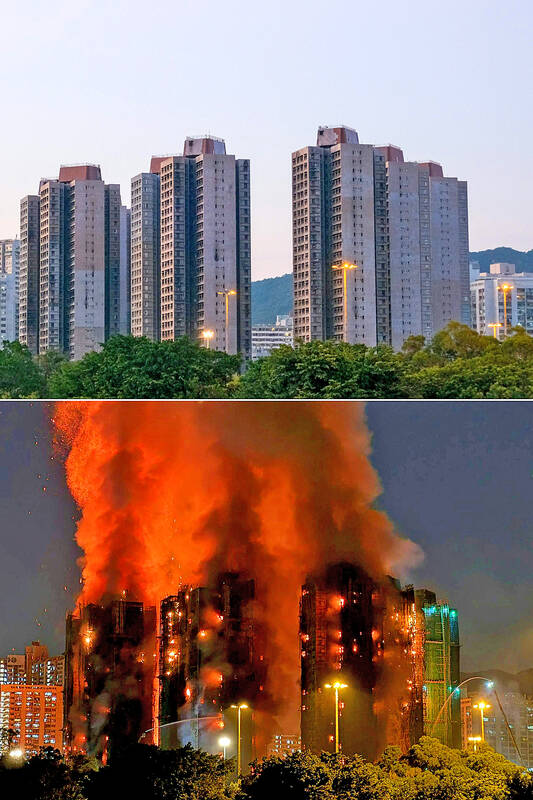
This combination of pictures created on Nov. 25 shows (top) the Wang Fuk Court complex on Nov.12 and (bottom) the residential estate engulfed in fire in the Tai Po district in Hong Kong on Nov. 26 last year.
Photo: AFP
YIP KA-KUI
Yip, 68, often finds himself retracing the path to the apartment complex that he used to take with his wife of four decades, Pak Shui-lin, whose death he says he still “cannot accept.”
Survivors say Pak saved lives by knocking on neighbors’ doors to alert them to the fire.
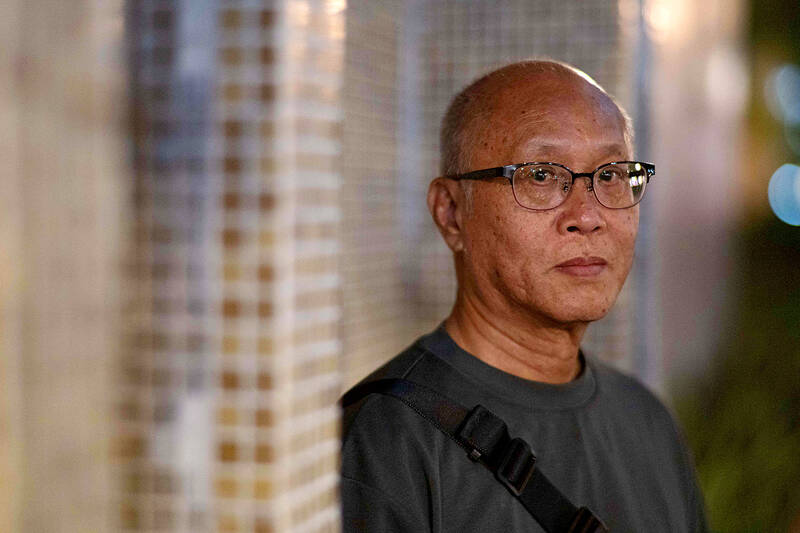
Yip Ka-kui, who lost his wife and home in the Wang Fuk Court fire on Nov. 26 last year that killed 168 people, poses for photographs as the ill-fated residential complex is seen in the background in Hong Kong on Nov. 16.
Photo: AFP
Simple moments of daily life remind Yip of her absence.
It’s as though “she is at home waiting for me to return,” he said.
He still sends life updates, such as their granddaughter’s report card, to his wife’s number.
Yip also sent their half-melted wedding rings for restoration, hoping that objects salvaged from the ruins can be passed down through generations as a reminder of the incident.
The government’s apology “lacked sincerity,” he said, adding that he hoped the society would ensure “justice is served.”
CHU
Chu, 38, recalled a coroner lifting the cloth covering his 76-year-old father’s charred remains recovered from their gutted flat, stirring ashes into the air.
“It felt like my dad was actually vanishing into the sands of time,” he said.
“I feel like I haven’t found my dad. Not long before the fire, I could still talk to him.
“I still can’t fathom what I saw in the mortuary was actually him.”
His 45-year-old sister also fears their memories of their father might “drift away” after his belongings were destroyed.
She still keeps the milk candies he gave her son for his birthday, six days before the fire.
Their father used to work as a vehicle mechanic for the colonial-era British garrison and as a night-shift taxi driver.
Among his belongings that survived the fire were a military blade and a jar of 50-cent coins — symbols of his hardworking spirit and unconditional love for the family, the siblings said.
BETTY HO
Ho, 61, lived in the housing estate for 35 years and spent two decades paying off her apartment.
She had just begun to enjoy retirement when she said the fire “took everything away from me.”
For Ho, the tragedy revealed “problems with the entire system and the government structure.”
Officials, she said, failed to heed residents’ complaints before the fire.
She now lives in government-arranged temporary housing, but is reluctant to call it home.
Unlike most other residents, Ho did not accept a government buyout and instead called for the housing complex to be rebuilt on the same site — a proposal rejected by authorities.
“That home is so close, but you can’t go back,” she said at her current residence, from which she can see her old flat.
Ho said she felt “helpless” a year after the disaster.
“It’s impossible to think about the next five years, I can’t even imagine it.”
HARRY LEUNG
Leung was among the last residents to escape the fire.
“We didn’t properly say goodbye to a place where we had lived for so long,” said Leung, who was in his late 20s and had lived in the flat since childhood.
He said he took the government’s buyout offer out of necessity.
“(The officials) had sugarcoated this as a mutually agreeable transaction,” he said.
As part of the buyout scheme, he bought another property but was saddled with more than HK$1 million (US$128,000) in debt.
That financial burden was “never part of my life plan,” he added.
“I’m still young... but for other residents who have already retired and may have little income, such change is an overburden for them.”
RHODORA ALCARAZ TUNACAO
Tunacao, 29, was a Filipino migrant domestic worker widely hailed as a hero for protecting a three-month-old baby girl during the fire one day after starting work in Hong Kong.
After being treated in the intensive care unit for smoke inhalation, she returned to the Philippines in December.
But she remains under emotional stress, according to Esther Tse, an advocate for workers rights who visits her regularly.
Tunacao also suffers from lung problems, requiring regular follow-ups and medication, Tse said.
At times, she coughed up black phlegm.
She needs depression medication and is easily agitated, but mental health professionals are scarce in her region, Tse added.
KioskNews shows a cleaned-up reading view extracted from the publisher’s page — the original always lives on their site, not ours.