Climate change hits trout and salmon in UK’s chalk streams
DECLINING WATER FLOW: Scientists, environmentalists and anglers are calling for rivers to be restored to their natural state, reduced water extraction and more shade
AFP, WINCHESTER, United Kingdom


A fly fisherman cast his line into the crystal-clear waters of the Itchen, a chalk stream in Hampshire in southern England, home to salmon and trout hit by climate change.
A summer of record-breaking temperatures and drought is threatening the ecological balance of rare chalk streams — rivers formed on chalk beds that are largely unique to England — and the fish that depend on them.
Wading through a branch of the Itchen near Winchester, Piscatorial Society Fisheries Director Robert Wellard, a recreational angler, dipped a thermometer into the clear water, drawing a reading of 17°C.
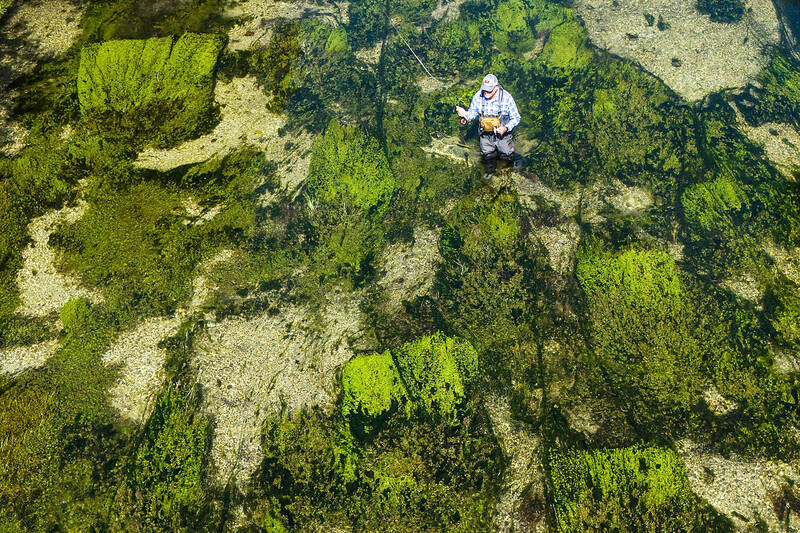
A man fly-fishes in the crystal-clear waters of the Candover Brook, a chalk stream tributary of the River Itchen, near Winchester, Hampshire, southern England, on Tuesday.
Photo: AFP
“We should be more around 12°C or 13°C” in August, said Kathryn Boler, manager of the Freshwater Program for the Hampshire and Isle of Wight Wildlife Trust.
Chalk streams, which are fed naturally by underground springs filtered through porous chalk bedrock, are known for their clear, cool and mineral-rich waters where fish such as brown trout and salmon thrive.
Out of 200 rivers of this type recorded in the world, 85 percent are found in England, according to the Wildlife Trust, which looks after the UK’s nature reserves.
These unique habitats have been at the forefront of climate change for years, with this summer’s successive heatwaves and bone-dry conditions warming the water, depleting groundwater reserves and reducing river flows.
“This year it’s been unique in the sense that we have had them [heatwaves] pretty much back to back. And so that puts a huge amount of stress on the natural environment,” Wellard said.
During heatwaves, “we’ve seen water temperatures... creeping up well above their normal temperature range,” Wellard said, adding that water temperatures this summer reached levels which start affecting wild fish.
Several angling clubs — which primarily practice catch-and-release fishing — have temporarily limited activity to reduce the stress on the fish.
In water temperatures above 19°C, salmon and trout experience “extra stress on their bodies,” as it reduces the oxygen available in the water and increases the physiological needs of fish, Boler said.
The Itchen chalked up a high of 21.7°C last month, Environment Agency data showed.
Falling river flows in drought conditions also expose the fish to predators.
For Atlantic salmon, which come to chalk streams to spawn and are already classified as endangered, the situation is particularly concerning.
“With the lower flow, salmon are effectively more trapped, and more susceptible to predation from things like harbor seals and cormorants,” said Paul Vignaux, who heads a local association for landowners and anglers in the Itchen.
In 2022, only 180 salmon came to spawn in the Itchen.
Preliminary figures for last year counted 250 individuals — 32 percent of the threshold considered necessary for the species’ conservation, Vignaux said.
This summer was also difficult for young freshwater salmon, the Environment Agency said in its July salmon count of the Itchen and another nearby chalk stream, the Test, with their “abundance and size ... far lower than usual.”
The average temperature of rivers where brown trout live in England is expected to exceed the tolerable limit “at most sites by 2070,” it said.
The critical threshold for salmon is expected to be exceeded in half of their habitats by 2080.
Scientists said climate change is increasing the frequency and intensity of heatwaves, drought and other extreme weather conditions.
Combined with river pollution, chalk streams are facing the perfect storm as declining water flows also cause pollutants to become more concentrated.
Scientists, environmentalists and anglers are calling for agencies to restore rivers to a more natural state, reduce water extraction and plant trees to improve shade.
“It’s really essential that as much water as possible stays in the rivers,” Boler said.
KioskNews shows a cleaned-up reading view extracted from the publisher’s page — the original always lives on their site, not ours.