From ‘gentle’ and ‘graceful’ to the ‘cane toad of the sky’: how Australia turned on the common myna
The common myna is sometimes referred to as “Australia’s most hated bird”. Originally from South and Central Asia, the introduced species from the starling family is abundant, raucous and bold.
Mynas thrive just about everywhere they’ve been introduced, from Taiwan to Mauritius to Florida. In 2000, they made the list of the 100 worst invasive species worldwide compiled by the International Union for Conservation of Nature.
This year, Queensland communities are trying to eradicate these introduced birds. But the same story has been written many times. In 2012, Canberra residents launched their own grassroots efforts to keep myna populations down. In 2004, an ABC article titled “Myna fightback” called for war on the bird.
Mynas – and humans’ efforts to monitor, trap and kill them – make for easy headlines. But there’s a cycle. People notice mynas are in abundance. Community organisations distribute traps. Bounties are offered. Myna numbers appear to decrease. But then people get complacent and the bird bounces back.
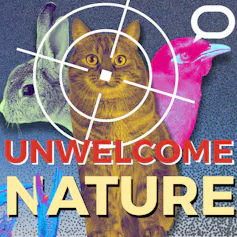
Every Australian knows common myna birds are bad, rabbits are worse and feral cats kill native animals unchecked.
But how do we decide what makes an introduced species “good” or “bad” – and will we ever concede that some species are here to stay?
Our new series on invasive species explores these questions.
We don’t know if myna numbers are actually soaring in Queensland, or whether people are simply noticing them more. But my research suggests introduced birds come under more scrutiny at times of anxiety about national identity. Earlier panics over the “immigrant bird” (the red-whiskered bulbul) made it explicit.
It’s too soon to say if similar dynamics are playing out for mynas. But it does raise a question. Is it time to acknowledge mynas are here to stay?
From admiration to loathing
I’m a fifth-generation settler Australian. But the ancestors of the mynas in my suburb were probably here before mine were. They’ve been in Victoria since 1862. In Queensland, they were introduced around Ingham and Townsville in 1883 in the hope they would control locusts and other insects (not unlike the later cane toad).
Attitudes towards mynas have shifted greatly over their 164 year presence in Australia. Though the bird’s ability to eat or damage fruit crops was recognised as early as 1868, its value as an insect eater seemed to balance this out.
Around the turn of the 20th century, birdwatching became a well-organised and popular Australian hobby. The “birdos” of this era often praised the myna.
An anonymous 1886 writer in Sydney’s Globe newspaper described mynas as “dear, gentle, sprightly, and highly amusing”. In 1906, naturalist Charles Barrett described Melbourne’s mynas as “extremely spruce and graceful”.
Even as late as 1971, Alec Chisholm – perhaps Australia’s most revered birdwatcher – wrote in the Sydney Morning Herald:
Obviously, then, this bird from India is now part of the Australian landscape. And it is not, I suggest, an objectionable feature. It does no economic damage, and its assured strutting, combined with its hearty chatter as it forages for insects and scraps in streets and parklands causes it to be regarded as an entertainer

In North Queensland, mynas were accepted much as they were in Melbourne and Sydney. In 1949, an amateur naturalist from the region declared the myna “may be foreign in origin – but he’s Aussie here”.
It was only in the 1970s that public opinion noticeably turned. Hatred for the myna became entrenched in the 1980s and 1990s as part of a broader backlash against what were increasingly called “invasive” species.
The “cheerful” and “dapper” bird was gone. Now it was “bold, arrogant […] and fiercely aggressive”.
Some language bordered on crudely xenophobic. In 1988, a piece in the Canberra Times described a stand of old, native trees as:
housing commission flats for mynahs, with an occasional crimson and eastern rosella occurring in a neighbourhood swamped and dominated and altered by the migrants, a metaphor for the worst fears of those opposed to “Asian” migration
A 1990 piece by the same author described mynas as “invaders” and “foreign bullies”.
Despite the shift in public opinion, it wasn’t until the late 1990s that peer-reviewed research began being published on the effect mynas had on native wildlife.
Researchers found mynas could outcompete native parrots for scarce breeding space. The most high-profile research called mynas “flying cane toads” and the “common thugs of the bird world”.
Here’s the thing. The common myna has certainly expanded its range and numbers over the decades. But the bird hadn’t changed. It looked and behaved the same as it did in the 1860s or the 1940s. What changed was public attitudes, which transformed it from a friendly creature into something malevolent and repulsive.

Here to stay?
Hatred of mynas is now the norm in Australia. But these birds are likely here to stay, no matter how we feel about them. Where trapping programs are common, mynas live in smaller groups and spend more time hiding. The sense trapping is reducing their numbers might be an illusion. Sometimes, in some places, we might be able to eradicate the common myna – but not everywhere.
Even if we do successfully bring myna numbers down, that will not resolve all our ecological issues. Efforts to reduce their numbers by trapping can create a gap which can be filled by the noisy miner. While this bird is a native honeyeater, it can also drive more vulnerable species away from dwindling habitat. There’s a risk of swapping one “problem” species for another.
As an environmental historian, I worry many people who are passionate about native wildlife are wasting their energy and talents fighting an unwinnable war. But I can also understand the desire to cull mynas.
Humans grow attached to the places we live. We tend not to like it when our places change around us – even when change comes in the form of a bird. Of course, some ecological changes do represent a crisis – but not all. Sometimes, the best response is to sit back, observe and hope for a new equilibrium to emerge.
KioskNews shows a cleaned-up reading view extracted from the publisher’s page — the original always lives on their site, not ours.