China’s access to some Nvidia chips in doubt as curbs gain traction in US
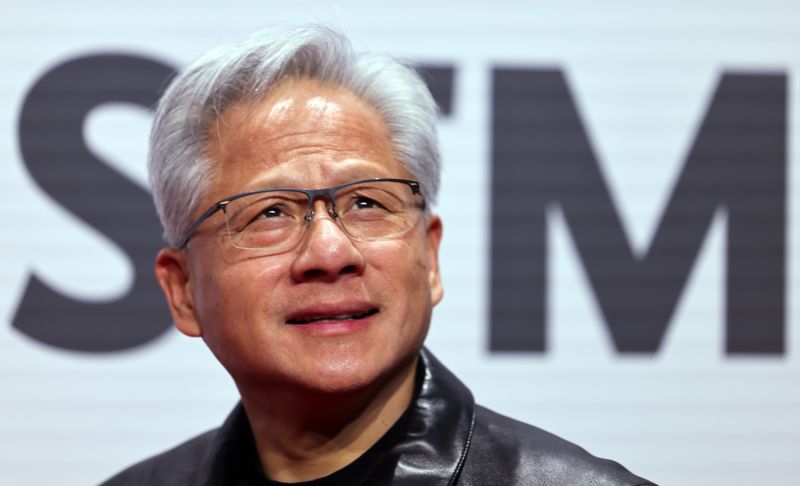
US House Speaker Mike Johnson said on Thursday there was growing consensus in Congress on limiting chip exports to China after a spy scandal forced out Huang, who has pushed to preserve access to the Chinese market and has close ties with US President Donald Trump.
Huang stepped down after news reports of a romantic relationship with a Chinese businesswoman whom US authorities suspect of spying for Beijing.
Lawmakers from both parties have since called for tougher restrictions on China's access to advanced AI chips, threatening access to chips that underpin China's surging AI development.
Senior White House officials were also discussing whether Commerce Secretary Howard Lutnick should be pushed out, two people familiar with the situation said, as the desire to take action rose across Washington.
A growing number of lawmakers have criticized Lutnick for the administration's refusal to add dozens of Chinese companies to a US trade blacklist, and questioned whether the government was properly overseeing Nvidia's exports to China.
Nvidia's advanced AI chips are widely used to develop cutting-edge AI models, making the company key to the US race against China to build superior AI systems. The US has sought for years to limit China’s access to Nvidia’s chips because it does not want the Chinese military to benefit from them.
"The export controls on chips to China has been a big issue around here," Johnson, a Louisiana Republican, told reporters at the US Capitol, adding he favored limiting China's access to the advanced technology. "I think there's a developing consensus in Congress that is an important position to take."
Investors dumped shares in Chinese AI models and hardware suppliers to the US on Friday, with AI model stocks Z.AI 2513.HK and MiniMax Group 0100.HK tumbling 12% and 8.4% respectively.
Data center suppliers Zhongji Innolight 300308.SZ and Eoptolink Technology 300502.SZ, whose businesses are heavily reliant on US markets, also slumped more than 8%.
The Chinese businesswoman at the center of the scandal, Alice Huang, was an executive at Megaspeed, an Nvidia partner the US government suspects of helping China obtain advanced AI chips restricted under US export controls. Beijing has denied Alice Huang is a spy.
REPUBLICANS EYE EXPORT RESTRICTIONS
The case has revived claims among China critics in Washington that US export policies are too weak, boosting calls for more restrictions.
Reuters reported that Chinese AI companies are trying to rent Nvidia-powered computing capacity outside China because they are worried the Jensen Huang allegations could spur Washington to tighten restrictions on their ability to access the company's chips remotely.
Congressional Republicans are keen to attach new restrictions on exporting advanced AI chips to China in the annual defense authorization bill, a must-pass measure that funds the military and typically attracts bipartisan support, according to a Senate aide, who spoke on the condition of anonymity.
Lawmakers are pressing their colleagues to pass at least four bills on chip exports, according to statements since Monday. The AI Overwatch Act would give Congress more power over advanced AI chip exports. The Chip Security Act would require companies to track the location of advanced AI processors to prevent smuggling.
The Match Act would pressure US allies to restrict sales and maintenance of advanced chipmaking equipment destined for China. The Remote Access Security Act would give the Commerce Department the tools to stop Chinese firms from renting overseas data centers to access Nvidia chips.
SCRUTINY OF HUANG LIKELY TO CONTINUE
Huang's resignation is unlikely to end congressional scrutiny of Nvidia and could leave the former chief executive more exposed to investigation, said Sunny Cheung, an analyst at the Washington-based Jamestown Foundation.
"Congress can still subpoena him and Nvidia should conduct an independent investigation to determine whether the problems extend beyond Huang," Cheung said.
Cheung said Huang's departure could weaken Nvidia's influence in Washington and create additional momentum for legislation that tightens restrictions on advanced chip exports. He said Nvidia's new leadership could also reconsider the company's China strategy as it seeks to rebuild trust with US policymakers.
Jensen Huang is separately expected to testify before Congress before Thanksgiving, which falls on November 26. House Foreign Affairs Chairman Brian Mast, a Florida Republican, told reporters on Thursday that congressional staff spoke with Nvidia on Wednesday night about a date and location for his testimony.
Mast and two other leading House Republicans asked Huang last week to brief them behind closed doors about his relationship with Alice Huang.
(Reporting by David Morgan, Courtney Rozen and Mike Stone in Washington; Writing by Doina Chiacu and Miyoung Kim; Editing by David Ljunggren, David Gaffen, Rod Nickel and Christopher Cushing)
KioskNews shows a cleaned-up reading view extracted from the publisher’s page — the original always lives on their site, not ours.