Do UAE-Saudi meetings signal escalation or efforts to contain conflict? - interview

Within 24 hours, two diplomatic moves placed the Gulf back at the center of an increasingly interconnected regional security crisis.
For more stories from The Media Line go to themedialine.org
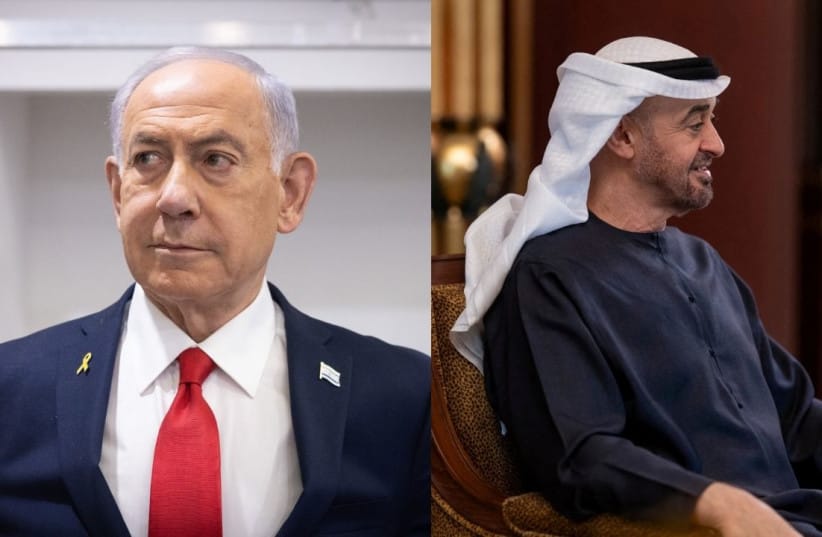
Prime Minister Benjamin Netanyahu traveled to Abu Dhabi on Sunday, September 27, for an unannounced meeting with UAE President Sheikh Mohamed bin Zayed Al Nahyan. A day later, Saudi Foreign Minister Prince Faisal bin Farhan arrived in Washington for talks with US Secretary of State Marco Rubio, officially focused on bilateral relations and regional and international developments.
The proximity of the two meetings, alongside renewed fighting in Yemen, ongoing tensions with Iran, and signs of greater military coordination around Saudi Arabia, raises an obvious question: Are regional governments preparing for another broader confrontation, or do the two visits reflect fundamentally different calculations?
For now, the evidence points to a combination of both. Israel, the UAE and Saudi Arabia are confronting overlapping security problems, but there is no indication that the Abu Dhabi and Washington meetings constitute parts of an agreed regional offensive.
“Still, we should distinguish between evidence of intensified diplomacy and evidence that a joint military operation has been agreed,” Cyril Widdershoven, senior advisor at Blue Water Strategy, told The Media Line. “In my view, these governments appear to be preparing for escalation at the same time. At the same time, they are trying to discuss how to set up arrangements to contain it,” he added.
For Widdershoven, the underlying shift is geographic as much as political.
“Yemen, Hormuz and the Horn of Africa are becoming increasingly interconnected through maritime security, energy exports and military access,” he said. “Keep in mind, however, that their conflicts retain separate local drivers,” he added.
That includes growing instability between Ethiopia and Eritrea, another potential escalation chain on the African side of the Red Sea.
Much of what was discussed between Netanyahu and MBZ is unknown
“The conflict in Ethiopia also fuels a regional escalation,” Widdershoven said. “It is now a combination of Ethiopia’s internal conflict and its deteriorating relationship with Eritrea,” he added.
Netanyahu’s meeting with Sheikh Mohamed remains particularly difficult to interpret because neither government immediately provided a detailed public readout. Reuters confirmed the meeting through a senior Israeli official, while the visit also came amid controversy in Israel over a Haaretz report alleging that the Emirati president had warned Netanyahu ahead of the October 7, 2023 Hamas attack. Netanyahu has denied the report.
“There is an important qualification concerning the Netanyahu-Mohamed bin Zayed meeting,” Widdershoven said. “Regional security may have been discussed, but information at present doesn’t show that the meeting concerned an agreed offensive against Iran or the Houthis. If we read it all exclusively as military coordination, this would be beyond what we know,” he added.
Maj. Gen. (res.) Giora Eiland, former head of Israel’s National Security Council, also pointed to a possible domestic political objective behind Netanyahu’s trip, while stressing that he did not know what happened inside the meeting.
“Netanyahu, I would say, in a desperate political move, flew to the Emirates. I was not attending the meeting, but according to all the reports, he flew to the Emirates in an attempt to persuade Mohammed bin Zayed to say, either in his own voice or through some official statement, that he did not call Netanyahu before October 7,” he told The Media Line. “At least so far, such an announcement has not been made. So, in a way, Netanyahu’s mission probably failed, if this was the main purpose,” he added.
Eiland similarly sees strong strategic convergence between Israel and the UAE, particularly regarding Iran, without interpreting that convergence as evidence that a new military campaign has been decided.
“Israel and the Emirates see the situation more or less in the same way,” Eiland said. “Both countries are trying to encourage the Americans not necessarily to resume the military offensive, but at least not to give up the economic pressure. In this regard, both countries are on the same page,” he added.
The relationship also has a substantial security component. Eiland noted the depth of Israeli-Emirati defense ties since the Abraham Accords, including access to Israeli defense technology and air-defense capabilities.
But Saudi Arabia’s visit to Washington has a much clearer immediate military context.
Prince Faisal’s arrival comes after weeks of escalating confrontation with Yemen’s Houthis. Reuters reported that Crown Prince Mohammed bin Salman had sought direct US military assistance against the group earlier this month. Washington declined to conduct strikes but agreed to provide intelligence and targeting support.
“The Saudi–American meeting has a clearer immediate security context,” Widdershoven said. “The meeting is therefore significant, but its occurrence does not, by itself, show that the American position has changed,” he added.

Saudi Arabia is trying to avoid endless conflict in Yemen
For Riyadh, the question goes beyond retaliation. Saudi Arabia is attempting to protect critical infrastructure and energy exports without returning to the kind of open-ended military intervention in Yemen that it spent years trying to leave behind.
“The real question is whether Riyadh can protect its economic lifelines without becoming trapped in an expanding war,” Widdershoven said. “At present, the Kingdom clearly needs an answer that protects infrastructure and restores confidence in exports. At the same time, it will still want to avoid an open-ended campaign whose political outcome remains uncertain,” he added.
That dilemma has become more acute because disruption around the Strait of Hormuz has increased the importance of Saudi Arabia’s westward export infrastructure, while the Houthi advance around the Red Sea has placed new pressure on the other side of the kingdom’s maritime network.
Widdershoven cautioned that moving crude toward Yanbu does not eliminate the threat.
“A functioning pipeline does not automatically provide a secure export system: pumping stations, terminals, and the vessels leaving them remain exposed,” he said. “A bypass can itself become a strategic vulnerability,” he added.
Eiland offers a more critical assessment of Saudi Arabia’s position. Despite Riyadh’s advanced weapons systems and extensive defense spending, he argues that the kingdom has struggled to translate those capabilities into sufficient operational strength.
“In Saudi Arabia, there is a huge gap between, on the one hand, the size of the country, its wealth and the advanced military systems that it has, the most advanced American weapons systems and, on the other hand, its actual performance,” he said. “They have the potential to be a very strong player, at least a local superpower,” he added.
However, concrete signs show that Saudi Arabia is strengthening military coordination.
On September 25, the military chiefs of Saudi Arabia, Pakistan and Turkey met in Riyadh under the Mecca Joint Defense Agreement and discussed greater intelligence cooperation, military coordination and integration of capabilities. Saudi and Yemeni commanders also met over the weekend to discuss military readiness and coordination as government-aligned forces continue operations against the Houthis.
Those developments provide a firmer indication of heightened preparedness than videos circulating on social media purporting to show Saudi military training.
Treat such footage with caution unless you can independently verify its date, location, and source. The current crisis has already produced examples of old military footage being recirculated with false or misleading descriptions, including one video presented as showing Saudi personnel during the current Houthi escalation that fact-checkers traced back to 2019.
Military readiness also does not necessarily mean offensive intent.
Eiland said that Israel, despite its security cooperation with Gulf partners, is unlikely to take an active role in a Saudi-Houthi war unless Israel itself comes under attack.
“In regard to Saudi Arabia, on the one hand, we are trying to help, but very carefully,” he said. “Certainly, we are not going to participate proactively in that war unless we are attacked. We have enough problems of our own,” he added.
“Maybe we help them with some intelligence systems, maybe with some know-how about how to do certain things,” he further noted. “But officially, I don’t think that any real proactive military assistance is being given to Saudi Arabia by Israel,” he added.
Eiland's assessment of Iran is similarly cautious
President Trump, Eiland said, could either resume military action or maintain economic pressure. He favors the latter.
“I personally don’t think that he will do it, and I don’t think that it is wise to do it,” Eiland said of another US military offensive. “The second option is to be patient and continue with the economic pressure, which is quite effective,” he added.
From Israel’s perspective, he argued, opening another front would also come with high costs.
“We have had a very painful three years. We need quiet and no additional front,” Eiland said. “So American economic pressure against Iran, for the time being, seems to me to be the right way to proceed,” he added.
The two meetings therefore sit within the same regional security environment but appear to serve different immediate purposes.
For Saudi Arabia, Washington is being asked to address an active and growing security problem involving Houthi attacks, critical infrastructure and the protection of trade and energy routes. For Israel and the UAE, the Abu Dhabi meeting reflects a broader relationship shaped by Iran, defense cooperation and regional strategy, but also by an unusually sensitive Israeli domestic political controversy.
That distinction could narrow quickly if another major attack changes the calculations in Riyadh, Washington, Jerusalem or Abu Dhabi.
Widdershoven sees limited military escalation as one possible pathway, particularly following a major attack on Saudi infrastructure, shipping or American personnel. But he argues that defensive coordination, intelligence sharing and diplomatic bargaining remain the stronger immediate baseline.
“My answer is therefore yes: further regional moves are likely, with defensive coordination, bargaining and preparations for possible escalation proceeding together,” he said. “The evidence does not yet justify saying that the two meetings mark the launch of a coordinated regional offensive,” he added.
The common thread is, instead, a regional security system in which Iran, Yemen, the Gulf, and the Red Sea can no longer be treated entirely as separate theaters.
“The larger strategic development is that governments increasingly have to address Hormuz, Saudi export infrastructure, Bab el Mandeb and access to the African coast as connected security problems,” Widdershoven said. “Any agreement that protects only one part of that system will leave substantial leverage in the hands of those able to disrupt the others,” he concluded.
KioskNews shows a cleaned-up reading view extracted from the publisher’s page — the original always lives on their site, not ours.