The 10 Best Ambiguous Movie Endings of All Time, Ranked

Ryan Heffernan is a Senior Writer at Collider. Storytelling has been one of his interests since an early age, with his appreciation for film and television becoming a particular interest of his during his teenage years.
This passion saw Ryan graduate from the University of Canberra in 2020 with an Honours Degree in Film Production. In the years since, he has found freelance work as a videographer and editor in the Canberra region while also becoming entrenched in the city's film-making community.
In addition to cinema and writing, Ryan's other major interest is sport, with him having a particular love for Australian Rules football, Formula 1, and cricket. He also has casual interests in reading, gaming, and history.
Sign in to your Collider account
There are few things in cinema as risky as an ambiguous, open-ended conclusion. Audiences crave closure and comfort, and when that is withheld from them, the response can be volatile. It can feel as if they’ve been betrayed by a snide and snickering filmmaker who wanted only to pull the wool over their eyes. It is nothing short of frustrating and cheap when executed poorly, and yet, when it’s done well, an ambiguous ending can be incredibly rewarding and thought-provoking.
So what makes for a good ambiguous resolution? Well, given the titles on this list range from icons of ‘80s horror classics to international dramas, satirical comedies, action blockbusters, and sci-fi sensations, it can be difficult to pinpoint. However, each of these great movies has found ways to achieve their ambiguity while still offering a sense of climactic catharsis, be it through thematic questions or emotional journeys, character arcs being resolved, or by using narrative uncertainty to emphasize an essential idea. All that is certain is we have no idea what these movie endings really mean, and we couldn’t be happier about it.
10 'Being There' (1979)

Something of a forgotten gem of ’70s comedy that is as sweet as it is satirical, Being There follows Chance (Peter Sellers), a naïve gardener who has learned all he knows from watching television. When his employer dies, Chance is cast into the street, where he forms a friendship with Ben Rand (Melvyn Douglas), an influential business mogul who mistakes his simple outlook on the world for philosophical genius. The film ends with Ben’s funeral, with the president speaking as his advisors scheme to make Chance the next U.S. President. Chance wonders away from the funeral, then he begins to walk across the surface of a pond.
Theories aplenty have arisen since Being There premiered in 1979, with literal translations suggesting Chance’s innocence granted him Christ-like properties, or could even be God himself. Others poetically view it as Chance is able to walk on water because he never knew it was impossible, while some believe he is simply walking on a slightly submerged platform, yet again giving the illusion of his apparent genius and divinity. Whatever viewers believe, Being There ends on a bold and fascinating note that brings a new, contemplative layer to the story.
9 'The Graduate' (1967)

It is one of the most iconic final shots in the history of cinema. The aimless Benjamin (Dustin Hoffman) dashes to interrupt Elaine’s (Katharine Ross) wedding ceremony, inspiring her to defy her family and run away with him. Enthused by freedom and experiencing the joy of youthful rebellion, they sit at the back of a boss still adorned with broad smiles, but director Mike Nichols doesn’t cut, and the Happily Ever After ending begins to fade with the duo’s smiles as a sense of uneasy uncertainty creeps over them.
Complimented by the melancholic tone of Simon & Garfunkel’s “The Sound of Silence” ushering in the credits, The Graduate ends with a piercing feeling of ambiguity. It questions whether Ben and Elaine truly love each other or if they simply see one another as an act of defiance from their parents’ expectations. It ponders on what the cost may be for their erratic actions. Most poignantly, it questions whether the thrill of taking charge of their own lives will be enough to satiate them when the pressing weight of reality sets in. Their fates are even more undecided than they were at the start of the film.
8 'La Haine' (1995)
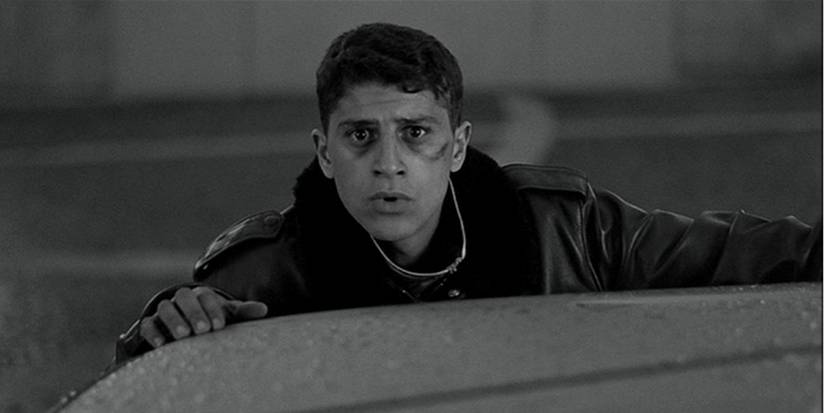
Gritty and confronting, La Haine delivers a visceral social thriller that embeds viewers in the chaos and anger of the Parisian streets, following three young men from immigrant families who set out to kill a cop after their friend is hospitalized after a riot. The international masterpiece, a brutal slice of life drama, depicts the cyclical nature of social outrage, with riots inciting a police response that incites riots, and so forth, and the ambiguity of the ending highlights this point magnificently.
A violent confrontation between the three men and an officer leaves Hubert (Hubert Koundé) in a Mexican standoff with Inspector Notre Dame (Marc Duret). The camera zooms in on a neutral Saïd’s (Saïd Taghmaoui) face who closes his eyes, the shot cutting to black moments before we hear a gunshot. Who shot who is never disclosed, and it is almost impossible to decipher, but La Haine’s intent is to show it doesn’t matter. In the context of three characters’ lives, the film resolves with uncertainty, but in the context of society it is abundantly clear. Police violence will continue, as will outrage and rioting, regardless of who fired.
7 'Rashomon' (1950)

Masterfully directed by Akira Kurosawa, there is an air of ambiguity that shrouds every frame of Rashomon. It is a brilliant way to explore the theme of absolute truth vs. subjective interpretation, with the film revolving around the trial of an accused murderer where the witnesses called up each give different stories of what happened. By the end of the film, the audience knows little more about what actually transpired in the forest than when the story started, but their preconceived notions of justice, truth, and morality have definitely been tested.
Not only does the climax leave the truth behind the crime unresolved, but it also sees a humble woodcutter share his own version of events with a fellow onlooker in the form of a priest whose faith in humanity is at breaking strain. It is just another layer to the ambiguity and mystique, and it allows Rashomon to end as a masterpiece of thought-provoking cinema that forces the viewer to come to their own conclusions, not only on the details of the film, but on their own philosophical ideas of legal process, objective truth, and hope for humanity as well.
6 'The Shining' (1980)
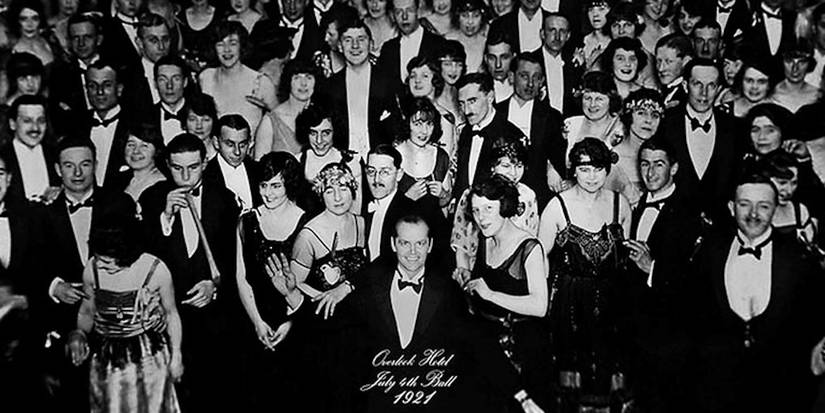
A ferocious departure from Stephen King’s source material, The Shining sees Stanley Kubrick transform what is a subversive haunted house horror into a harrowing descent into madness. After the remote Overlook Hotel drives Jack Torrance (Jack Nicholson) into a murderous frenzy, his wife and child make their escape, leaving Jack frozen in the snow. It’s a well-rounded ending that delivers vindication and closure, but the final shot changes everything as it glides through the hotel’s halls and zooms in on a picture of a party from 1921 with Jack Torrance front and center.
Many feel as though it illustrates the Overlook Hotel is itself a possessive, soul-absorbing entity and the photograph represents all the guests that have been claimed by its evil, but other theories include Kubrick’s own of an endless cycle of reincarnation and a broader visual metaphor for violence and domestic abuse being repetitive issues across generations. Given the film deviates so drastically from King’s book, audiences can’t even rely on the source material for answers, making The Shining a sensationally stupefying horror hit that knows how to linger on the mind.
5 '2001: A Space Odyssey' (1968)

It has been almost 60 years since 2001: A Space Odyssey first premiered in theaters, and yet the sci-fi classic remains one of the most fiercely debated movies of all time. It marks another confounding ending from Stanley Kubrick, who closes out his hypnotically perplexing space-exploration epic with Bowman (Keir Dullea) passing through a psychedelic wormhole, awakening in a futuristic room where he sees then becomes older versions of himself, then is seemingly resurrected as a fetus-like “Star Child” hovering in Earth’s orbit.
Tens of millions of people have seen 2001: A Space Odyssey, and tens of millions of people have their own interpretation as to what the final minutes truly mean. In many ways, that is the brilliance of the movie. In refusing to give up easy, comforting answers, Kubrick forces the viewer to think deeply about some quite confronting ideas like humanity’s place in the cosmos, mortality and what lies beyond the grave, and what the future, technology, and space exploration may bring for mankind.
4 'Doubt' (2008)

A lot of the time, ambiguous endings conjure a thrill in themselves from viewers, with audiences groaning and enthralled in agony as they crave to know just a little bit more. Doubt, however, uses an approach of climactic ambiguity to enrich its confronting thematic depth. Complimented by outstanding performances, it unfolds in a Catholic school where Sister Aloysius (Meryl Streep) begins to question the newly arrived Father Flynn’s (Philip Seymour Hoffman) relationship with one of the students.
The conclusion sees Flynn resign from his post and transfer to a different school, but whether that is out of guilt and shame or simply to distance himself from an overzealous accuser is impossible to specify. Even Sister Aloysius breaks down in the finale, confessing she has her own doubts about Flynn’s guilt and reluctantly accepting her dogged certainty has corrupted her soul to some extent. Given that Doubt functions not as a mystery thriller, but as a powerful, perfectly performed drama about how people live, behave, and cling to faith when the absolute truth can’t be known, the ending is ingenious, a rewarding though ravaging conclusion that implants the viewer in Sister Aloysius’ angst while leaving them unsure of how to feel about Father Flynn.
3 'Mulholland Drive' (2001)

Few movies are as enigmatic as Mulholland Drive, a typically surreal and stylized picture from David Lynch that blends a candy-cane-colored dream with the crippling brutality of reality. The movie initially follows Betty Elms (Naomi Watts), an aspiring actress who helps an amnesiac woman ascertain her true identity. However, around half-way through, it pivots to a more grueling reality where Elms, now Diane Selwyn, is a struggling bit-part player reeling from romantic heartbreak.
As such, the final act of the movie becomes a gripping character examination that contrasts Diane’s desperation and squalor with the idyllic version of her presented in the first half of the movie. At least, that is one theory. With the film ending violently after Diane is chased through her apartment by two manifestations of career pressure, the final shot returns to Club Silencio where a blue-haired performer whispers “Silencio” just before the credits roll. Keeping in the same style as the movie prior, Mulholland Drive ends as a stylistic and bold spectacle that is purposefully open to interpretation.
Collider Exclusive · 8 Questions · 2 Minutes What Is Your Biggest Horror Nightmare? Elm Street · Chucky · Scream · The Conjuring
Four horror franchises. Four completely different ways of scaring you. One waits until you fall asleep. One makes sure nobody believes you. One is already in your group of friends. And one is in the house with your family. Answer eight quick questions about how you actually watch horror, and find out which nightmare was built for you.
😴Elm Street(Freddy Krueger)
🧸Chucky(Child's Play)
📞Scream(Ghostface)
🕯️The Conjuring(The Warren Files)
01
Which horror scene makes you cover your eyes? Four classic images. One of them is worse than the others for you.
02
You are home alone and you hear a noise. First thought? Everybody has one. It arrives before you have decided anything.
03
Which horror movie rule would you break first? Everybody thinks they would survive. Almost nobody actually does.
04
Something genuinely frightening happens. What do you do? Not in a film. In your actual living room, tonight.
05
How do you actually watch a horror film? Be honest about this one. Nobody is checking.
06
Somebody offers you serious money. Which do you still refuse? The amount does not matter. There is one on this list you are not doing.
07
Which feeling stays with you a week after the film? Good horror does not stop when the credits do.
08
Something wakes you at 3am. What is the worst possibility? Eight questions in, this is the one that decides your nightmare.
The Lights Just Went Out Your Nightmare Is…
Four franchises, four completely different ways of getting underneath your skin. This is the one built out of your particular fear, why it works so well on you, and what it would leave behind.
Elm Street
Your nightmare does not wait outside the door. It waits for you to close your eyes, which you are going to have to do eventually, because nobody has ever won that particular argument.
- Freddy is horror's cruellest idea: a threat that lives in the one place you cannot guard, cannot lock, and cannot avoid forever.
- You are the one who is fine during the film and wide awake at two in the morning. Your own head is where this does its damage.
- These films understood exhaustion as a horror engine. The kids on Elm Street do not lose because they are weak. They lose because they are tired.
- You can lock every door in the house. You still have to sleep.
Chucky
Your nightmare is not really the doll. It is the face of the person you tell, and the way they decide, very kindly, that you have imagined all of it.
- Chucky works precisely because he is absurd. That is the trap: the more accurately you describe him, the less anybody is going to believe you.
- You are the one shouting at the screen because the characters are not listening. You know that feeling from real life too.
- The franchise is at its best when the adults in the room are the real obstacle, and you have met those adults.
- By the time somebody finally believes you, you will have handled most of it on your own.
Scream
Your nightmare has your number, knows your name, and has almost certainly been inside your house before. The worst part is that you already know them.
- Scream is the only one of these where the killer takes the mask off and turns out to be somebody who was at the party.
- You are the person who calls the twist out loud before it lands. You watch people the same way you watch films.
- The franchise made the rules of horror part of the plot, which means the survivors are the ones paying attention. You would be paying attention.
- Everybody is a suspect, including the person who just offered to walk you home.
The Conjuring
Your nightmare is not really about you. It is about the people asleep down the hall, and the feeling that whatever is here is not interested in leaving.
- The Conjuring films are domestic horror. The house, the family, the perfectly ordinary room that quietly stops feeling ordinary.
- Your instinct is to get everybody into one room. Your fear is protective rather than personal, which is rarer than it sounds.
- This is the one franchise where belief is the weapon. The people who come through it are the ones who are not alone and refuse to be.
- Whatever is here did not come for you. It came for the household, and you are the one standing in the hallway.
2 'The Thing' (1982)

44 years have passed since The Thing first hit theaters, and still the nature of its ending is one of the most debated and examined sequences in the history of horror cinema. It revolves around the excruciating question, “Was one of them a thing?”. The movie as a whole unfolds as an assimilating alien wreaks havoc on an American research base in Antarctica, taking the form of its victims and leaving the survivors with no idea who they can trust and rely on.
After an explosive finale in which the alien in all its terrifying glory is blown up, the triumph simmers back into ambiguity when the iconic ‘80s horror famously ends with the only two remaining survivors—MacReady (Kurt Russell) and Childs (Keith David)—staring at each other, neither certain if the other is human or alien. Fan theories have been presented en masse, declaring all possibilities to be the absolute truth. The only thing that is sure is The Thing’s conclusion is truly ingenious, not only because it has successfully endured in pop-culture circles for decades, but because of how it complements the movie’s focus on social paranoia, distrust, and isolation as well.
1 'Inception' (2011)

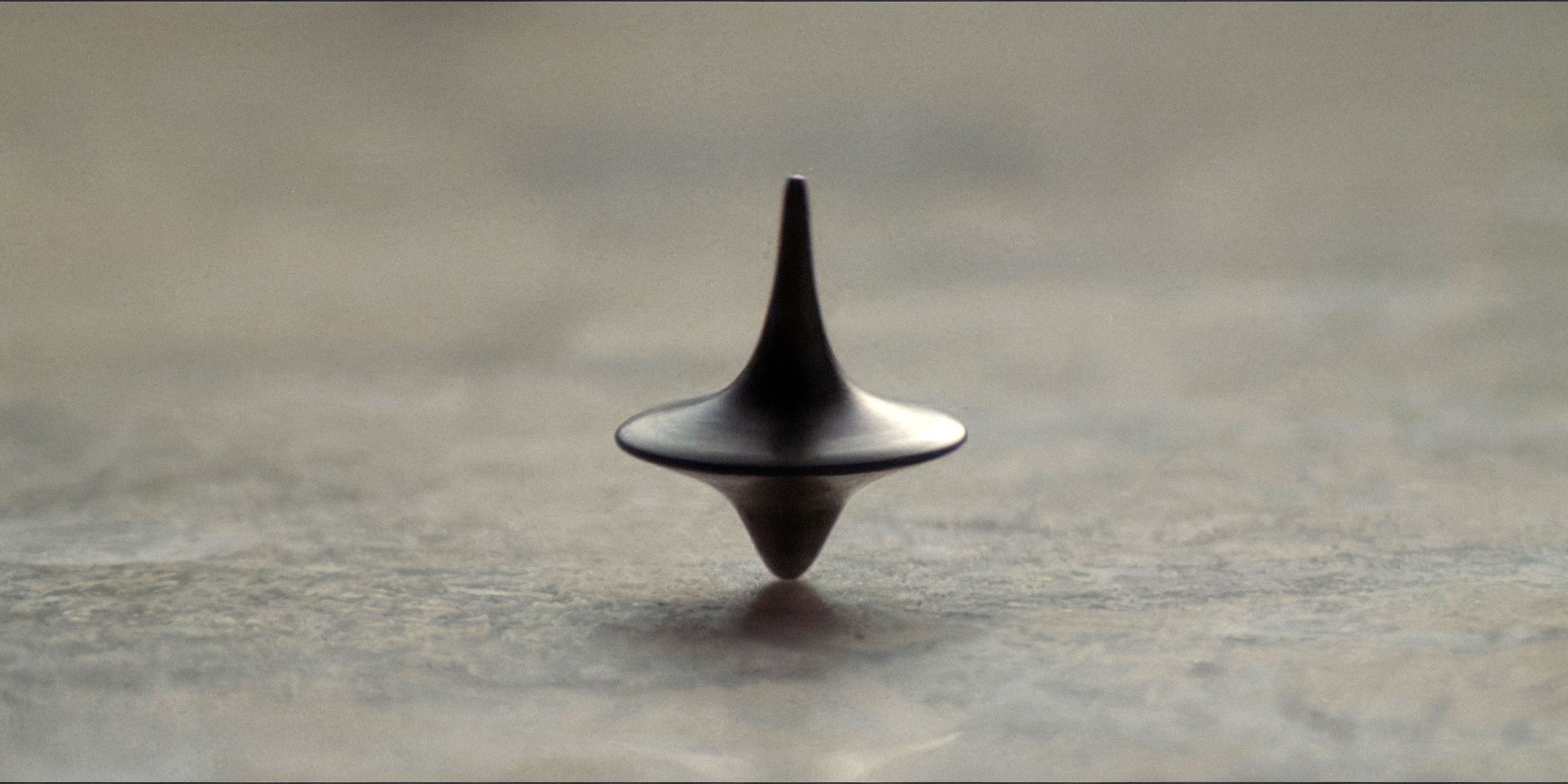
It has become one of the most analyzed and discussed sequences of any movie released this century. Does Cobb’s (Leonardo DiCaprio) spinning top show signs of wobbling? Following two-and-a-half hours of reality-warping, dream-stalking action carnage, Inception ends by refusing to disclose to audiences if Cobb has successfully returned to America and been reunited with his children, implying that it could all still be part of a dream.
A huge reason why this ambiguous ending works so well is because Christopher Nolan doesn’t make Cobb returning home the main question of the movie. By the final minutes, audiences know he accomplished his goal of planting an idea in the mind of Fischer (Cillian Murphy), and that the elaborate three-tiered dream descent has worked. It means the final moment has huge stakes, but it doesn’t undermine the journey of the movie by maintaining a sense of uncertainty. Admittedly, there are also clues suggesting Cobb is in the real world, such as his wedding ring and Professor Miles’ (Michael Caine) presence, but it is impossible to be positive, and that impossibility has helped make Inception one of the more iconic blockbusters of the century so far.
KioskNews shows a cleaned-up reading view extracted from the publisher’s page — the original always lives on their site, not ours.