Study: Data center energy costs hit lower income households hardest
With data centers cropping up around the United States, the cost of the energy infrastructure on which they rely, and who pays for it, are among the country's most debated economic and political questions. A new study has uncovered some answers: It found that, in 2025, the rising energy costs associated with AI data centers landed hardest on lower-income, rural households, which bore disporportionate shares of the financial burdens compared with the data centers themselves.
Authored by Cornell University researchers and published this week in the journal Nature Energy, the study analyzed growth in both energy demand and infrastructure projects along four major U.S. power grids between 2020 and 2025. It also looked at data from 4,000 existing and proposed data centers spread across the nation. Its results showed that the AI boom, and relative profileration of the data centers used to support it, hike up energy costs in ways that place the greatest economic strain on people who benefit least from the technology.
The study found that data centers unevenly raised wholesale power prices. Those costs are determined through an open markeplace where electricity is bought and sold in bulk between power generators and utilities, before reaching transmission lines, and, eventually consumers. Power grids that were already stretched saw the greatest price increases, researchers said.
In the California's Southern Bay Area, data centers were estimated to raise wholesale energy prices by almost 20% last year. In Texas' Dallas-Fort Worth, the increase in 2025 approached 17%, according to their estimates. Both regions have seen influxes of data centers in recent years. Places like New York, where data centers are less prevalent, didn't experience significant changes in wholesale energy prices, according to the study.
Higher wholesale prices had a downstream effect on energy consumers, the researchers said, as residential customers paid huge fractions of the spending on transmission built for data centers. The study found that spending across the four power grids jumped from $2 billion in 2020 to $34.2 billion in 2025, with data centers responsible for $8.25 billion of energy infrastructure costs last year. Residential users were responsible for just under $3.5 billion, but they were billed more than $16 billion while data centers were billed about $3 billion.
Researchers said that antiquated formulas used to allocate energy costs along a power grid have historically divided those costs based on previous energy consumption, rather than new growth. That means households take on much of the costs for developing new power infrastructure.
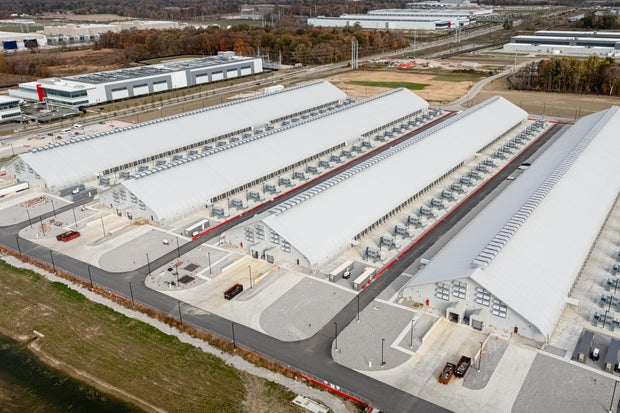
"It's kind of a chicken-and-egg problem," said Fengqi You, one of the study's authors, in a statement. "Because if you're going to build a data center, you need to expand this power infrastructure. Otherwise, there's no electricity for them to run. But before they build, they're not using energy."
Residents of rural and lower-income areas saw their bills skyrocket, and in some cases faced increases in energy costs that were 76% larger than residents of urban communities, according to the study. The researchers said that despite the concentration of data centers near metropolitan hubs, the financial loads they trigger often seep into surrounding suburban and rural areas because of policies that govern how energy costs are shared across regions. They argued that such policies warrant review.
Researchers also pointed to what they called a "paradoxical mismatch" in states that saw the greatest increases in energy prices linked to data centers, and those that reported using AI technology. According to the study, states that faced the largest cost increases, like West Virginia and Ohio, also reported the lowest uses of generative AI compared with other states around the country.
The study also found instances where states saw price increases linked to AI data centers located geographically far from them, essentially paying for infrastructure "they neither contribute to nor benefit from," researchers said. Residents in New Jersey and Pennsylvania helped pay for power grid updates tied to data center growth in Virginia, for example.
"You do not have to live next to a data center to help pay for its power infrastructure," You said in a statement. "The grid connects communities across states, and cost-sharing rules connect them financially."
Researchers suggested that data centers cut back on their energy use during their region's peak demand hours or pay states directly for the new energy demand they add to a given power grid. Since regulating data centers was a huge focus of November's midterm elections, You said his team hoped their findings could help lawmakers decide what to do next.
"This is an issue that connects directly to debates in many states and in Congress," said You. "We want to provide science-based evidence and concrete data so that all the stakeholders can better understand the picture and weigh their options."
KioskNews shows a cleaned-up reading view extracted from the publisher’s page — the original always lives on their site, not ours.