Alan Cumming’s boyish charm brings out the spiky streak in a joyfully spirited My Fair Lady

When Mrs Higgins remarks that her son Henry, a professor of phonetics, and his companion Col Pickering are “a couple of babies playing with [their] live doll,” you know exactly what she means. Played by Julie Legrand – an amusing mixture of the haughty and perceptive – she has seen right through them. Not so much Pickering who, in the hands of Martin Ball, is the bluff, avuncular figure you expect. But as Henry Higgins, Alan Cumming is disarmingly playful.
With an eccentric riot of grey hair, John Lennon glasses and a single button clasping his cardigan, he slips behind the Covent Garden columns of Tim Hatley’s set like a naughty toddler trying to make himself disappear. He emerges with a flash of teeth and a boyish giggle. You would think such frivolity would diminish his authoritarian streak, but it only makes it more sinister.
When he berates Eliza Doolittle, the cockney flower girl he has plucked like an exotic specimen from what he regards as the gutter, he goes from quirky to callous. Is it a blinkered upper-class upbringing that leads to his calling her “this baggage” or something more sinister? Cumming sings I’m an Ordinary Man with a Jekyll and Hyde mix of tenderness and vitriol.
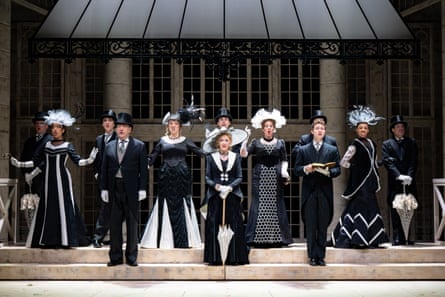
Streetwise Eliza can give as good as she gets and, played by a delightful Verity Power, she ranges, vocally and emotionally, from the gutsy to the dulcet. She will be nobody’s doll.
As a threesome, she, Higgins and Pickering make an uneasy alliance. As ever, that makes the ending more ambivalent than happy, especially with Eliza’s cautious relationship with her young suitor Freddy (Alex James-Hatton). We can thank George Bernard Shaw for such knottiness. Filtered by Alan Jay Lerner and Frederick Loewe, his original play makes Eliza’s Cinderella transition across the class divide contentious at every turn. The story needles the audience’s prejudices as much as it does those of the men who think they can fashion her to their liking.
The songs, of course, are sumptuous and are gloriously sung to Ben Kubiak’s offstage band, playing with chocolatey warmth. Especially good are the ensemble numbers, robustly choreographed by Ashley Nottingham and joyfully performed. Briskly directed by Maria Friedman, it makes for a spirited and spiky evening.
Year-end fundraiser
$0 of $2,000,000 goal
A moment full of possibility – and risk
We hope you appreciated this article. Before you close this tab, can we ask you to spare 37 seconds to sustain the Guardian’s fearless journalism in the decisive year ahead?
In the last two years alone, Donald Trump has eroded many of the pillars of US democracy – slashing funds for universities, undermining science, shutting down arts institutions, and attacking the free press as an “enemy of the American people” and “a threat to our national security”. While he and his allies have enriched themselves and spread lies, federal forces have harassed and imprisoned innocent people and violated the constitutional rights of many Americans.
Now, in a sweeping change election, the American people have spoken: Donald Trump, Pete Hegseth, RFK Jr, Elon Musk and the tech oligarchs may finally be held to account. A majority of American voters have demanded an end to the costly and immoral wars, the flagrant profiteering, and the corrosive attacks on communities and democratic institutions.
It’s a moment full of possibility, with more stories than we can possibly cover. New leaders are emerging from Texas and Michigan to Iowa and South Carolina – and heading to Washington to fight for affordability, against wealth inequality, and for human survival in the face of AI and the climate crisis.
These new leaders will be facing a cornered Trump and his hardline chief of staff, Stephen Miller, who have nothing left to lose. The next few years are critical for the future of the country. Journalism that covers the epic clash between these forces has a vital role to play right now.
Investigative journalism provides a fact-based paper trail for an emboldened Congress to follow. Members of Congress – and the American public – often rely on our in-depth reporting to inform the tough questions, to connect the dots and to pursue accountability for wrongdoing.
At the Guardian, our newsroom is devoted to uncovering the truth and conveying it to as many people as possible. We’re not alone in this mission, but this kind of journalism faces unprecedented hurdles: big tech threatening our financial stability and stealing our work for AI, billionaire owners telling journalists what to publish, and a hostile executive branch intent on suppressing our reporting.
The Guardian is free to dig deep without fear because we’re funded by our readers. Our readers hold us to account, and we hold the powerful to account.
However, this only works when enough of our readers contribute. Against the advice of most industry analysts, we’ve refused to put up a paywall – we believe good journalism should be freely available to all people, regardless of ability to pay. If you’re counting on our reporting, and you can’t afford to pay, please stop reading this message and go back to our articles.
If you can afford to contribute, please know that your support is not only helping yourself – from voters in Kansas to immigrants in Minnesota and families in Gaza, your generosity is bringing factual news to people around the globe.
Today is among our most important fundraising days of the year. To sustain our unique financial model, our goal is to raise $2,000,000 before the new Congress is seated on 3 January. More than 19,000 people have contributed already. If you can afford 37 seconds, please join our ranks – and show your support for the rekindling of democracy in the US and around the world.
KioskNews shows a cleaned-up reading view extracted from the publisher’s page — the original always lives on their site, not ours.