Netanyahu's Chagall hall speech: Eisenkot, unity, and racism allegations - opinion
I must admit that I expected all sorts of embarrassing moments during the swearing-in ceremony in the Knesset plenum last Tuesday, similar to the sort we were fed by the Netanyahu-led opposition in the 24th Knesset, during the government of change's term.
To my great surprise, the opening plenary sitting of the 26th Knesset went by relatively smoothly.
There was some heckling, for example, when all the Arab MK’s, except for Ra’am leader Mansour Abbas, walked out of the plenum when the national anthem was sung.
But there were also some uplifting moments, such as when the new MK Elisha Medan (Likud), who lost both his legs in the war in the Gaza Strip, received a standing ovation as he stood up on his two prostheses during his declaration of allegiance.
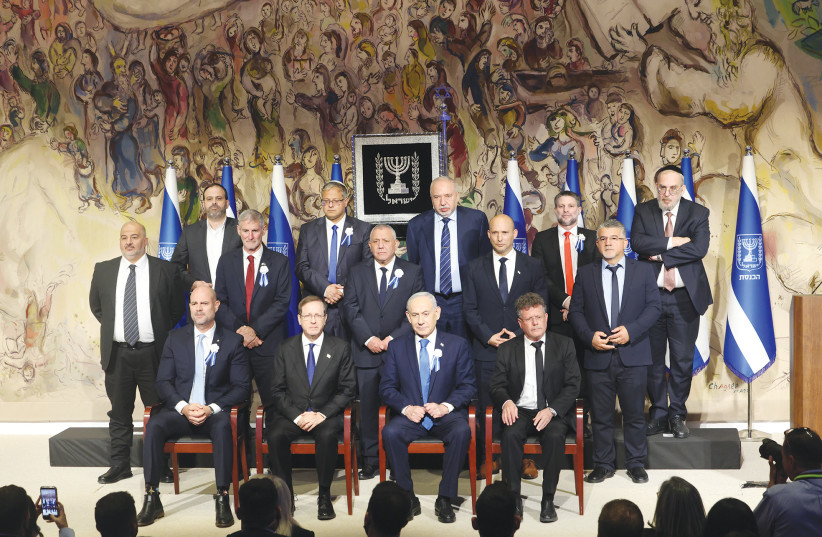
I was preparing to switch off my TV as most of the MK’s of the 26th Knesset sat down in the Chagall Hall for the traditional raising of toasts, usually followed by a brief speech by the prime minister, and finally the official photograph of all the new parliamentary group leaders and the state’s top position holders: the president of the state, the Knesset speaker, the prime minister, and the president of the Supreme Court.
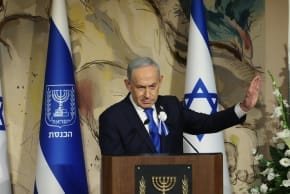
However, as I noticed Prime Minister Benjamin Netanyahu walking briskly over to the podium after the toasts were over, with a face that expressed something other than the serenity of a ceremonial speech, I decided to change my plans and listen. Twenty-one minutes later, I was as dumbfounded as many others were.
Netanyahu started by calling for a national unity government, which is what he has been calling for since the elections, even though no one really believes he has a true unity government in mind.
Within minutes, he moved on to accusing Yashar leader Gadi Eisenkot, who had been assigned by President Isaac Herzog the task of trying to form a new government two days earlier, of seeking to form a government based on the support of the 19 members of the two Arab parliamentary groups – Ra’am and the United List.
Netanyahu went on to accuse these MKs of supporting terrorism against Israel and sharing the goal of eventually destroying Israel as a Jewish state.
He then moved on to accusing the leaders of the Arab parties of receiving vast sums of money from unnamed foreign sources to distort the election results.
So far, no concrete evidence has been revealed that proves these allegations to be true, though this did not stop Netanyahu from speaking of them as concrete facts, which the attorney-general is trying to refute.
The only party leader who got up and left the Chagall Hall in protest was Yair Golan, leader of the Democrats, who returned only after the speech ended, for the official photograph.
Another opposition leader, Naftali Bennett, started shouting back at Netanyahu, asking him, “What about a State Investigation Commission for October 7? Why don’t you declare Qatar an enemy state? What about your Qatari advisors?”
Later on, Eisenkot canceled a meeting that was supposed to take place the following day with Likud representatives.
The final reckoning
There is no doubt that what Netanyahu said in his speech about the Arab MKs and their parties may be considered manifestations of racism, as the term is defined in articles 144a – 144e of the Israeli Criminal Code.
The incitement to racism, if proven, can lead to a two-year prison sentence, though Netanyahu was careful to speak derogatorily only of the Arab politicians, and not the Arab voters – i.e., Israel’s Arab citizens in general.
In fact, it might be argued that Netanyahu is not necessarily a racist, but rather an opportunist who makes use of racist arguments when it serves his purpose.
Last Friday, three days after the swearing-in ceremony on Channel 12’s Ofira, Ohana, Seri show, MK Ahmed Tibi, head of Ta’al, within the United List, revealed text messages he had received from Netanyahu’s confidant, Natan Eshel, several days before the recent elections and immediately after the election results were published, which dealt with various cooperation options.
So why did Netanyahu speak as he did last Tuesday? Supposedly, because if Eisenkot does not have the option of forming a minority government with the support of all 19 MKs from the Arab parliamentary groups, his chances of forming any government will be greatly reduced.
Theoretically, he would still have the option to form a government with the two haredi (ultra-Orthodox) parties, but Netanyahu is pressuring United Torah Judaism to avoid reaching an agreement with Eisenkot.
If he succeeds, Shas may also avoid reaching an agreement with Eisenkot.
Finally, should the Likud and its partners manage to prove that there was decisive foreign intervention in the Israeli elections with which the Arab parties collaborated, and which significantly changed the election results to the benefit of the Arab lists (as Netanyahu insinuated in his speech), there is a chance that the election results will be automatically canceled, and new elections called.
In the final reckoning, Netanyahu’s main goal appears to be a new round of elections, in which he hopes to improve the performance of the Likud and all its “natural” partners. Getting the results of the October 27 elections canceled because of proven fraud is the simplest way to get new elections – that is, if a serious investigation of the allegations actually proves that fraud took place.
None of this justifies anything Netanyahu said in his inciteful speech. Even if his motivation was not racist incitement per se, it certainly served to encourage virulent public manifestations of anti-Arab racism, which is rampant in any case these days. Since Netanyahu’s speech, the number of incidents of this sort on all TV channels appears to have grown in number and intensity.
Though it is said that Netanyahu’s speech has actually increased the determination of the Arab parties to support a minority government led by Eisenkot, since it will send Netanyahu to the opposition benches and be difficult to bring down (only a majority of at least 61 MKs can topple a minority government), the negative effect it is having on the legitimization of manifestations of Jewish anti-Arab racism is unwelcome.
The writer has written journalistic and academic articles, as well as several books, on international relations, Zionism, Israeli politics, and parliamentarism. From 1994 to 2010, she worked at the Knesset Library and the Knesset Research and Information Center.
KioskNews shows a cleaned-up reading view extracted from the publisher’s page — the original always lives on their site, not ours.