Thirty years on from their maiden World Cup, the Springboks are a team for all South Africans
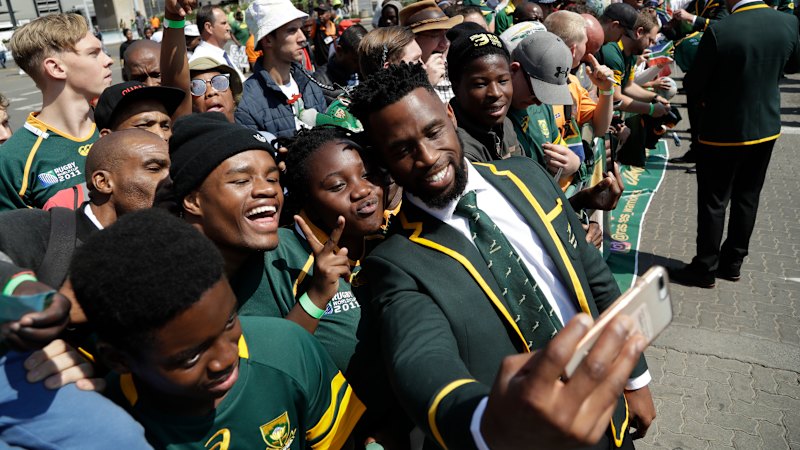
The Springboks’ bench named to face the Wallabies in Perth on Sunday night is largely defined by its ability to change a game at will.
It has eight world-class players who have the potential to dominate fatigued opponents with both speed and strength. Those players also tell the story of the modern South Africa they represent.
Back-rower Jasper Wiese grew up on a remote Northern Cape farm, his junior school too small to field a rugby team. Prop Ox Nche was born in the Free State town of Thaba ’Nchu, where organised sport was a luxury few could access.
Playmaker Sacha Feinberg-Mngomezulu was born in Cape Town to Nick Feinberg, the son of a white anti-apartheid campaigner, and Makhosazana Mngomezulu, a lawyer of Zulu descent.
Every player who represents the Springboks carries the legacy of the 1995 World Cup final win. That victory gave a glimpse into what was possible for South Africa as a society, but also highlighted the huge amount of work still to do in a country that had recently emerged from the horrors of apartheid.
Morne Du Plessis is one of South African rugby’s greatest captains, leading the Springboks to 13 wins in 15 Tests from 1975 to 1980. But one of his greatest achievements was as team manager for the 1995 champions.
He was able to see both sides of South African rugby – the one that was closed to the majority of the country and the one that started to open up.
“Before ’95, we were deeply divided [as a country]; a minority of people would support the Springboks in those years that I played, and let’s be frank about that,” Du Plessis said.
“And the World Cup win of ’95, I’d like to believe, was a catalyst for change. Mandela, himself agreeing to continue with the Springbok emblem and the Springbok jersey, was pivotal as well.
“Mandela had the foresight that rugby, being what it was and where it came from, could be a catalyst in pulling people together.”
The South Africa side that beat New Zealand in the 1995 final contained only one non-white player: the late Chester Williams, who started on the left wing.
Du Plessis knew more work needed to be done before the Springboks would be embraced by the entire nation. He has watched as the momentum lost after 1995 was regained with the emergence of coach Rassie Erasmus, his captain Siya Kolisi and an all-conquering team.
“I played in the apartheid days, and I was the manager in ’95, so I saw both sides. I was privileged to see the new dawn, as it were,” Du Plessis said.
“From then on, it lost a little bit of momentum because there weren’t standout opportunities again like that. But then came Rassie and Siya, and they’ve taken that unifying ability of rugby to another level. Absolutely another level.”
Erasmus grew up in the working-class Eastern Cape town of Despatch, completing his compulsory military service in 1991. That same year, Kolisi was born in the Port Elizabeth township of Zwide. They came from entirely different worlds, but in 2018 Erasmus named Kolisi as the first black captain of the Springboks, a move that helped the team attract widespread support.
Many black players selected in the Test after 1995 were unfairly scrutinised, in some cases being made to feel unwelcome. But the appointment of Kolisi as captain by Erasmus, a former Afrikaner Springbok, carried huge weight and opened the eyes of many non-white South Africans to possibilities in the game they hadn’t previously imagined.
“For many years, transformation – meaning giving everybody a fair chance of coming through the system and making it to the top – was seen by many people, whether they’d admit it or not, as a sort of punishment, a payback, something we have to go through for a while,” rugby commentator John Robbie said.
“There was this dreadful phrase of ‘quota players’, where you had guys who many from the white community [in South Africa] said were not good enough and the [non-white] players themselves would say, ‘no one takes us seriously.’
“That doesn’t happen any more ... what Rassie has done is seen beyond that prism of biases. He’s seen this massive number of people, the potential in a community that never got the chance before. And the answer is what we see on the field.”
If you drive through South Africa, you get an idea of the power of the Springboks and how the whole country embraces them as a team. Winning two World Cups in a row, of course, helps, but representation helps the support to endure. In the townships, the suburbs, the city centres and throughout farmland, you see Springbok jerseys.
Bob Skinstad played 42 times for South Africa and was part of the 2007 World Cup-winning squad. He made his Test debut in 1997 and competed directly with Erasmus as a player, before watching him take the team to World Cup wins in 2019 and 2023.
Skinstad sees the impact of Kolisi’s leadership of the Springboks within his own family; the back-rower has become a hero to the nation.
“My young 12-year-old son doesn’t want to be Bob Skinstad, he wants to be Siya Kolisi and many years ago that wouldn’t have been true, because there would have been a racial divide between what children wanted to be,” Skinstad said.
“If you look at the transformation of the team, they represent all corners of South Africa. It’s been something that everybody’s been able to get behind, and something that South Africans are really proud of.”
Skinstad’s work as a business consultant and an investor in Beziers rugby club in France takes him all over the world.
He witnessed the huge crowds that followed the Springboks to watch them defeat New Zealand in Baltimore recently. On Sunday, thousands more South Africans will gather in Perth to cheer on a team that gives them an impenetrable link to their home country.
“We feel very privileged that we’ve got a number of quality individuals who are willing to represent South Africa and go out there and put their bodies on the line for what is essentially a cause that’s bigger than themselves. It’s a cause for the country. It’s not just a cause for the team,” Skinstad said.
“Wherever you are around the world, that national team means much more than just the results on the field. It means a link back to your home country and probably the place of your birth, and family and friends, and a whole bunch of other emotional ties.”
South Africa’s problems will never be solved entirely by a unified rugby team. This month, the bodies of nine women were found in South Africa’s Ekurhuleni municipality, forcing Kolisi to post on Instagram ahead of the Wallabies Test, stating, “violence against women is an everyday reality in our country, and we cannot keep leaving women to carry this fight alone. I don’t have all the answers. But silence is not an option. Awareness is not enough. We need action.”
No other Test rugby captain carries such responsibility to not only lead a team on the field, but also a country off it.
Crime, violence, governance issues and unemployment remain realities for many in South Africa, but the world champion Springboks provide a glimpse of what is possible when all strands of its 64 million population, with 12 official languages and diverse cultures, combine.
KioskNews shows a cleaned-up reading view extracted from the publisher’s page — the original always lives on their site, not ours.