TAIEX slumps 3.41 percent to four-week low
TECH STRAIN: TSMC and other major companies came under pressure as foreign investors pull back from chip and hardware stocks, an analyst said
By Crystal Hsu / Staff reporter


Stocks in Taiwan slumped to a four-week low yesterday as hotter-than-expected US inflation rekindled concerns over interest rates and a global sell-off in technology shares intensified.
The benchmark TAIEX fell 1,655.96 points, or 3.41 percent, to close at 46,969.87, on turnover of NT$1.319 trillion (US$40.9 billion), Taiwan Stock Exchange (TWSE) data showed.
Foreign investors led the sell-off with net sales of NT$302.56 billion, while proprietary dealers sold a net NT$95.82 billion, largely through hedging transactions.
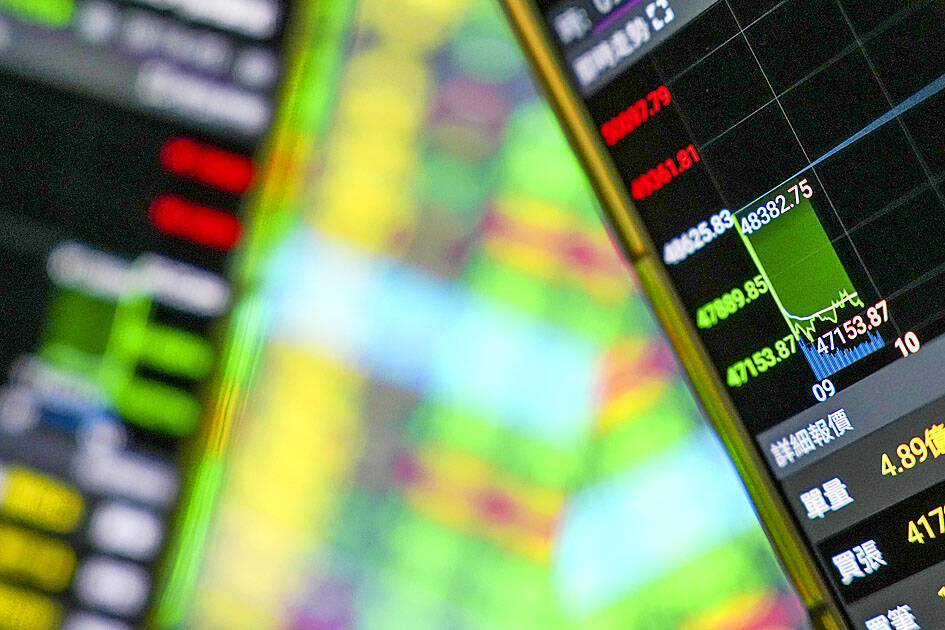
A smartphone displays the TAIEX’s movement at a brokerage firm in Taipei yesterday.
Photo: CNA
Investment trusts were the only net buyers, purchasing NT$28.3 billion of shares, TWSE data showed.
The decline came after US consumer prices rose 3.7 percent year-on-year last month, exceeding economists’ 3.6 percent forecast and raising concerns that the US Federal Reserve might raise interest rate again later this month or in December, putting further pressure on technology shares, whose valuations are sensitive to borrowing costs.
US technology stocks fell on Wall Street overnight, extending a decline in semiconductor shares to a sixth consecutive session. The sell-off spread across Asian markets yesterday, with South Korea’s KOSPI plunging 7.57 percent and Japan’s Nikkei 225 falling 4.9 percent.
The Fed is due to review its monetary policy on Oct. 27 and 28.
Taiwan’s market was particularly vulnerable to the downturn because of its heavy reliance on technology stocks. The electronics sector came under pressure, with major companies including Taiwan Semiconductor Manufacturing Co (TSMC, 台積電), MediaTek Inc (聯發科), Nanya Technology Corp (南亞科) and Delta Electronics Inc (台達電) among the hardest hit.
Cheng-tung Security Investment Consultant Co (承通證券) analyst Cheng Lung (陳龍) attributed the sell-off across Asia largely to foreign investors pulling back from semiconductor and hardware stocks.
“Investors are more concerned about the sustainability of artificial intelligence [AI] spending, as rising financing costs heighten the risks of a recession,” he said, advising against drawing direct comparisons between Taiwan and South Korea, which have different industrial structures.
Memory makers might be posting strong profits, but competition from Chinese rivals could erode their edge, Chen said.
Young Cheng Asset Management Co (永誠國際資產) analyst William Chen (陳威良) urged investors to stay calm amid market volatility, advising them to focus on the fundamentals of AI-related stocks and avoid making hasty decisions.
Concerns have mounted following Broadcom Inc CEO Hock Tan’s (陳福陽) warning that many AI investors do not understand what they are buying, comparing their behavior to casino gambling.
The sell-off in technology stocks intensified, as bond yields at US AI cloud provider CoreWeave Inc surged past 15 percent overnight, fueling unease over the financing risks of the AI boom.
KioskNews shows a cleaned-up reading view extracted from the publisher’s page — the original always lives on their site, not ours.