GLP-1 weight-loss drugs can cause blindness in rare cases, FDA warns
By Jonathan Chin / Staff writer, with CNA


Taiwan is weighing its first-ever compensation claim over vision loss allegedly tied to prescription semaglutide, health officials said yesterday, two days after the US issued a warning about the increased “eye stroke” risks from the drug.
On Monday, US regulators ordered makers of glucagon-like peptide-1 (GLP-1) drugs — commonly known as weight-loss shots — to add information about increased risk of non-arteritic anterior ischemic optic neuropathy (NAION) to warning labels.
This condition, also known as eye stroke, is a rare disorder of the eye that can lead to blindness.
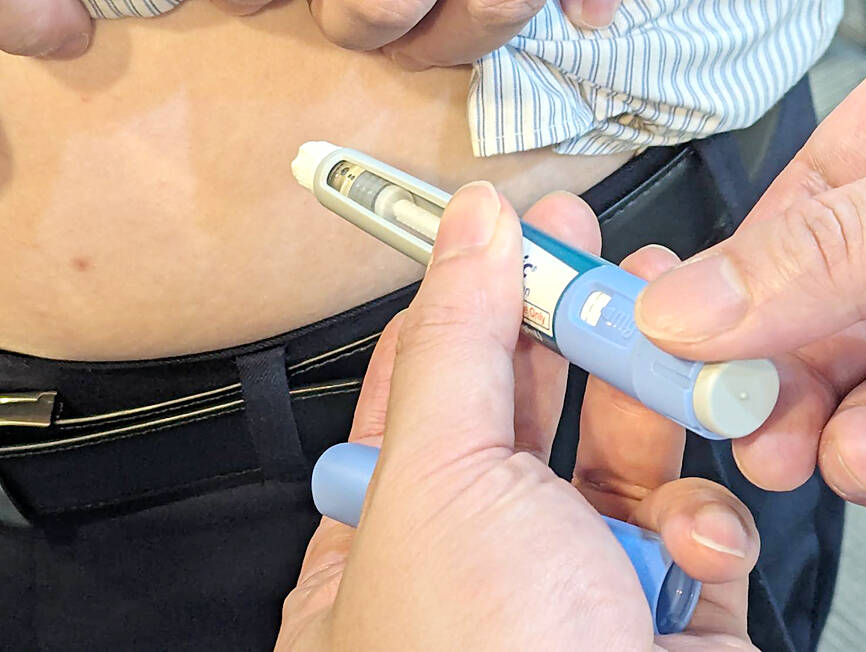
A doctor administers a GLP-1 shot on Dec. 26, 2024.
Photo: Wu Liang-yi, Taipei Time
GLP-1 drugs include Ozempic and its generic counterpart, semaglutide.
Pulmonologist and social media influencer Su Yi-fong (蘇一峰) told local media that one of his patients experienced blindness in one eye and partial blindness in the other after using Ozempic for weight loss.
He has filed medical injury compensation claims for the patient but received an “accusatory” letter from the government asking him about the reason for the patient’s GLP-1 prescription and its dosage, Su said.
The person was extremely unlucky, as the chances of eye stroke for people using prescription GLP-1 are about 1.5 in 10,000 and the medical drug has obtained government approval, he added.
In response, Food and Drug Administration’s (FDA) Medicinal Product Division head Lin Yi-chu (林意筑) told reporters that the agency is dealing with the case.
The Taiwan Drug Relief Foundation in March picked up the claim, which became a government case in the following month, Lin said, adding that the agency is waiting for the applicant to provide additional information.
Medical injury compensation is government relief generally awarded to people who sustained a serious injury from taking a prescription drug for an approved use, she said.
The applicant said that they were taking Ozempic as part of obesity treatment, but the drug was approved only for treating type II diabetes in Taiwan, Lin said.
This meant the agency needs to know the circumstances surrounding the affected person’s use of the medical drug, including its purpose and amount prescribed, before determining their eligibility for relief, she said.
The National Adverse Drug Reaction Reporting System has received 314 cases linked to semaglutide, including 12 cases that involved eye disorders, as of Thursday last week, Lin said.
So far, Su’s patient is the only case in which the GLP-1 user provided clear documentation proving that they had NAION, Lin added.
KioskNews shows a cleaned-up reading view extracted from the publisher’s page — the original always lives on their site, not ours.