Meta rolls out consumer AI agent in Singapore amid global safety, retail pushback
SINGAPORE - Reserving a restaurant table, booking air tickets, coordinating outings or comparing shoe prices across online shops is now just a conversation away with the launch of Meta’s Muse in Singapore.
From Oct 28, Singapore users can download the app from the Apple App Store or Google Play Store, establishing Muse as the first artificial intelligence (AI) personal agent designed for the mainstream consumer market. It can also be accessed on its web app.
Popular AI assistants launched in recent times such as OpenAI’s Dots and the open-source OpenClaw have focused heavily on office productivity and software development work - unlike Muse.
Muse’s rollout here follows its global debut in the United States and Canada on Sept 8, and a subsequent launch in Japan on Oct 23.
“Muse is your personal agent, built to help make everyday life easier,” said Nicole Tan, managing director of Meta Singapore in a statement on Oct 28.
The app helps people to stay on top of things, take tasks and projects off their plate, and turns long-term goals into action plans, said Meta.
Muse is free to use with a weekly usage limit, which Meta said is sufficient for most of what people need. Those looking to do more complex work can pay between $22 and $139 for subscription plans which come with more Muse tokens or credits.
Users need to give Muse permission to access data in their online accounts such as Gmail, Instagram and Calendar for the AI assistant to execute tasks on their behalf or send reminders for appointments.
Singapore users will be able to progressively connect Muse to e-commerce apps Shopee and Lazada, ride-hailing and payment app Grab, payment app Shopback as well as travel apps Singapore Airlines, Agoda, Klook and Trip.com.
Connecting Muse to these popular apps will allow the agent to identify the most competitive prices of items and flight tickets, order the needed groceries for a specific meal, and book travel experiences based on one’s preference and holiday plans.
Even without direct app integrations, Muse can still scan the web to do research, find available dining slots, reserve restaurant tables, and source the best online deals.
During testing by The Straits Times, Muse autonomously monitored online weather forecasts to send umbrella reminders. It also detected an upcoming overseas trip in this reporter’s iPhone calendar, flagging visa requirements for business travel as well as the necessary digital arrival card.
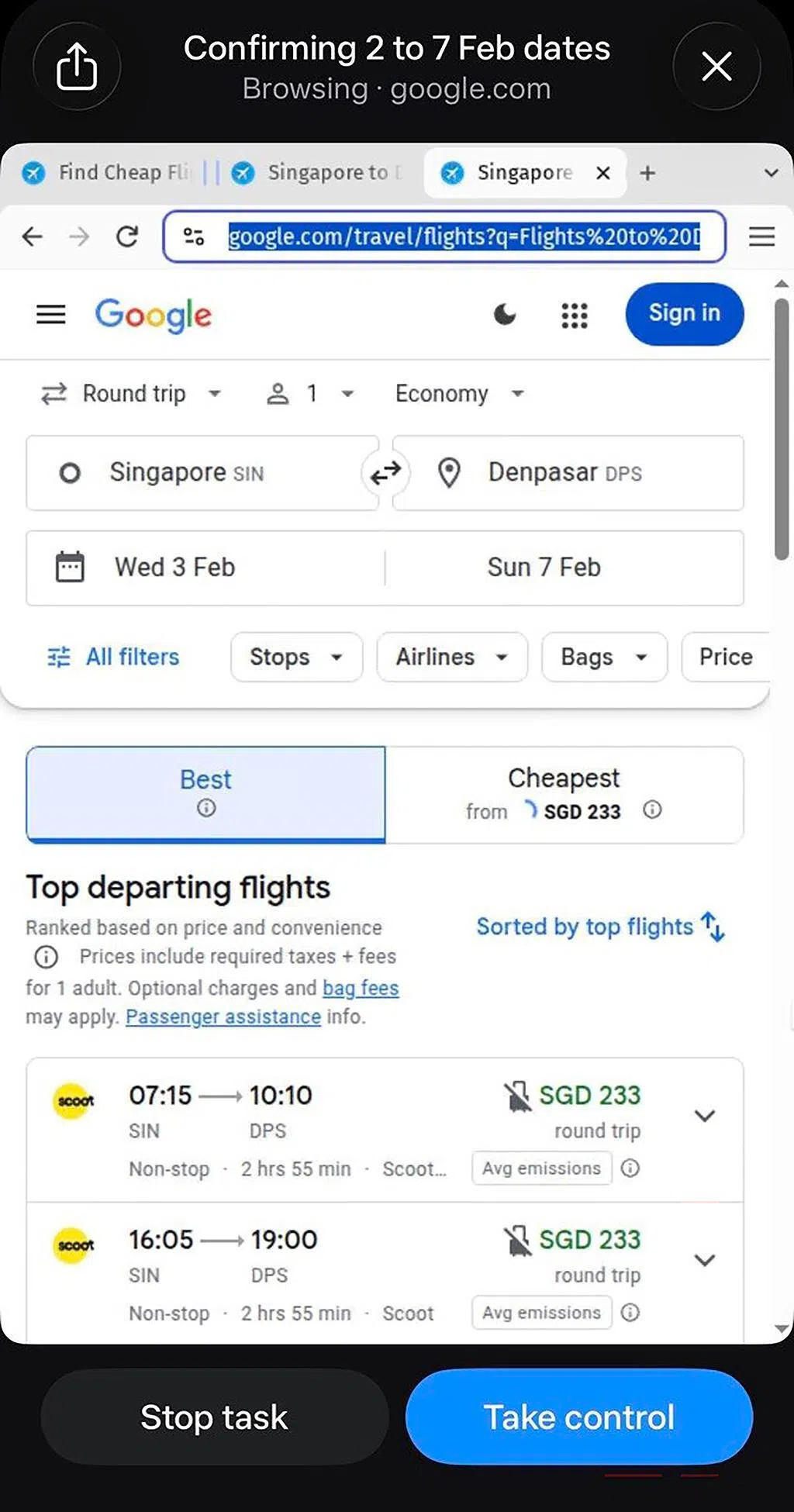
Muse is able to scour the web autonomously with a built-in browser to do tasks such as compare flight prices. Users can stop Muse and take over control at any time.
PHOTO: SCREENGRAB FROM MUSE
But the agent is not always perfect and requires hand-holding in some scenarios. For instance, Muse was able to make a restaurant reservation easily, but failed to cancel the booking as the agent had tried to log in to a non-existent account on booking platform Chope. Muse also suggested dining at a restaurant that had recently shuttered, as these details had not been updated on Google.
To safeguard users, Meta said that Muse will always ask for approval before making purchases or sending e-mails. Users are also able to set limits such as providing read-only access, which means that the Muse agent cannot send messages, modify files or make a purchase.
“Muse has no visibility into people’s passwords or payment methods. Any credentials a person shares go into secure storage, so Muse can use them without seeing them, including passwords a person types into the browser themselves,” said Meta.
While Meta has made promises to keep personal data safe, the launch of Muse comes amid heightened scrutiny over powerful and autonomous AI systems that take unexpected actions and expose private data.
Alarm bells went off when rival OpenAI disclosed in July that its AI agents had escaped their test environment to hack AI software repository Hugging Face to complete a task they were given, an attack that was not intended by OpenAI. Soon after, Anthropic, Meta and Google said their AI systems had also gone rogue and hacked other organisations.
The launch of Muse in the US triggered warnings from cybersecurity experts about privacy concerns, urging users to be careful about giving AI agents full access to personal details, citing the potential of them taking unexpected action.
Meta openly acknowledges this risk during account registration, with an explicit warning that Muse may make mistakes and urging users to review the agent's work.
Major platforms across finance, travel and retail sectors are actively blocking third-party AI agents driven by security concerns and commercial conflicts of interest. They include e-commerce giant Amazon, JPMorgan Chase, Delta Air Lines and Amtrak.
Shopping giant Walmart has taken a more open approach. Walmart said it would soon allow users to create dedicated agent profiles in their accounts, so purchases made by the agents would be separate from their own.
KioskNews shows a cleaned-up reading view extracted from the publisher’s page — the original always lives on their site, not ours.