ANALYSIS: US candidates against data centers win big
PIVOTAL ISSUE: Democratic candidates opposing data centers sundered previously formidable Republican bastions such as Texas and Georgia, a wake-up for the industry
Opponents of data centers were among the biggest winners of the Democrats’ landslide wins in the US midterm elections, pointing to a shifting public mood on artificial intelligence (AI) and a possible slowdown of the boom that has propelled US economic growth and stock markets, investors said.
The size and breadth of the Democratic wins were still coming into focus. But in elections for the governorship in Texas and Georgia, Democrats who campaigned in part on a moratorium on data center development won offices that the party had not held for decades.
Their victories lend political heft to the backlash against the projects, which are at the heart of the AI boom, but are loud, thirsty for water, hungry for electricity and deeply unpopular with their neighbors, investors said.
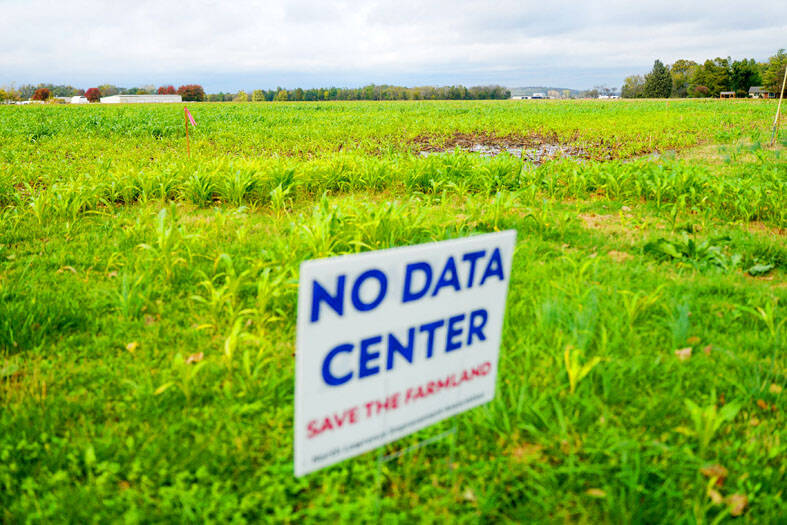
A sign protests the construction of a data center in Leavenworth County, Kansas, on Tuesday.
Photo: Reuters
Investors said the results are likely to usher in tougher regulation and could ripple across financial markets where AI stocks were falling yesterday; big bets have already started to wobble due to concerns about spending and overcapacity.
“In our view, the significance of these midterm elections is more like a referendum on AI than a referendum on [US President Donald] Trump,” Amundi Investment Institute senior investment strategist Aidan Yao (姚遠) said. “If the AI theme is subject to some restrictions, then the US economy, US inflation and US monetary policy all become very, very uncertain.”
The most stunning ballot box upset was in Texas, which GLJ Research LLC estimated accounts for about a quarter of US data-center capacity due to come online by 2030.
Democrat Gina Hinojosa ousted Greg Abbott as governor in an upset that ended three decades of Republican hold on the office, while fellow party member James Talarico became the senator-elect.
A conservative, oil-rich state, Texas has worked for years to reinvent itself as a tech hub, attracting companies such as SpaceX and oligarchs such as Elon Musk, who gave more than US$150 million to the Republican campaign.
However, even Republicans turned against data centers, which opponents say drive up utility bills, pollute the night sky with lights and do not create sufficient jobs or taxes to justify the incentives that states pay.
In Georgia, where commercial real-estate services and investment firm CBRE Group Inc says Atlanta is the most active data-center construction market in the country, Democrat Keisha Lance Bottoms was elected governor, ending more than two decades of Republican control.
AI has been a major theme this year in the financial markets, driving stocks higher due to bets on chip demand while pushing up bond yields, as the data center construction boom boosts economic growth.
Chip and AI firms such as Taiwan Semiconductor Manufacturing Co (TSMC, 台積電), Samsung Electronics Co, SK Hynix Inc and Kioxia Holdings Corp fell in Asia — along with bond yields — yesterday.
“The Democrats will likely push for greater regulation,” Vantage Point Asset Management Pte Ltd chief investment officer Nick Ferres said.
“The two key risks ... have been the return on investment and the financing of the boom. Both have likely become more challenging now,” he said.
Many analysts said a slowdown in the building of data centers in the US did not necessarily herald a change in demand for AI or computing power, and some view a roughly 8 percent drawdown in the NASDAQ over the past month as an opportunity to buy.
Ilan Benhamou on JPMorgan’s equity sales desk in New York said the Texas race was “the only thing that matters” in a pre-election note to clients, and investors are taking it as a wake-up call.
“Companies do have to have the social license to operate, and I think the current AI providers really have a PR crisis right now on their hands,” TCW Group Inc chief executive officer Katie Koch said at a Hong Kong financial summit. “They need to define what the social utility is going to be of AI and data centers to Americans, and so far they’ve been failing to do that.”
KioskNews shows a cleaned-up reading view extracted from the publisher’s page — the original always lives on their site, not ours.