Real wage growth in Taiwan hits an 11-year high
By Crystal Hsu / Staff reporter


Real wage growth in Taiwan reached an 11-year high in the first eight months of this year as robust exports supported earnings gains and inflation remained relatively moderate, helping improve purchasing power despite wide differences across industries, the Directorate-General of Budget, Accounting and Statistics (DGBAS) said yesterday.
The average regular monthly wage rose 3.28 percent from a year earlier to NT$52,523 in August, while the total monthly wage — including bonuses, overtime pay and other compensation — climbed 6.64 percent to NT$69,520 on average, the agency said.
DGBAS Census Department Deputy Director Tan Wen-ling (譚文玲) attributed the gains to robust export growth, saying employment, regular wages and total earnings had all increased from a year earlier.
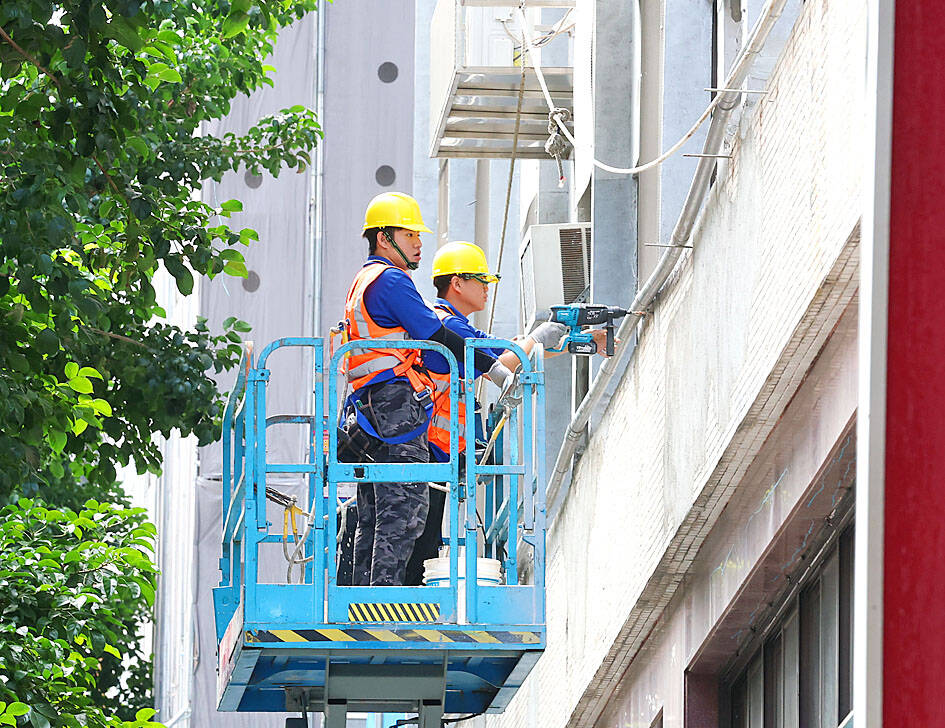
Two men work on a building in Taipei’s Zhongshan District yesterday.
Photo: CNA
Overtime hours also continued to rise, she said.
“Wage increases and bonus payments, coupled with moderate inflation and government efforts to stabilize prices, have helped wages outpace consumer prices and support workers’ purchasing power,” Tan said.
However, the gap between average and median wages suggests that typical workers earn considerably less than the overall average.
The median regular monthly wage, a statistic that is less affected by outliers, rose 3.46 percent year-on-year to NT$41,353 in August, notably lower than the average wage of NT$52,523, DGBAS data showed.
Over the first eight months of the year, the median regular monthly wage increased 3.06 percent to NT$39,383, while the average regular monthly wage rose 2.94 percent to NT$49,110 and the total monthly wage increased 4.55 percent to NT$549,200.
After adjusting for inflation, the increase was 1.2 percent for the median regular monthly wage, 1.08 percent for the average regular monthly wage and 2.66 percent for the total monthly wage, which was an 11-year high, the agency said.
Wage growth also varied considerably by industry. Financial and insurance services recorded the strongest increase among major industries in the first eight months, with average regular monthly wages rising 5.85 percent from a year earlier to NT$75,313, the data showed.
Wholesale and retail trade wages increased 3.52 percent to NT$50,414 on average, while manufacturing wages rose 3.47 percent to NT$51,661 on average, it said.
Accommodation and food services recorded the weakest growth, with the average regular monthly wage rising just 0.4 percent to NT$38,871, underscoring the uneven distribution of wage gains across industries, the data showed.
Average working hours totaled 172.9 in August, up 0.5 hours from a year earlier, while average overtime hours increased by 0.1 hours to 8.9, reflecting sustained demand for labor amid strong demand for artificial intelligence hardware, the DGBAS said.
KioskNews shows a cleaned-up reading view extracted from the publisher’s page — the original always lives on their site, not ours.