Resource security key as global economy faces uncertainty: Finance minister
The remarks assume significance amid global economic uncertainties triggered by US tariffs and conflicts in Ukraine and West Asia, which have disrupted global supply chains and resulted in higher prices of key commodities.
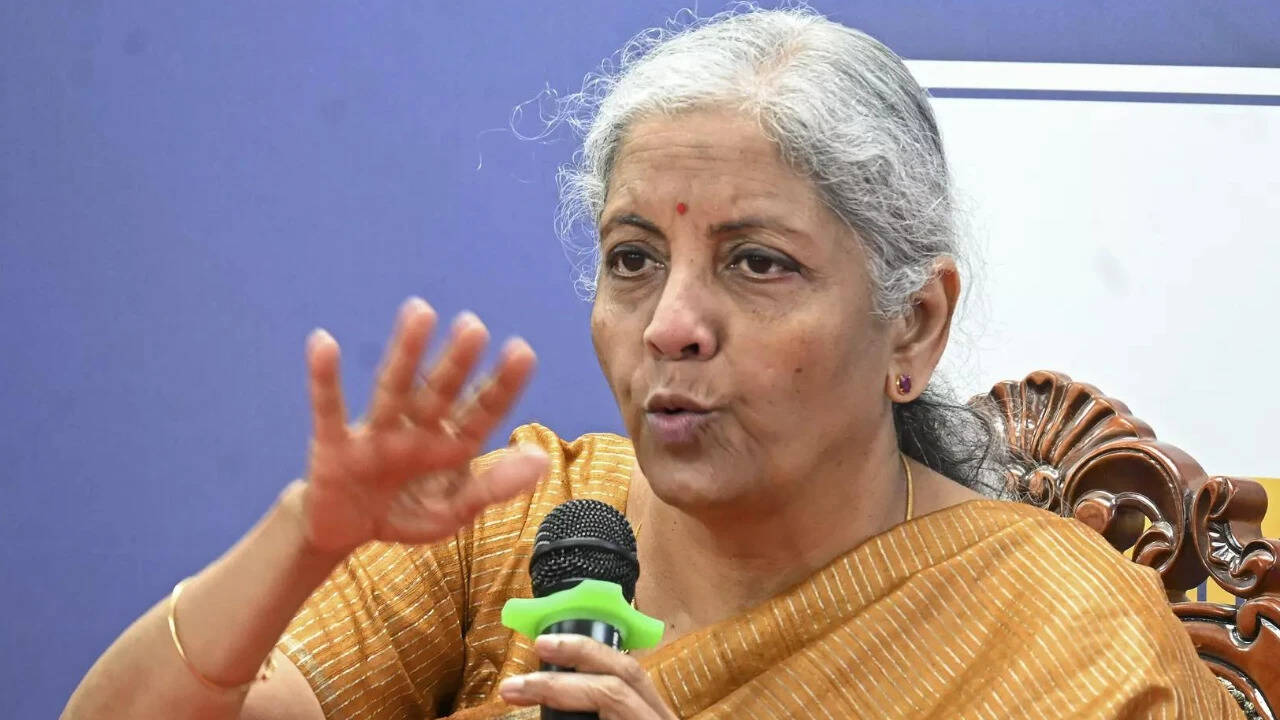
NEW DELHI: Union finance minister Nirmala Sitharaman on Saturday said that amid uncertainty, “now a standing condition” of the global economy, national security requires structural autonomy in strategic inputs, as strategic resource security sits at the centre of macroeconomic policy.Besides, she argued for private investment to lead the cycle, including in research and innovation and skilling to prepare people for a changing world of work, while asserting that global financial architecture should reflect where growth was coming from.“We need to keep building resilience as we go along; it’s not a one-time exercise. The coming years call for preparation, and India approaches them from strength,” she said at Kautilya Economic Conclave.The remarks assume significance amid global economic uncertainties triggered by US tariffs and conflicts in Ukraine and West Asia, which have disrupted global supply chains and resulted in higher prices of key commodities.“A price shock can be cushioned with monetary and fiscal tools. But a quantity shock tests buffer stocks and the reach of delivery systems and therefore the capacity of the state itself,” she added.
Sitharaman said supply chains optimised for cost alone carry hidden fragility. To replace fragile single-source dependencies with domestic operational depth, the government has launched programmes focused on critical minerals and rare earths, semiconductors and small modular nuclear reactors.She said for India, resilience means building upon the structural foundations laid over the past decade such as entrepreneurial growth, focusing on efficient last-mile delivery, infrastructure creation and managing prices, essential supplies and external pressures.
“The test of the coming years will again be partly invisible: the shocks India absorbs without disruption to households and enterprises.”The evidence of resilience lies in the counterfactual, in the outcomes that did not materialise, such as an inflation spiral that did not take hold, queues that did not form at the fuel outlets, banking stress that did not surface and a fiscal correction that was never forced. “These counterfactuals deserve as much attention from economists as the headline growth rate,” she added.
Talking about open, predictable and rule-based global economic relationships, Sitharaman said nations should engage with one another through dialogue and negotiated agreements, rather than allowing geopolitical differences to become barriers to trade and investment.
KioskNews shows a cleaned-up reading view extracted from the publisher’s page — the original always lives on their site, not ours.