Nearly half of Mexican firms report that US tariffs impact their cost structure
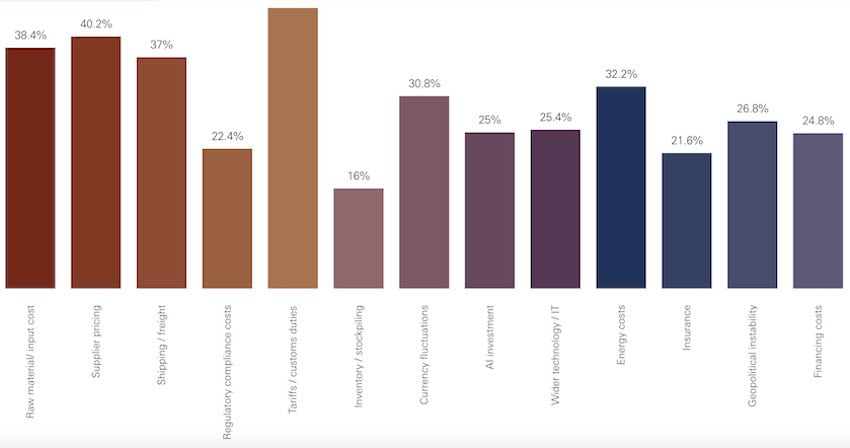
U.S. tariffs have had an impact on the cost structure of 45% of companies in Mexico, a global survey conducted by HSBC revealed, with most businesses (68%) believing that the resulting high costs will continue through the next few years.
According to the survey, conducted among 500 companies in Mexico, tariff costs affected expenses more than supplier issues (40%) and raw material prices (38%).
Which of the following have impacted your cost base over the past 6 months?
Nevertheless, 90% of Mexican business owners plan to expand their international business in the next two years. Such optimism about bilateral trade despite the tariffs has actually strengthened since last year’s HSBC survey, when 86% of Mexican businesses foresaw a rise in the international exchange of goods,
Maximiliano Rossi, regional director of Global Trade Solutions at HSBC Mexico and Latin America, told Imagen Radio that the survey’s offsetting findings (tariff impact and trade expansion) are notable, particularly in light of “the uncertainty surrounding [U.S.-Mexico trade] negotiations and the issue of tariffs.”
Rossi said companies established in Mexico have “modified operating processes and supply networks to mitigate the financial impact of trade barriers and maintain competitiveness in international markets.”
In this regard, global trade has begun to abandon the indiscriminate opening and outsourcing scheme toward Asia of the 1980s and 1990s and regional blocs are now playing a more important role.
As such, 83% of companies indicated that the changes made to respond to trade uncertainty and disruptions have been effective.

Survey respondents confirmed that the changes are reshaping suppliers, energy security, inventory and production footprints. “With further action planned, the redesign of trade networks remains an ongoing process rather than a one-off response to disruption,” the HSBC report says.
Rossi went further, saying that “supply chains are adapting, and Mexico has a unique, unparalleled situation.”
AI adoption as tariff adaptation
Furthermore, as businesses “expand internationally through the transformation of supply chains, the adoption of digital channels and the use of digital intelligence (AI) tools” are becoming increasingly important.
Of note, the HSBC survey found that AI adoption is accelerating faster than AI oversight.
While 85% have already deployed AI in at least one trade-related function, 76% have implemented fewer than five of the 10 AI safeguards assessed in the survey.
In other findings, 73% said changes made to their supply chains have improved their cash flow and working capital, and 49% of firms said they have optimized their trade networks.
KioskNews shows a cleaned-up reading view extracted from the publisher’s page — the original always lives on their site, not ours.