Crisafulli brushes off calls for special CFMEU probe prosecutor
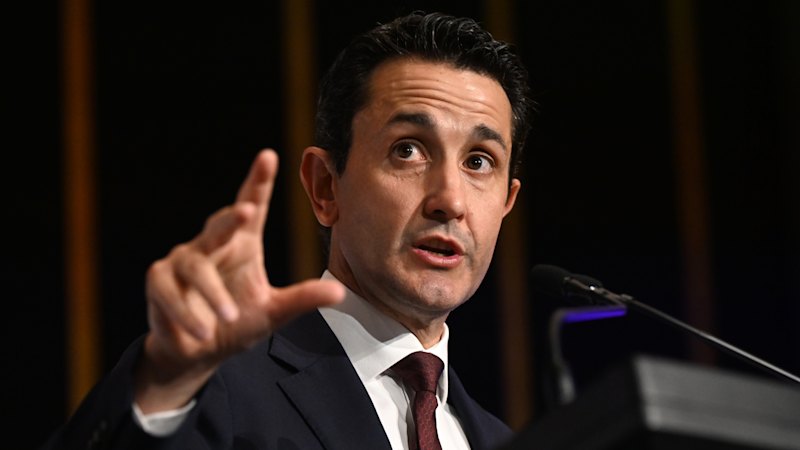
Queensland Premier David Crisafulli has brushed off calls for a special prosecutor to act on evidence of criminality in the construction sector heard by his government’s now 28-month, $95 million inquiry, saying it had already justified itself.
Asked about the suggestions for a Victorian inquiry-style arrangement to work alongside the probe and ensure matters are pursued to the point of charges before a final report not due until December next year, Crisafulli deferred sharing an explicit view.
“Let’s see where it goes, and let’s see what unfolds and where things head,” he said in response to a question from this masthead at a Queensland Media Club event in Brisbane on Wednesday marking the halfway point of the state electoral cycle.
Figures including the head of Queensland’s peak union body, the Australian arm of global anti-corruption body Transparency International, and barrister Geoffrey Watson SC – whose 2025 report for the union administration proved a catalyst for the inquiry – have publicly backed the idea.
Watson’s report was prompted by this masthead’s reporting of allegations of corruption and criminal links in the union nationwide, and the construction sector more broadly. The Queensland inquiry will hold its 17th public hearing block next week.
Evidence of wrongdoing or questionable action heard by the inquiry to date spans the police service, CFMEU figures, the former Labor government, and the workplace safety regulator, along with major building firms.
“I’m a great supporter of the idea ... that a special prosecutor could be appointed right now. And I would ask the commissioner, Stuart Wood KC, to consider it.”
Geoffrey Watson SC in comments to this masthead last week
On Wednesday, after the government previously sought to suggest the calls were a matter for the inquiry itself to respond to and provided only supportive remarks about its work more generally, Crisafulli downplayed the role of Watson’s report.
“I don’t underestimate the work of Mr Watson, who’s spoken out on things for many, many years, and should be respected and applauded for that,” Crisafulli said, after a 20-minute speech focused heavily on his government’s work to date on crime.
“But the catalyst for the CFMEU inquiry, to be clear, was some of the images we’d seen ... of violence, of misogyny, of intimidation, of bullying, of standover tactics that had spewed out onto worksites, and allegations of, let’s call it, criminal activity.”
Crisafulli noted his deputy and Industrial Relations Minister, Jarrod Bleijie, had been “speaking about it for 10 years relentlessly” and so was not something the government had “just woken up one day and thought, hey, this will be good to do”.
He said he had spoken at a Property Council event earlier in the day about returning productivity and what that means for the state’s construction and business sectors, broader economic growth, “and how that excites me”.
“So, the commission in my mind has justified its existence already,” Crisafulli said, going on to reference the now-dumped best practice industry conditions policy of the former government.
“That’s my focus: on making sure we don’t drift back to an IR [industrial relations] space where one union can control effectively government policy. That’s my priority at the moment.”
Building and civil construction peak bodies have described the idea of a special prosecutor as either unnecessary, or a matter for government. The inquiry has also echoed the comments that it would be a government decision to make.
Victorian CFMEU insider and former industrial lawyer Emma Walters, the estranged wife of the union’s former Victorian leader John Setka, has also questioned whether the probe will deliver on its promised action to seek the “hard truth”.
Crisafulli’s appearance at the event was met with protests by the union movement, which has vowed to fight against workplace safety law changes made earlier this year, and a more recent proposed push to wind back the ease of workers’ compensation claims for psychological injuries.
Under the bill, introduced to parliament last week, Bleijie would also be handed powers to terminate protected industrial action by key state workforces, with further changes slated to make it easier for employers to apply to the industrial commission to pause or stop such action.
Facing multiple questions on the bill, Crisafulli reiterated suggestions that Bleijie’s powers would only be used sparingly and the process was “very fair and very balanced”.
“I do think anyone who has seen strike action the way it’s unfolded in recent times – all Queenslanders want is the ability for people to be able to speak out and have their say, and that’s fair and reasonable,” Crisafulli said.
“But once there’s an impasse, there is an independent body – which is the [Queensland Industrial Relations] Commission, and that body should be able to hear it, free from political interference … and the sooner that body hears it, the better it is for everybody.
“So, the way that the legislation has been drafted gives exactly that. It gives the right for people to be able to strike. It gives the right for people to be able to have their say. And, equally, it gives the right for the government to say, ‘well, there is a third party – there’s an independent umpire. Over to you. Make the decision.’”
Start the day with a summary of the day’s most important and interesting stories, analysis and insights. Sign up for our Morning Edition newsletter.
KioskNews shows a cleaned-up reading view extracted from the publisher’s page — the original always lives on their site, not ours.