Chinese scientists find neurons may act as minicomputers that help decision-making
Chinese scientists have found evidence that individual neurons can act like powerful minicomputers that enable flexible behaviour such as making decisions.
Scientists do not have a complete understanding of how our brains adapt to changing contexts to respond appropriately to sensory information.
But by studying mice, the team obtained the first experimental evidence that dendrites – branchlike structures attached to neurons – can integrate learned rules with incoming sensory inputs to drive flexible choices.
These new insights into the cognitive process could also help in the design of more adaptable and efficient AI systems modelled on the human brain, the researchers said.
“These findings indicate that a single cortical neuron can perform a cognitive computation for flexible behaviour,” the team wrote in a paper published in the peer-reviewed journal Science on October 15.
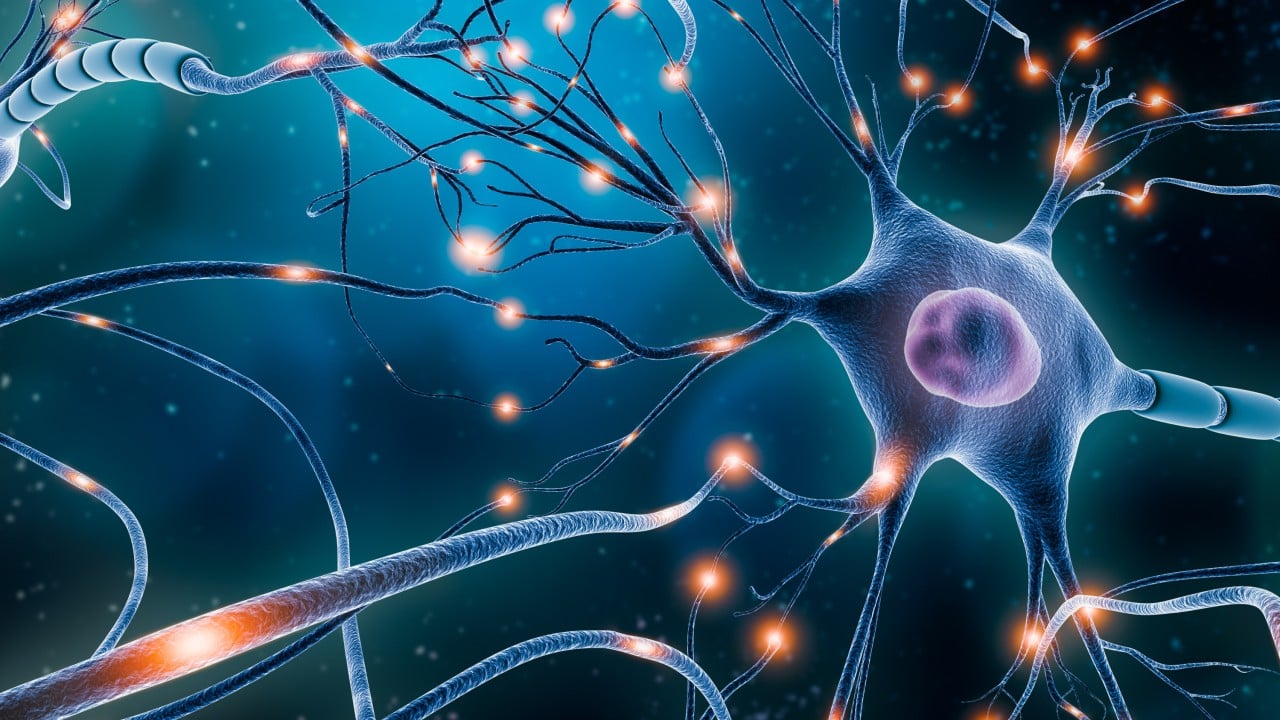
Neurons are specialised nerve cells that form the building blocks of the brain and nervous system, while dendrites are their branched extensions that receive incoming electrochemical signals from other neurons.
In the past, individual neurons were seen as simple units that acted as basic switches or summation points, with complex cognition assumed to emerge from their interactions in a vast network.
However, the findings by the Chinese Academy of Sciences team suggest single neurons are far more sophisticated, with dendrites carrying out complex computations before sending information to the neuron cell body.
“This is equivalent to work that would otherwise require multiple computers networked together being accomplished by a single ‘dendritic’ supercomputer,” Xu Ninglong, the study’s lead author and a researcher at the academy’s Institute of Neuroscience, told the official Science and Technology Daily.
Intelligent behaviour needs both sensory inputs and an understanding of changing abstract rules, a process that depends on the brain being aware of the context in which it is operating.
The team illustrated this with the example of a ringing phone, which people would answer at home but know to silence it in situations such as a meeting.
“Decision-making involves transforming sensory inputs into appropriate motor outputs in a context and state-dependent manner, where the same sensory input may be mapped to different motor outputs depending on the environmental state or task rule,” the team wrote.
Although this ability is a key part of cognition, the team said that how individual neurons carry out such flexible mapping had been poorly understood.
“Theory has long held that these dendrites integrate distinct streams of information within a single cell, yet direct evidence linking dendritic processing to flexible cognition has been lacking,” the researchers said.
They added that most decision-making studies had treated each neuron as a single point and overlooked dendritic computation.
The researchers focused on the role of cortical pyramidal neurons, the most common signalling neurons in the mammalian cerebral cortex, which is the part of the brain involved in complex sensory, cognitive and motor functions.
These have two main types of dendrites: apical dendrites, which form a single trunk that extends upwards from the cell body, and shorter basal dendrites that sprout directly from its base.
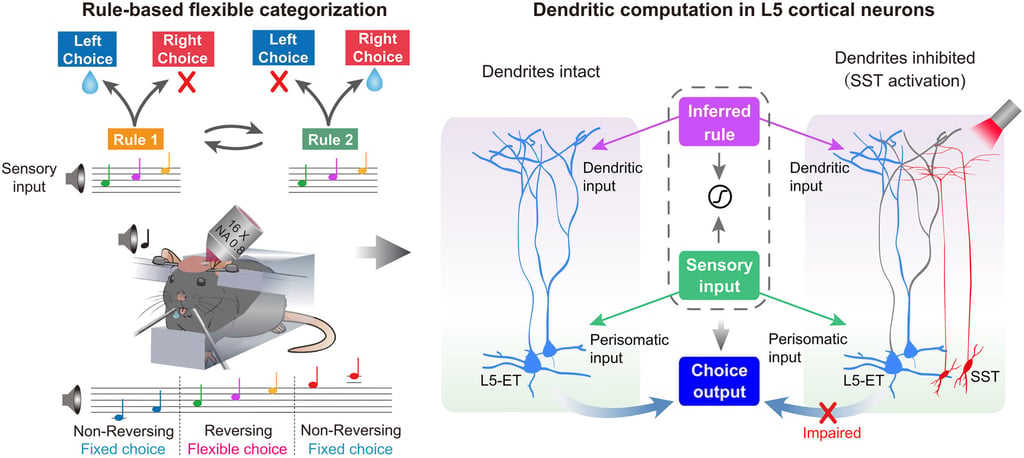
To study dendritic computation, the team trained mice to carry out a flexible categorisation task.
The animals were played tones of different frequencies and had to lick either a water port to their left when a lower-frequency tone was played or a port to their right for higher-frequencies.
The rules determining which frequencies belonged to each category periodically switched, and the mice were rewarded with water when they were correct.
The mice had imaging windows fixed to their heads, which the team used to record the activity of apical dendrites and cell bodies in the auditory cortex, which controls hearing.
They then suppressed dendritic activity and found that had impaired rule-dependent choices – which in turn suggested that dendritic activity in the cortical neurons actively drove flexible behaviour.
“These findings reveal a single neuron-level computation based on dendritic compartmentalisation and integration that supports flexible, rule-based decision-making,” they wrote.
As well as advancing understanding of the cognitive process, the team’s finding may also help find new ways to design more flexible, brain-like AI systems.
“More broadly, this form of within-neuron computation expands the capacity available to cortical networks during flexible behaviour and may inform the design of more-efficient artificial systems,” the study said.
KioskNews shows a cleaned-up reading view extracted from the publisher’s page — the original always lives on their site, not ours.