Two spaces, one legacy: Inside Mahatma Gandhi’s birthplace and Kirti Mandir memorial
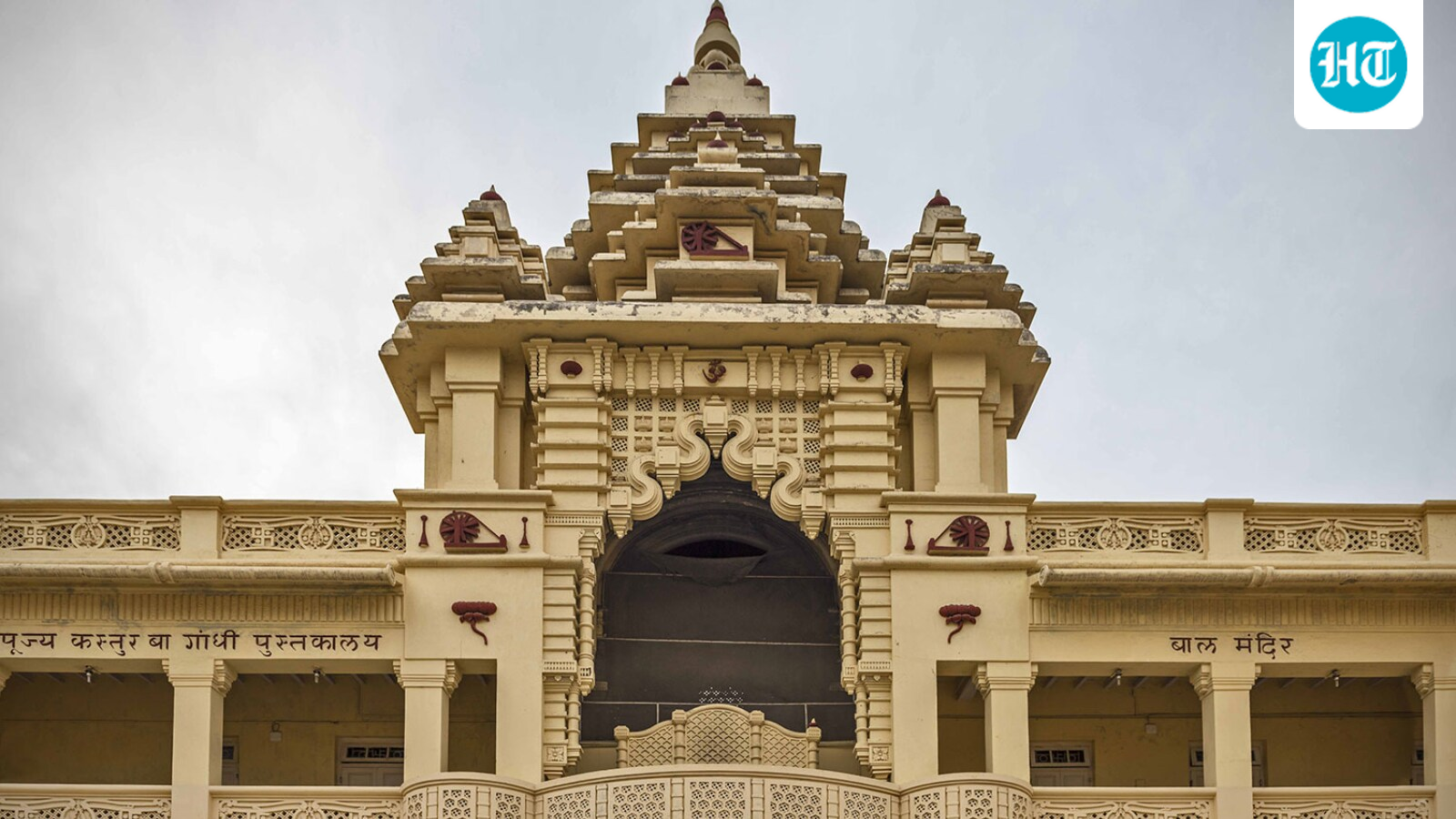
The Archaeological Survey of India looks after Gandhi's birthplace, while the state government maintains the Kirti Mandir memorial through a committee.

 Prefer HTon Google

A small room where Mohandas Karamchand Gandhi was born in 1869 and the adjoining Kirti Mandir, built years later in his honour in Porbandar, Gujarat, tell two different parts of the story of Mahatma Gandhi's life and legacy.
Gandhi was born in Porbandar on October 2, 1869. He was assassinated in Delhi on January 30, 1948.
On the occasion of Gandhi's 157th birth anniversary, Gujarat chief minister Bhupendra Patel on Friday paid floral tributes at Kirti Mandir in Porbandar, and an all-religion prayer meeting was also held at the memorial.
Inside Mahatma Gandhi's birthplace
Gandhi was born in an ancestral haveli where his family lived. The house had 22 rooms and was bought in 1777 by his great-grandfather, Harjivadas Gandhi.
His grandfather, Uttamchand Gandhi, later expanded the property, Porbandar sub-divisional magistrate SA Jadav, who is also the member secretary of the Kirti Mandir management committee, told news agency PTI.
Uttamchand Gandhi and Mahatma Gandhi's father, Karamchand Gandhi, both served as diwans (chief ministers) of the erstwhile Porbandar State.
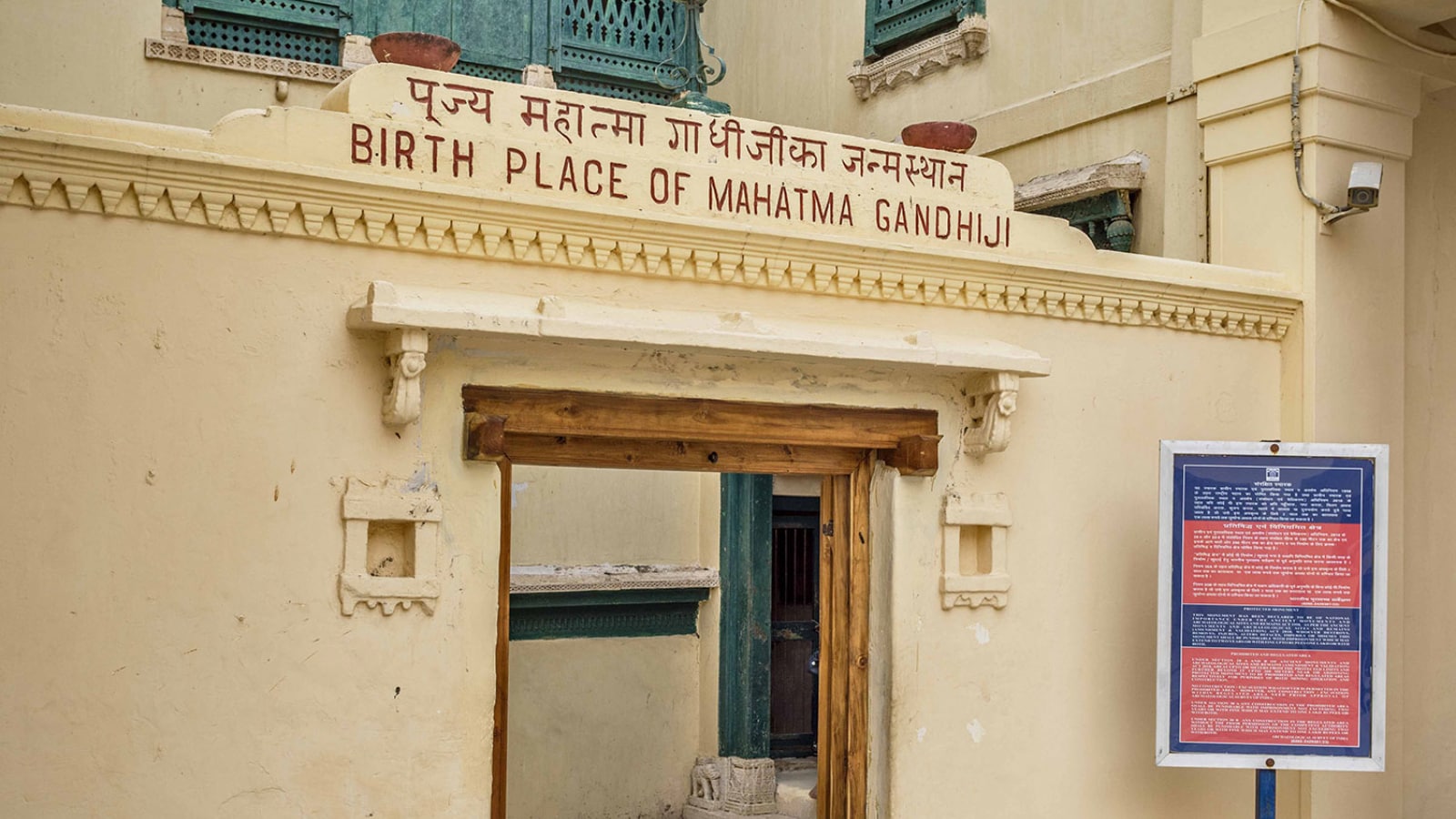
Mohandas Karamchand Gandhi was born in this family home on October 2, 1869. The room where he was born is marked with a 'swastik' and has been preserved as part of the birthplace complex.
How the idea of building a memorial came about
The proposal for a memorial took shape in 1945. Porbandar's Maharaja Natwarsinhji and businessman Nanji Kalidas Mehta met Gandhi, who was staying near the Aga Khan Palace in Pune, and asked for his approval to build a memorial close to his birthplace, Jadav said.
Gandhi agreed to the proposal but made it clear that the memorial should not turn into a place of worship.
"He did not want to become God and had said that there should be no incense sticks or lamps but a donation box for the welfare of Harijans (Dalits)," Jadav said.
The memorial was planned around Gandhi's belief in "Sarva Dharma Sambhav" (equal respect for all religions). Its design reflects this idea through elements linked to different faiths, including a Buddhist pagoda, a Hindu swastik, Islamic latticework, Jain artistic features and elements of Christian architecture.
Inside the Kirti Mandir memorial
Jadav said Gandhi wanted his ideas to reach more people. In keeping with this vision, 26 marble pillars stand within the Kirti Mandir compound, each carrying his thoughts.
Work on the memorial began in 1945 but remained unfinished when Gandhi was assassinated on January 30, 1948.
Sardar Vallabhbhai Patel inaugurated Kirti Mandir on May 27, 1950, Jadav said.
The memorial's design also reflects Gandhi's lifespan. He lived for 79 years, and the main structure of Kirti Mandir stands 79 feet tall. A total of 79 earthen lamps have been placed on its roof as a tribute to his life, the official said.
Two adjoining spaces tell Gandhi’s story
The original house preserves the birthplace of Gandhi, while Kirti Mandir honours the ideas and principles that shaped his public life.
The Archaeological Survey of India looks after Gandhi's birthplace, which has been declared a national monument. The state government maintains the memorial through the Kirti Mandir management committee.
With inputs from agencies

Follow the latest breaking news, major developments and agenda-setting stories from India and around the world with the newsdesk at Hindustan Times. Operating round the clock, the desk brings together experienced editors, reporters and correspondents to deliver fast, accurate and contextual reporting across subjects that influence public policy, governance, business, society and international affairs. The HT News Desk covers politics, elections, government policies, the economy, business and markets, science and technology, the environment, law and order, infrastructure, education, climate issues and geopolitics, while closely tracking developments across states, institutions and global capitals. The team also leads coverage of major breaking news events, policy announcements, court proceedings, natural disasters, public emergencies and significant international developments. Reports published by the newsdesk are based on information gathered from reporters on the ground, official statements, government agencies, court records, regulatory filings, recognised institutions and other authoritative sources. Stories undergo editorial scrutiny and verification processes to ensure accuracy, fairness and relevance, and are updated as events evolve and additional information becomes available. Whether covering a key political decision in New Delhi, an economic policy shift affecting millions, a landmark court ruling or a major global event, the HT News Desk aims to provide readers with reliable, fact-based journalism that delivers not only the latest developments but also the context and analysis needed to understand their wider implications.Read More

KioskNews shows a cleaned-up reading view extracted from the publisher’s page — the original always lives on their site, not ours.