‘Dark money made darker’: funding labyrinth conceals donors to Republican campaigns
In the summer of 2024, a non-profit called the Green Dragon Coalition wired the last $20,000 of a $445,000 grant to a Super Pac. Its tax return for that year would describe the purpose of the transfer as “educational”.
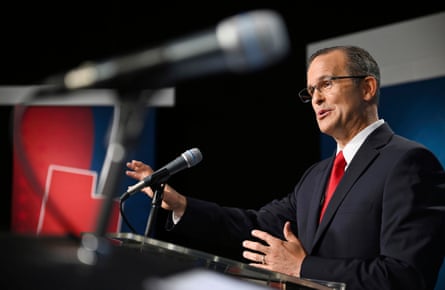
The same day, according to Federal Election Commission (FEC) records, the Super Pac spent $8,000 attacking Celeste Maloy, the Republican congresswoman for Utah’s second district, four days before the primary that would decide whether she kept her seat. It had already spent more than $400,000 promoting her challenger, Colby Jenkins, who was running to her right with the endorsement of the rightwing Utah senator Mike Lee.
One man was involved at every stage, and his name is on the paperwork for the charity that raised the money, the non-profit that passed it on, the Super Pac that the non-profit donated to and the campaign this money eventually supported.
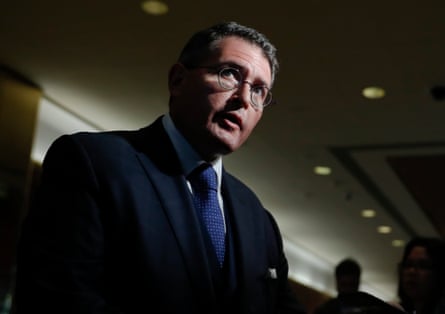
His name is Thomas Datwyler, and his businesses are mostly headquartered in a rented address in Hudson, Wisconsin, a town of 15,000 near the border with Minnesota. Datwyler operates at an industrial scale, acting as treasurer of more than 350 federal political committees in the current election cycle, including 115 congressional campaigns and 100 Super Pacs, and as an officer of more than two dozen non-profits.
The extent of Datwyler’s activities over several political cycles raises questions about the attitude of Republican campaigns and candidates to campaign finance in the run-up to the November midterm elections, and the evolution of so-called “dark money” electoral funding.
Across the 2024 and 2026 cycles, Super Pacs whose books Datwyler also keeps have spent more than $2m supporting 14 candidates that are also his clients, or attacking their opponents, according to FEC filings. In several of those races the money reached the Super Pac through charities and social welfare groups for which he is a treasurer.
Datwyler-tied groups have been funded by donors connected to the rightwing megadonor Leonard Leo, along with the Conservative Partnership Institute and the personal foundation of the Claremont Institute’s board chair, the Thomas Klingenstein Fund, among others.
Money raised from these conservative donors has gone into organisations that Datwyler runs the books for, and those organisations have passed money on to Super Pacs that spent in Republican primaries. Non-profit tax filings do not show which donors’ funds made up any particular onward transfer.
Along the way, the same firms are paid by both the campaigns and the groups that are legally required to be independent of campaigns in order to maintain their tax-exempt status. In Florida’s 19th district, a campaign and the supposedly independent Super Pac backing it share 14 vendors, according to FEC filings.
Federal law prohibits coordination between Pacs and campaign committees, but proving it is challenging. The FEC is a reluctant cop, and while Datwyler has attracted significant controversy and state-level investigations, what he does may not be illegal.
“Somebody in Datwyler’s position is well aware of where all the cracks and crevices in the system are, how to sort of exploit the rules in a way that maximises his clients’ ability to secretly influence elections,” says Saurav Ghosh, director of federal campaign finance reform at the non-profit Campaign Legal Center.
“There’s a reason why the same handful of people – and Datwyler’s probably the chief among them – tend to come up in connection with these dark money operations. It’s because they have the knowhow of how to do it. And they’re willing to be the public face on each of these entities.
“The actual donors providing the money don’t want to be publicly outed as the source of the outside money pouring into the race.”
Datwyler wrote to the Guardian that “AxCapital [where he is CEO] is grateful that so many clients entrust our team to facilitate their participation in the democratic process. As an industry leader, we have strict internal firewalls, strong safeguards, and robust policies to ensure full compliance with all laws, regulations, and requirements.”
The Green Dragon pipeline
The Green Dragon entities exemplify a pattern that recurs across Datwyler’s network.
The Green Dragon Coalition is a 501(c)4 social welfare non-profit, and one of three entities registered in Delaware in 2023 with sequential IRS employer numbers, all listing the same address in Hudson, Wisconsin. The other two were the Green Dragon Society, a 501(c)3 charity, and the Constitutional Conservatives Fund, a Super Pac.
Datwyler is treasurer of all three, and is the only officer that any of the organizations pay: the Green Dragon Coalition paid him $25,012 during the 2024 cycle and the Green Dragon Society paid him $29,066.
This is just a fraction of the compensation Datwyler has received across various arms of the political operation he works on. Tax filings indicate that he received at least $487,545 in the 2023-2024 cycle from non-profits. FEC filings indicate that during the last two election cycles at least $793,470 flowed to Datwyler directly, or to two Delaware-registered consultancies, 10Six Consulting and Same Day Processing, that share a Wisconsin address with the vast majority of his political and charity organizations.
Meanwhile, AxCapital, where Datwyler is CEO, brought in $4.9m across both cycles. AxCapital was created in a 2022 merger of HenryAlan and Datwyler’s 9Seven Consulting.
The Green Dragon Coalition’s $445,000 “educational” grant to the Constitutional Conservatives Fund in 2024 is recorded in the Pac’s FEC receipts in five payments between 15 March and 21 June 2024. In turn, the Pac spent $447,347 supporting Jenkins. Datwyler was also treasurer of Colby Jenkins for Congress, a role he had held since October 2023, and of the candidate’s joint fundraising committee. Datwyler is therefore keeping the books for the charity, the social welfare group, the Super Pac attacking the incumbent and the campaign it was attacking her on behalf of.
The Green Dragon Coalition’s 2024 revenue was $917,002, of which $750,000 – or about 82% – came from the Concord Fund, the Leonard Leo-network group formerly called the Judicial Crisis Network. The Green Dragon Society, a 501(c)3, also took $250,000 from Purple Action, a 501(c)4 whose officers include tech mogul and former Trump administration “crypto czar” David Sacks, and $200,000 from the Conservative Partnership Institute, and $90,000 each from “dark money” vectors DonorsTrust and Fidelity’s donor-advised fund. The Thomas D Klingenstein Fund gave the 501(c)3 $75,000 in 2023, before the 2024 payments to the Super Pac.
Lawson Bader, the president and CEO of DonorsTrust, said the organisation was “unfamiliar with the Constitutional Conservatives Fund, and the fact that the Green Dragon Coalition has an affiliated 501(c)4”. Grants from donor-advised funds to a 501(c)3 “cannot be used for political purposes”, he said, adding that DonorsTrust “would reconsider future grant recommendations made to organizations that violate the rules governing charitable activities”.
A Fidelity Charitable spokesperson said: “Use of Fidelity Charitable grants for political contributions or campaign activities is prohibited. The terms all non-profits receive when grant funds are issued to them include explicit language to that effect.”
These are not the only money flows from major conservative funders through Datwyler-connected entities.
In 2024 American Majority Action, a 501(c)4 founded by conservative activist Ned Ryun, gave Integrity Minnesota, for which Datwyler served as treasurer, $250,000 for “voter registration and activation plans”. (A 2020 Campaign for Accountability complaint asked the IRS and two state agencies to investigate whether Ryun’s groups spent more than half their money on politics, which would violate IRS laws governing 501(c)4 groups. Campaign for Accountability communications director Michael Clauw told the Guardian that the IRS did not respond to the complaint or take any action.)
American Majority Action did not respond to a request for comment.
Integrity Minnesota also received $50,000 that year from Restoration of America, which the Chicago Sun-Times reported in October 2024 was part of “a sprawling empire of organizations pushing far-right agendas and election denialism”, funded by at least $150m from shipping-supplies billionaire Richard Uihlein.
The Guardian contacted Restoration of America for comment.
And a separate Datwyler vehicle, Aurora Venture, received $300,000 from Ardleigh Impact Corp, a Delaware 501(c)4 with one director, no employees and no website, registered to the Springfield, Virginia, home of Staci Goede, a former Republican State Leadership Committee finance chief who is the treasurer of 26 federal political committees this cycle.
The Daily Beast reported on 16 May 2024 that Ardleigh had moved more than $2.5m to Republican Super Pacs within months of being formed, raising the suspicion that it may be a straw donor.
The Guardian contacted Goede for comment.
The money pipeline functions such that none of these organizations are named as donors in the FEC filings of the Super Pacs.
The Guardian contacted the Concord Fund, Thomas Klingenstein and the Conservative Partnership Institute for comment, and emailed Purple Action at an address that returned the message undelivered. None responded.
This cycle, the Green Dragon Coalition has put a further $177,500 into the same Super Pac in seven payments since 5 December 2025, the most recent on 21 April 2026. The Pac’s independent expenditures so far this cycle total $15,000 in support of Barry Moore, the Alabama congressman currently running to replace Tommy Tuberville, who is departing the US Senate to run for the Alabama governor’s seat.
The Guardian contacted Barry Moore for comment.
Elsewhere, the Pac’s expenditures have gone to organizations connected to Datwyler’s associates.
Its payments to L4 Consulting LLC total $164,809 across 13 installments between 2 January and 5 June 2026, with the disbursements booked as “PAC strategy consulting” and “fundraising consulting”. L4 is run by Dan Hauser, who is president of both Green Dragon entities and takes no salary from either.
Hauser was reported in October 2025 to have been a paid senior adviser to the Utah senator Mike Lee, another Datwyler client, during the same period. In the 2024 cycle, L4 took $207,560 from the same Super Pac. Green Dragon’s charity separately paid L4 $128,033 for “event production”.
The Guardian contacted Hauser for comment.
Ghosh, the campaign finance reformer, pointed out that while non-profits have to disclose donors to the IRS, with the exception of private foundations and some political non-profits, they do not have to disclose them to the public.
“So if the entire object is to conceal the sources of the money, the [501](c)4 on its own can accomplish that objective. The only thing the [501](c)3 layer adds is that [501](c)3 donations are tax deductible for the donor,” he said.
Ghosh added: “But that’s a little riskier because if they are using the [501](c)3 to first obtain a tax deduction and then that money is being used to influence elections, that’s one of the few things that federal tax law does prohibit.”
Either way, he said that “that’s a transparency nightmare. It becomes this problematic daisy chain where the [501](c)3 is sending money to the [501](c)4, theoretically not to support its political advocacy. But again, who can say exactly whether that’s happening or not? These are opaque entities. They are black boxes.”
Alyssa Bowen, executive director of True North Research, put the same structure more bluntly. “It’s like dark money made darker,” she said. “It’s almost like he’s running science experiments to find out all the ways you can conceal who’s donating.”
She said the charity layer carried a second advantage for the giver. “The Pacs are legally required to disclose your donors, but you’re not [required to do so] for a 501(c)3 or [501(c)]4. And then there’s also the tax benefits – donors receive tax benefits for donating to a 501(c)3,” she said. “So it’s twofold for these donors that are trying to make sure that they’re not held accountable for some of the more political spending that they do.”
Parallel pipelines
A similar pattern is visible across four other 2026 races. In each, Datwyler is treasurer of the campaign and of the Super Pac spending in that race, and in each he held both roles before the spending began.
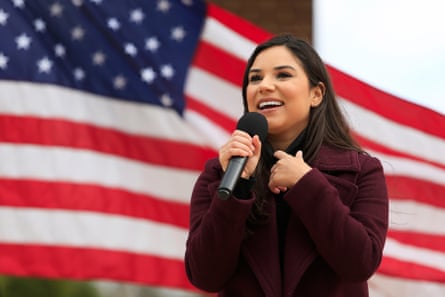
The Love America Uphold Freedom Pac spent $248,091 for Catalina Lauf in Florida’s 19th district between 13 and 24 July 2026, which is all the independent spending it has ever made. It is registered at Datwyler’s own address, and amended its registration on 11 July to add the domain LAUFPAC.com, two days before the advertising started.
It shares 14 vendors with Lauf’s campaign, seven of them substantive digital firms, over overlapping periods – which engages the FEC’s common-vendor conduct standard independently of who the treasurer is.
The Guardian contacted the Lauf campaign for comment.
On shared vendors, Ghosh said this is “more pressing than just having a treasurer in common. The use of vendors in common for things like media production, placement – that’s exactly the kind of spending that would be the subject of prohibited coordination. If the vendors they’re using are actually taking what they learn from their work for the campaign clients and then utilising that information or passing that information to their Super Pac clients, that’s exactly what the law prohibits.”
The Defending Conservative Values Pac was registered on 9 May 2026 and spent $485,213 against Blake Moore, the incumbent Karianne Lisonbee is challenging, between 29 May and 20 June – again, 100% of its spending, and again in Utah’s second district. The Show Me Valor Pac was registered six weeks after Taylor Burks’ campaign, with Datwyler as treasurer, and spent $166,051 supporting him. The American Honor Pac spent $162,800 for David Flippo in Nevada’s second district; Datwyler is its treasurer, custodian of records and only named officer, and its entire 2026 income – $155,000 – came from Stephen Flippo.
The American Liberty Foundation is simultaneously the name of a 501(c)3, a 501(c)4 and a Super Pac, all with Datwyler as treasurer, the first two presided over by Raymond Yonkura, Jim Jordan’s chief of staff for nearly a decade. The Super Pac spent $294,021 for Jenny Costa Honeycutt in South Carolina’s first district in June 2026, funded by $355,000 from the social welfare arm, $250,000 from the Geo Group’s Pac and $250,000 from a group called Voice of the Children of Israel.
What those campaigns knew is the open question for True North’s Bowen. “It’s concerning that all of these organisations and entities are using him, because what do they know about his past?” Bowen said, referring to Datwyler. “Is that why they’re using him – or are they totally unaware?”
She was skeptical that one person could service so many committees properly. “It feels far-fetched that he could be doing a good job,” she said.
‘Stunning … inexplicable’
In the current electoral cycle, Datwyler has already attracted controversy.
The Delaware Republican party reportedly claims he went unresponsive and then left in January 2026 amid five straight months of negative federal cash balances, missing a filing deadline and drawing an FEC warning of “civil money penalties, an audit or legal enforcement action”; he says he resigned because the party had not paid him.
In Alabama he is the sole officer of a Pac registered to a rented mailbox that has reportedly drawn legal threats over its attack mailers. A former state senator, Dell Hill, reportedly said in April that he had launched the Pac, whose registration names only Datwyler. Datwyler reportedly said he was “strictly the accountant doing the books” and had “nothing to do with producing the ads”.
after newsletter promotion
One of the Republican incumbents it targeted, the state representative Matt Simpson, lost his primary in May.
In a telephone conversation, Simpson said of Datwyler: “If he found loopholes to try to exploit for his purposes, then that’s the nature of the business that we’re in. You can’t lie, though. That’s the problem that I have with it.”
He gave the Guardian a copy of a later mailer in which the Pac said a false claim about Simpson’s positions “was a printing error”.
The Guardian contacted Phillip Pettus, another incumbent the Pac targeted, for comment.
A Texas campaign Datwyler keeps books for drew a watchdog complaint in May 2026, and Andy Ogles, whose campaign he still runs the books for, confirmed in 2024 that, at that time, the FBI was investigating his campaign finances.
The complaint has not moved because the FEC needs four votes to open an investigation and has had only two commissioners since October 2025. Donald Trump’s two nominees have sat with the Senate rules committee since 11 February with no further action.
In May this year, the Campaign Legal Center asked the commission to investigate Datwyler again, over a $250,000 payment to one of his Super Pacs from the private prison company Geo Group, ICE’s largest contractor.
Datwyler has not been charged with any offence, and several of the investigations closed without findings. His firm’s general counsel has called the allegations against him “baseless attacks”.
The incidents are part of a longer pattern of scandal and regulatory scrutiny.
To date, Datwyler has been named as a respondent in 24 complaints before the FEC. Two ended in penalties, both for conduct that predated his appointment as treasurer. The other 22 were dismissed or closed without a penalty, at least three of them after commissioners deadlocked 3-3.
In January 2023 the FEC fined Josh Mandel’s Senate campaign $15,080 for failing to promptly report contributions totalling $147,601 received between 14 and 30 April 2022, before the 3 May Ohio primary.
Datwyler’s successor as Mandel’s campaign treasurer, Elizabeth Curtis, wrote to the FEC about “the stunning number of inexplicable reporting errors made by Mr Datwyler … ignoring the FEC and potentially incurring significant fines without notifying the Committee”.
The Guardian contacted Curtis for comment via a consultancy website contact form.
In 2023, the FEC fined four campaigns for failing to file required notices of late contributions in the 2022 elections while Datwyler was their treasurer: Mandel’s Senate campaign ($15,080) and the House campaigns of Rodney Davis ($5,820), Ann Wagner ($3,560) and Joe Kent ($3,304), for a total of $27,764. Fines against the campaigns of Rich McCormick and Kyle Sinclair also named Datwyler as treasurer, for failures that predated his appointment.
Those were not the only cases. A Guardian review of FEC enforcement records found 13 cases in which a committee was penalised for failures that occurred, at least in part, while Datwyler was its treasurer, with penalties totalling $110,791. The largest came in April 2024, when Rodney Davis’s campaign agreed to pay $43,475, in a settlement Datwyler signed, after it failed to refund $479,783.82 in general-election contributions within the permitted time once Davis had lost his 2022 primary.
The largest penalties to name Datwyler concerned reporting from before he took over.
In March 2024, Mike Braun’s Senate campaign agreed to pay a $159,000 civil penalty over improperly reported loans from the 2018 race. The FEC’s file on the matter records that Datwyler became the campaign’s treasurer on 29 January 2019, after the period in question, and that the campaign blamed its former treasurer for the errors. Commissioners deadlocked 3-3 on a separate allegation, that the campaign had misreported receipts and disbursements.
A representative for Datwyler reportedly said he “served as treasurer at the time the issue was corrected, reviewed, and resolved, not at the time of the underlying activity”.
In July 2022 Jim Jordan’s campaign agreed to pay $60,000 for failing to accurately disclose $1.2m in receipts and disbursements in five reports covering late 2018 to mid-2020. The FEC’s referral lists Datwyler as its treasurer from 15 July 2020, and the campaign told the commission he had “identified hundreds of errors” in its earlier accounting and filed corrected reports.
He was the shared treasurer of Joe Kent’s 2022 congressional campaign and of a Super Pac backing it – an arrangement the Guardian examined in February 2025, when campaign finance experts questioned the campaign’s routing of more than $1m through a company they described as a possible shell.
Liberty Ohio
In December 2021 Mike Dowling, a former FirstEnergy executive defending himself in a shareholder lawsuit over the $60m scheme that secured passage of Ohio’s HB6 energy bailout, subpoenaed two dark-money groups at the centre of that scandal: Partners for Progress and Generation Now, the latter of which had pleaded guilty to racketeering that February.
He asked for their communications with a list of people and organisations that included Liberty Ohio Inc, a non-profit for which Datwyler was treasurer, as well as Datwyler himself and the group’s secretary, Scott Guthrie. The same list named Ohio’s governor and lieutenant governor and every current and former member of the state legislature. Neither Datwyler nor Liberty Ohio was served with a subpoena or was a party to the lawsuit.
The lawsuit settled in August 2022, with $180m paid to FirstEnergy by insurers to resolve the derivative claims, less $36m in court-awarded legal fees. The defendants admitted no liability or wrongdoing.
Both Datwyler and Guthrie were working at the time on Josh Mandel’s Senate campaign, with Datwyler as its treasurer and Guthrie as its manager. Mandel subsequently lost the 2022 Republican primary to JD Vance, who was subsequently elected Senator for Ohio, and then vice-president as Donald Trump’s running mate.
Committees for which Datwyler served as treasurer spent more than $7m across the race – more than $5.4m of it from the USA Freedom Fund, a Super Pac registered to his own post office box, which put $831,281 behind Mandel and a further $4.6m into attacking his three main rivals: $3m against Mike Gibbons, $1.5m against JD Vance and $36,530 against Jane Timken.
The Guardian can reveal other striking transactions involving Datwyler during that campaign. Between September 2021 and June 2022, Team Josh – the joint fundraising committee for Mandel’s campaign and his leadership Pac – transferred $1.1m in seven installments to the federal account of the Shelby county Republican party, a committee registered not in Ohio but at Datwyler’s post office box in Hudson, Wisconsin. The federal account of a second Ohio county party, Delaware, sent a further $362,458.
Those two transfers were the entire declared income of the Shelby county account, amounting to $1,471,200. It then spent $1,398,811 on independent expenditures supporting Mandel, amounting to 95 cents of every dollar it took in, and wound itself up that December. Datwyler was treasurer of all three committees, and of Mandel’s campaign.
The Guardian contacted Scott Guthrie for comment. An email to Josh Mandel was returned undelivered.
State-level enforcement
Twice, state authorities have probed Datwyler as opposed to his clients.
The most developed coordination allegation against him is in Tennessee. In 2024, the state’s registry of election finance referred a complaint to the attorney general over the Republican primary in the fourth senate district, where a dark-money Pac spent more than $600,000 to defeat the incumbent, Jon Lundberg. Datwyler was treasurer and officer of that Pac, East Tennessee Conservatives; he was also treasurer of the congressional campaign of Diana Harshbarger, whose son Bobby was the challenger.
The attorney general’s report found that Datwyler had helped Bobby Harshbarger set up his campaign in April, after being introduced by the congresswoman’s chief of staff. According to the report, Datwyler sent him guidance on appointing a treasurer, obtained a tax number for a bank account and opened a fundraising account with Republican donation processor WinRed, and that the Pac he ran then spent heavily against Lundberg.
Investigators could not reach a conclusion, mainly because Datwyler declined, through counsel, to be interviewed or to produce documents. Two registry members said he should be subpoenaed. “The system’s not working the way it needs to on the dark money side,” the registry’s chair, Tom Lawless, said, “and I don’t know if we’ve got the tools to do anything for it.” Datwyler’s lawyer, Eric Brown, reportedly said that “news reports confirm that the AG report found no factual or legal basis to support the allegations of improper coordination”.
The registry dismissed the complaint in May 2025 at the request of Ken Yager, the Republican state senator who had filed it. “It’s just one of those where nobody was here to prosecute it,” Lawless said at the time.
The Guardian contacted Bobby Harshbarger for comment.
A second Tennessee complaint went further. Lawyers for the Civic Engagement Forum and Datwyler conceded to the registry that the group had operated as a political campaign committee and should have registered and disclosed its spending, and offered $2,500 to settle. The registry’s chair, Tom Lawless, said the offer was not high enough. In July 2025, the registry deferred a decision and ordered the group to register and file its disclosure reports, and in September it accepted a revised offer of a $6,000 penalty and closed the case.
Datwyler reportedly told the attorney general’s investigators that he had no personal knowledge of the Citizen Engagement Forum, a second group named in the complaint.
In April 2024 Emily’s List asked the FEC to investigate an Arizona group with a Democratic-sounding name, the Turn AZ Blue Pac, which had disclosed neither its spending nor its donors and which was listed with Datwyler as its treasurer. Through a lawyer, Datwyler told the commission he “is not, nor has he ever been, the treasurer” of the group, and the FEC’s dismissal report records that he swore he had never heard of it before the complaint. The commission dismissed the case in April 2025.
That July, a Nevada leadership Pac formed to back the Republican Senate candidate Jim Marchant asked the justice department to investigate Datwyler for alleged wire fraud over a $500 cheque written from its account to his compliance firm, AxCapital, after he had stepped down as its treasurer. The complaint, written by the Republican election lawyer Dan Backer, alleged “a long history of running roughshod over federal campaign finance law”. It said Datwyler first described the payment as a bank error made through an online bill-pay system, then said he would refund it; the Pac’s own FEC filings record a $500 “compliance refund” from AxCapital on 22 April 2024. Eric Brown, general counsel of Axiom Strategies, which owns AxCapital, reportedly said the firm faced “baseless attacks” and that the letter was “nothing more than a stunt”. No charges have followed.
Backer told the Guardian this week that he believed the $500 was refunded “only after filing the [justice department] letter”; his letter is dated 26 July 2024. Asked whether the justice department had responded, he said: “Law enforcement agencies generally do not comment on pending investigations.” He said Datwyler had “cost the GOP vast sums of money” and was “just not cut out for this line of work at this level”, and that aggrieved former clients rarely act because “no one ever wants to spend the money or put their reputation out there, to sue or to file an FEC complaint”.
The Guardian also contacted the Tennessee complainant, the state representative Michele Reneau, and Emily’s List for comment. They did not respond.
In Maryland, Datwyler was listed as the treasurer of “Dan Cox for US Congress”, a committee registered in the name of a candidate who had not filed to run. In Ohio’s Mahoning valley, county party chairs of both parties could learn nothing about a group attacking local officials beyond his name on the treasurer designation.
In Texas, a Super Pac Datwyler kept books for reportedly spent almost everything it raised on credit card fees and nothing on campaigning, according to its own FEC filings.
Perhaps most notoriously, George Santos’s campaign named him treasurer in January 2023 and his lawyer told the FEC the appointment was unauthorised – a position the same lawyer later retracted, writing that he had lost confidence in his client’s account.
Santos, the New York Republican who fabricated most of his biography, was expelled from the House in December 2023 and sentenced to more than seven years in April 2025 for wire fraud and aggravated identity theft. He served 84 days before Donald Trump commuted the sentence in October.
Secrecy
Datwyler is steadfast in maintaining secrecy on behalf of funders.
Asked in October 2024 about $200,000 that arrived at a Super Pac opposing Sheldon Whitehouse from his Wisconsin address, Datwyler said a Florida couple were the primary funders and declined to name them.
Occasionally, Datwyler’s denials have been undone by his own filings.
Asked in October 2025 about attack mailers in a Utah school board race, he said the address on them “is not associated with us at all”; hours later, the Pac filed state paperwork listing him as its primary officer.
Time after time, however, investigations that reached committees he kept have ended without action against him. Three executives of Navatek, a Hawaii defence contractor, pleaded guilty over schemes that included routing $150,000 of company money through a sham entity, the Society of Young Women Scientists and Engineers, to 1820 Pac, a Super Pac backing Susan Collins for which Datwyler was treasurer. The Pac told the FEC the contribution was lawful. Commission lawyers later recommended finding that it had failed to refund the money once its source came to light, but the commissioners never voted on that, and in January 2025, with the statute of limitations running out, they dismissed the allegation against the Pac and Datwyler in his official capacity. The Pac’s FEC reports show no refund.
On Datwyler’s overall operation, Saurav Ghosh said: “What you’re describing is both incredibly common and incredibly problematic for our elections.”
KioskNews shows a cleaned-up reading view extracted from the publisher’s page — the original always lives on their site, not ours.