New crocodile species found in rocks of Egypt’s Great Sphinx
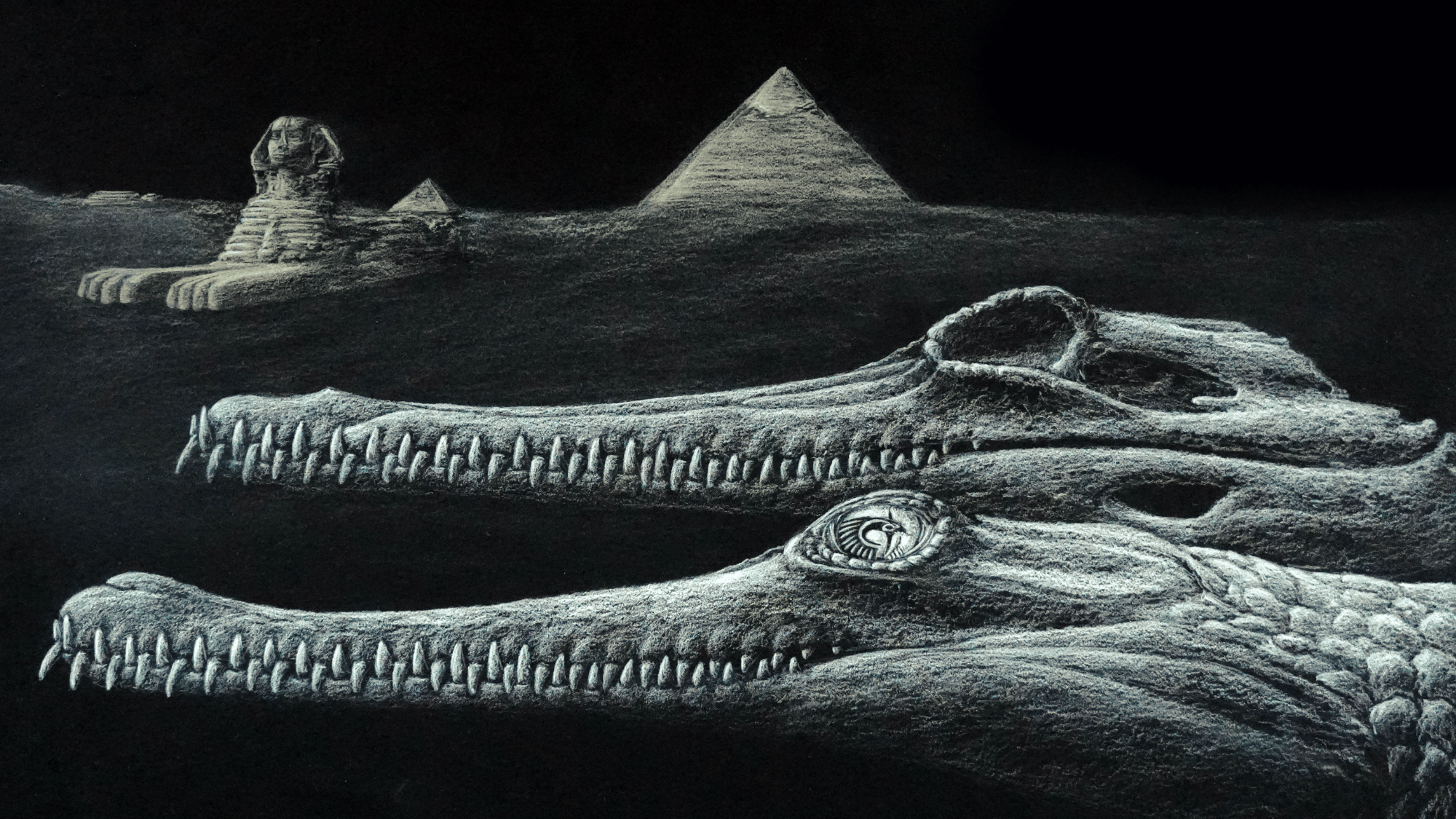
For 4,500 years, the Great Sphinx in Giza, Egypt, has been shrouded in mystery and intrigue. Mysteries still linger and discoveries await deep inside the bedrock of one of Ancient Egypt’s most famous monuments. These discoveries now include a new species of extinct crocodile. And just like the Great Sphinx is missing the tip of its nose, the fossil crocodile is missing the tip of its snout. The newly discovered species Herugavialis cairensis is described in a study published today in the journal Royal Society Open Science.
The Great Sphinx stands at 66-feet-high, with the head of a man and the body of a lion. The lion’s body was used to represent a king as a demonstration of his power in sphinx statues. While we still don’t know exactly who built the Great Sphinx, it was likely carved during the Fourth Dynasty (2613–2494 BCE), during the reign of Khafre. Khafre is known for building the second of the famous Giza pyramids.
Like lions, crocodiles appear throughout Egyptian art and inside tombs. The newly discovered crocodile is a gavial, a group of crocodiles characterized by their long, thin snouts. They live in freshwater environments on the Indian subcontinent and Southeast Asia, with only two living species today: Gavialis gangeticus and Tomistoma schlegelii, aka the ‘false gharial.’
Based on the fossil record, gavials were once found all over the world. For over 100 million years, many gavials likely lived in shallow marine environments. Several crocodile fossils were recovered from Egypt’s 45-million-year-old Mokattam Formation during the 1920s. Scientists initially believed that these fossils (including a nearly complete croc skull) belonged to Tomistoma since they resembled the false gharial.
However, advances over the past 100 years have made it easier for paleontologists to look inside skull fossils like the one found in the 1920s. While the Herugavialis skull is relatively well preserved, one feature caught their attention—the missing tip of its snout.
“Given this coincidence with the famously missing nose of the Great Sphinx, we decided to name the new crocodile after the Egyptian god Heru, who was possibly the inspiration for this iconic monument,” Philip Mannion, a study co-author and evolutionary biologist at University College London, said in a statement.
When the Great Sphinx was built 4,500 years ago, Herugavialis was not the only crocodile in Egypt. The region was covered by shallow marine environments that housed at least two other species of gavial crocs.
“Throughout much of the last 50 million years, the Mediterranean region hosted a high diversity of crocodiles, including gavials,” added co-author and Swedish Museum of Natural History paleontologist Paul Burke. “However, this diversity fluctuated over time, seemingly corresponding to changes in global temperature and sea level, before the loss of all crocodiles in this region as a result of the drying of the Mediterranean approximately 6 million years ago.”
KioskNews shows a cleaned-up reading view extracted from the publisher’s page — the original always lives on their site, not ours.