'Unforgiven' Meets 'Kill Bill' in Quentin Tarantino's Western Masterpiece

Anthony Crislip has always loved movies and television, and has been published in outlets such as SlashFilm and Ultimate Classic Rock. While working as a film programmer or judge at a film festival, he has striven to develop interest in underseen films. He is a particular fan of digging deep into forgotten corners of film history.
While Quentin Tarantino is famous for drawing from various disparate B-movie genres in his filmography, it’s amazing that it took him until 2012’s Django Unchained to finally make his first Western (technically a “Southern,” given its locale). With it now streaming free on Pluto, it’s worth a second look. The director spent the ‘90s in the world of Los Angeles crime fables, which could be condensed to the moments after a heist gone wrong (Reservoir Dogs) or expanded to fill a vast criminal underworld (Pulp Fiction). But with his two-part Kill Bill saga in 2003 and 2004, he expanded his palette to pretty much every genre under the sun. Kill Bill was a revenge thriller, a Kung Fu movie, even an anime film, with touches and music imported directly from spaghetti Westerns. Suddenly, nothing was off-limits for the filmmaker — his next movie, Death Proof, was a shockingly accurate pastiche of ‘70s car chase flicks, with some of his best action scenes ever and a memorably mean Kurt Russell performance.
In many ways, Django Unchained felt like a film that Tarantino had been working towards for his whole career. The director had often spoken of his love of spaghetti Westerns, the Italian take on American frontier stories that were often filmed in Spain, and trafficked in the kind of hyperviolent, morally ambiguous, and historically inaccurate tales that would be a massive influence on his work. He's cited Sergio Leone’s The Good, the Bad, and the Ugly as a favorite, and it’s hard to imagine his filmography without that movie’s staging, editing, and use of music. But Django Unchained in particular drew from a tradition of spaghetti Western filmmaking that was far more obscure — the character of Django, popularized by Franco Nero in the 1966 film of the same name.
Like All Quentin Tarantino Movies, 'Django Unchained' References Older Genre Films
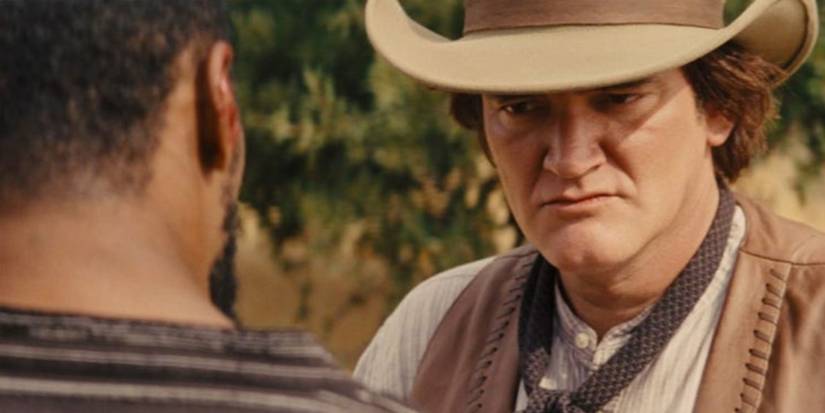
What makes Django Unchained special is its blend of genre storytelling and a surprising social conscience from Quentin Tarantino, who had faced criticism throughout most of his career for his portrayal of race in his films. A white filmmaker crafting the final act of Pulp Fiction, and then casting himself as a character who says slurs for what feels like half an hour, is enough to warrant some suspicion. According to his 2022 book Cinema Speculation, Tarantino spent much of the 1970s in Los Angeles theaters watching exploitation movies with Black father figures, learning how to study films that were often considered low-rent or trashy with the same close critical eye he would apply to more artistically regarded cinema. The so-called “Blaxploitaiton” genre capitalized on a hunger for Black stories within traditional genre movie structures, which led to actors like NFL vets Jim Brown and Fred Williamson starring in Westerns and action movies with an explicit social bent. Tarantino’s beloved Pam Grier, who would go on to star in the director’s Jackie Brown, was in many of these as well.
Django Unchained followed in that tradition. While Tarantino’s next Western, 2015’s The Hateful Eight, would be more of a chaotic tumble of post-Civil War racial tension, Django is the director’s most straightforward and heroic film: an enslaved Black man named Django (Jamie Foxx) is freed from his chains by the kindly German dentist and bounty hunter Dr. King Schulz (Christoph Waltz), and ends up becoming a bounty hunter himself. Rather than the anonymous Southwestern settings of most of the ‘60s and ‘70s Westerns Tarantino is referencing, Django Unchained is deeply mired in the world of the antebellum South — its most memorable image is that of a villain’s blood sprayed on cotton fields. Django’s quest involves rescuing his enslaved bride Broomhilda von Shaft (Kerry Washington) from the plantation of the vile Calvin Candie (Leonardo DiCaprio) in a movie whose reference points veer from the north star of Sydney Poitier’s Buck and the Preacher to the slavery glorification of Gone With the Wind and Birth of a Nation. It’s a rich text.
Django Is A Folk Hero of Spaghetti Western Lore
Django Unchained is also indebted to the Django character of spaghetti Western lore, with Franco Nero, the original Django, even showing up for a brief cameo in the movie’s second half. 1966’s Django, directed by Sergio Corbucci, is set in a Mexican border town, following a cynical Union veteran as he navigates the squabbles of Mexican revolutionaries and Confederate gangs still holding on to their old ideology. The movie’s violence was notorious, leading to its being banned in the United Kingdom, a dubious honor you can imagine Quentin Tarantino would have wanted for one of his own films. Indeed, Tarantino spent most of the press run for Django Unchained discussing how the project’s impetus involved writing a yet-unseen book of film criticism on Corbucci, telling the Village Voice that that, as well as a desire to create an element of Black masculine folklore, ultimately led to his take on Django.
Part of the Django lore is in its lack of copyright. After the success and controversy of the 1966 original, Django movies have been made sans Nero and Corbucci ever since, with nearly thirty movies borrowing the archetype of a rootless, violent drifter (including a Japanese one from Takashi Miike that Tarantino guest starred in). For Tarantino, creating a Black folk hero was the most important part of the project. The movie is explicitly borrowing from the German folk hero Siegfried, and Tarantino would idly conceive of a Django follow-up that would show him crossing over with an older Zorro — a plot that became a comic run some years later. While the movie’s wild tone and co-opting of Western tropes and Black iconography led to more of the complaints that have followed him since his first films, particularly by regular critic Spike Lee, it’s the rare Tarantino movie where his heart seems to be in the right place. Django Unchained is ultimately a love story, an epic Western, and a tribute to the Blaxploitation genre from one of its keenest admirers.
KioskNews shows a cleaned-up reading view extracted from the publisher’s page — the original always lives on their site, not ours.