Indonesia's Kadin proposes three steps to strengthen intra-BRICS trade
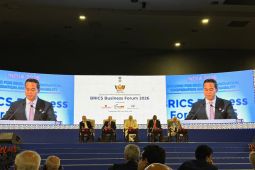
Jakarta (ANTARA) - Indonesian Chamber of Commerce and Industry (Kadin) Chairman Anindya Novyan Bakrie has proposed three measures to strengthen trade and services among BRICS member countries.
The measures include facilitating cross-border mobility for companies and professionals, strengthening the interoperability of payment systems, and increasing investment in human resources and infrastructure supporting trade in services.
Bakrie made the proposals at the BRICS Business Forum 2026 in New Delhi, India, on Friday (September 11), according to a statement received here on Saturday.
As a first step, Bakrie urged BRICS countries to ease cross-border mobility for companies and professional workers.
He said the BRICS Business Council should identify concrete obstacles faced by businesses and submit specific proposals to the governments of member countries to address them.
Bakrie said mutual recognition of certain professional qualifications and streamlined business travel procedures could accelerate transactions and investment.
He also proposed developing a BRICS Business Travel Card to facilitate business mobility.
The second step is to connect and strengthen payment systems among member countries, particularly digital payment systems.
Bakrie said India, Brazil, and China have demonstrated significant potential in real-time payments, with the challenge being to make such systems interoperable and efficient for cross-border transactions.
BRICS should also expand the use of local currencies for trade where appropriate while maintaining data security and financial system stability, he said.
“Financial sovereignty does not have to mean financial isolation,” said Bakrie, who also chairs the BRICS Business Council Indonesia.
The proposal is in line with discussions at the BRICS Business Forum on payment system connectivity, expanding transactions using local currencies, and developing fast, low-cost, and secure cross-border payment mechanisms.
As a third step, Bakrie urged BRICS countries to increase investment in human resources and infrastructure that support trade in services.
He said businesses need to strengthen worker training, expand collaboration with universities, and help companies, particularly micro, small, and medium enterprises (MSMEs), harness artificial intelligence (AI).
Bakrie proposed that each BRICS Business Council chapter establish measurable annual targets for the number of workers trained.
He also said the New Development Bank could help finance digital networks, training programs, and supporting infrastructure.
According to Bakrie, new member countries such as Indonesia must help shape the BRICS agenda rather than simply become markets for products and companies from earlier members.
He said every partnership should build domestic capacity so that people across all member countries can become both service providers and users.
Bakrie described genuine BRICS integration as an ecosystem in which micro and small business owners in Surabaya, Sao Paulo, Durban, and Alexandria can find customers, offer services, and receive payments through the BRICS economic network.
“That is the true test of meaningful BRICS integration,” he said.
Related news: Indonesia, India elevate global roles through BRICS partnership: Envoy
Related news: Ministry calls for leveraging OECD, BRICS to boost competitivenes
Translator: Rizka, Kenzu
Editor: Primayanti
Copyright © ANTARA 2026
KioskNews shows a cleaned-up reading view extracted from the publisher’s page — the original always lives on their site, not ours.