Sonia Gandhi's Interview With NDTV In 2004, Now Seen From Her Memoir's Lens
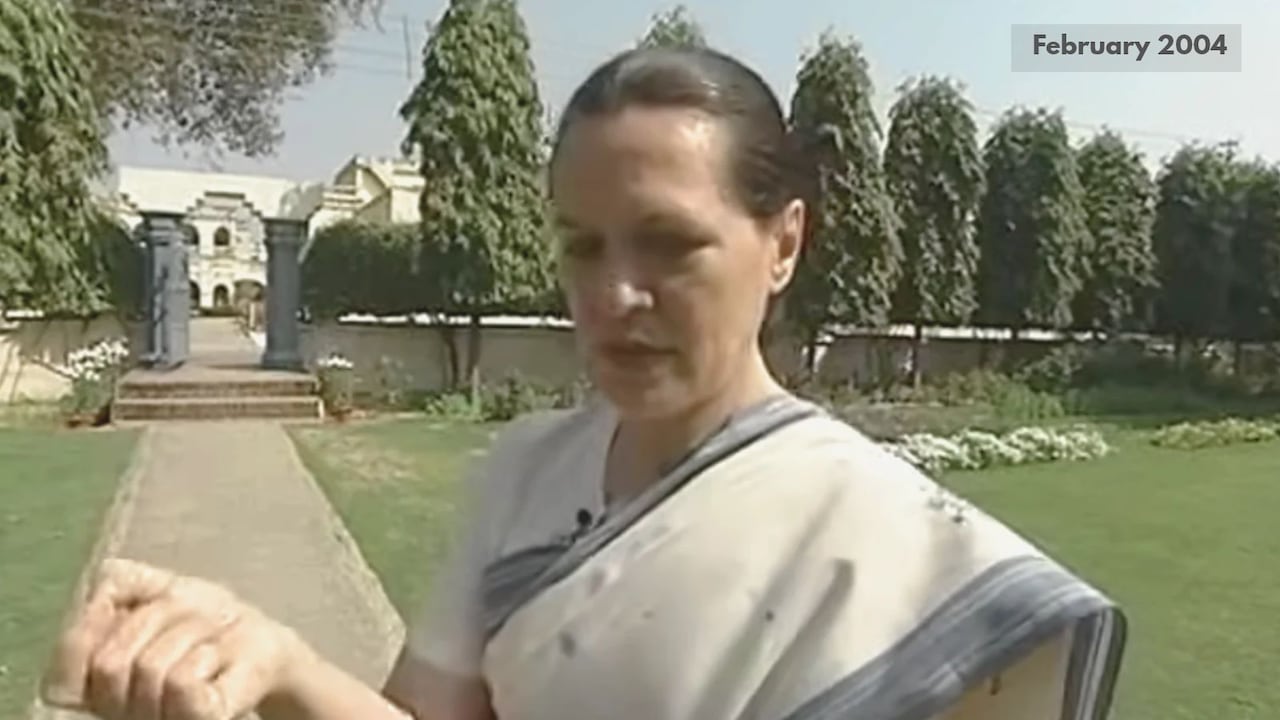
Three months before the 2004 Lok Sabha election verdict brought the Congress-led coalition to power, Sonia Gandhi told NDTV that she had never wanted to enter politics. She also shared that a persistent concern about her husband Rajiv Gandhi being assassinated unfortunately came true.
The main reason behind her decision to join public life was to stop the BJP, she had said, and also indicated that Manmohan Singh would have a "key role" if the Congress returned to power - an event that actually happened.
The remarks made during an interview with journalist Shekhar Gupta for NDTV's Walk The Talk in February 2004 got new significance after Sonia Gandhi disclosed in her memoir, Belonging: A Journey of Love, that she had already told her children she would "absolutely not" become prime minister.
The book, released today, described the private turmoil that preceded her decision to nominate Manmohan Singh for the post after the election results. Alliance leaders had briefly forced an inaudible "theek hai" from her, but she returned to her original refusal after her children Rahul Gandhi and Priyanka Gandhi challenged her decision.
READ | Why Sonia Gandhi Begged Husband Not To Enter Politics But Didn't Stop Son
In the NDTV interview, Gandhi did not say whether she would accept the prime minister's post but repeatedly described politics as a life she had resisted and associated with personal loss.
"I was not ever keen to join politics. In fact, I didn't even want my husband to join politics because I had seen my mother-in-law's life struggles, being rejected, all sorts of accusations being hurled at her," Sonia Gandhi said.
Indira Gandhi had led "a life of service and a very difficult life" before she was assassinated in 1984, she said, adding the killing had left the family expecting another attack.
"After my mother-in-law was killed, I knew that he too would be killed," she said of Rajiv Gandhi. "All of us, my children, knew that it was just a question of when my husband would have been killed."
Former prime minister Rajiv Gandhi was assassinated during an election campaign in Tamil Nadu in May 1991. In her memoir, Gandhi recalled that Rahul Gandhi had warned her two months earlier, "If something isn't done about pa's security, I know I'll soon have to come back for his funeral."
On what eventually drew her into politics, Gandhi told NDTV that Congress leaders had sought her help when the party was struggling. She said she felt she was failing in her duty whenever she passed photographs of her husband and mother-in-law in her drawing room.
READ | 'She Was Preparing For Her Death': Sonia Gandhi On Indira After Op Blue Star
Apart from personal reasons, a political factor also compelled her to join public life and it was linked to the BJP. "That was 1998 and the BJP was gaining somewhat. That was the main reason for me taking that decision," she said.
She alleged the BJP pursued a "divisive agenda" that could "divide our country and break our country". Her disagreement with the Atal Bihari Vajpayee government also extended to its economic priorities as the Congress wanted to continue economic reforms but combine them with social-welfare programmes, rural development, poverty alleviation and stronger panchayats.
"At the same time, I believe we have to focus on the poor. These are not mutually exclusive... People from the Congress who authored economic reforms to begin with, particularly Dr Manmohan Singh, will have a key role in this," Sonia Gandhi said.
"There is no repudiation of Dr Manmohan Singh or his policies. There is no repudiation, there is no rejection."
READ | When Indira Gandhi Feared George Fernandes Would "Blow Her Up"
After the election, Sonia Gandhi rejected the prime ministership and proposed Manmohan Singh as leader of the Congress parliamentary party, a decision which her memoir said was taken months earlier when Rahul Gandhi and Priyanka Gandhi asked whether she would accept the post.
"Absolutely not!" she told them. When they sought confirmation, she replied: "I'm very clear."
In the NDTV interview, Sonia Gandhi also rejected the Vajpayee government's "India Shining" account, citing unemployment and inadequate investment in agriculture. "Where is this feel-good factor coming from? Frankly, I don't know. I have not seen it anywhere in the places which I have visited," she said, three months before the 2004 general election results showed the Congress-led coalition won.
Finally, the economist whom Sonia Gandhi said would have a "key role" became the prime minister.
KioskNews shows a cleaned-up reading view extracted from the publisher’s page — the original always lives on their site, not ours.