When Aboriginal people appeared in a 1950 film they were asked to invent dialogue. Now a spotlight is shining on the tale they told
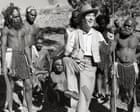
The first time Vonda Last watched Bitter Springs, she recognised her grandfather. The black-and-white Australian classic drew headlines at the time for being the first English film made in South Australia, starring the likes of Tommy Trinder, Chips Rafferty and Charles “Bud” Tingwell. But for the people of Ooldea in the central desert, it is notable for a different reason: it also stars 120 Anangu people, speaking in language.
Last’s grandfather, Thumu Pluto Hicks, was among those who travelled for two days in a train carriage from his remote community to the railway town of Quorn in the Flinders Rangers to appear in the film.
He died when Last was seven but she recognised him “straight away”.
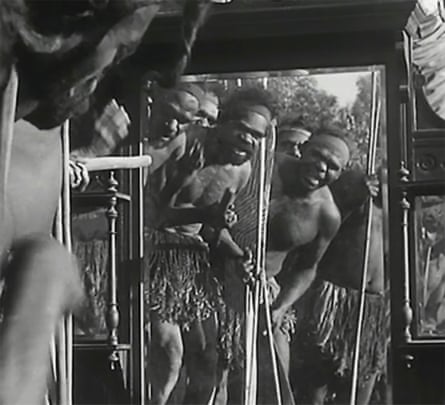
“I was very proud,” the Ngaantjatjara woman says. “He was a wati [initiated man], and all of the men would’ve been senior men in that film, who were representing their strength and identity as Aboriginal men.”
The film tells the story of Wally King, played by Rafferty, who moves 600 miles into the outback to settle land he has leased from the government. On the journey, white settlers warn him about the “Abos, blacks – hundreds of them” he would most likely encounter.
It is regarded as one of the first mainstream stories to challenge the narrative of the Australian frontier and the right of settlers to take Aboriginal land.
The Anangu actors weren’t given a script. They were cast in the roles of two fictitious tribes and just told to talk.
A joint project by linguists and First Nations language speakers to unpick the older dialect and translate what they said has now revealed a second, deeper story. The Anangu actors weren’t just saying meaningless words or sentences, which is what the film crew thought at the time – they were improvising this historical dialogue and giving a true depiction of what life was like when white settlers invaded their land and displaced them.
The translation project aims to shine a light on a forgotten piece of history and bring recognition to the Anangu actors who journeyed by train from remote parts of north-west SA, including from communities near the Maralinga lands. Some also came from remote parts of Western Australia
“Its powerful to hear that language because that’s the first language spoken in country,” Last says. “I said to another aunty, I said, ‘Can you understand that language?’ – because I sent her a link to that film.
“She reckon it’s language they spoke at Ooldea, back down Tjuntjuntjara. You can hear that it’s a different dialect to Pitjantjatjara. I don’t know if it’s an old language that people haven’t spoken for a while.”
‘Bitter Springs time’
A social anthropologist and honorary associate professor at the Australian National University, Dr Maggie Brady, has been working with people from the remote Aboriginal communities of Yalata, Oak Valley, Maralinga and the Anangu Pitjantjatjara Yankunytjatjara lands for the past five decades. While working to support the 1984 royal commission into the British nuclear tests at Maralinga, she heard locals speak of the years immediately proceeding the tests, which began in 1952, as “Bitter Springs time”.
Later, she would travel to Quorn to ask the non-Indigenous locals what they remembered of the production. She was shown photo albums featuring the film production and crew on set, including many pictures of the Anangu, and took a reel-to-reel copy of the movie to Yalata to play for the community.
“I guess I just realised that the film is probably a big part of their history,” she says, adding: “I got permission from the Quorn Historical Society to make copies and I made them up into photobooks and took them back to Maralinga and Oak Valley.
“I thought maybe we can identify some people in these photographs and, to my shock, I found that people were able to recognise their parents and grandparents in these images, even though, when those pictures were taken, their grandparents were just children.”
The production was scheduled to take 10 weeks but was delayed by bad weather. The white stars of the film stayed in Quorn’s Transcontinental hotel while the Anangu were housed in a campsite near the filming locations.
An Aboriginal language expert at Adelaide University, Associate Prof Sam Osborne, who speaks fluent Pitjantjatjara, is working with the Iwiri Aboriginal Corporation in Port Adelaide, alongside Pitjantjatjara and Yankunytjatjara interpreters, to translate and subtitle the film. It’s a complex process, involving some now unspoken dialects.
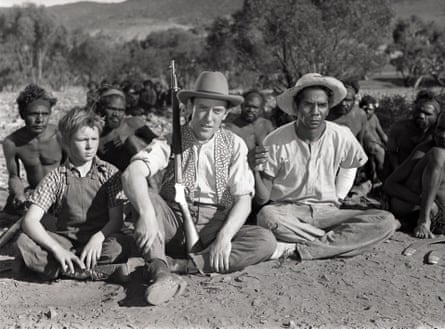
The primary question about the Anangu actors’ involvement before the translation project began, Osborne says, was whether they were just “verbalising, or vocalising and saying ‘blah, blah, blah, blah’” or whether they were improvising and taking part in the story’s development.
“What we discovered is that Anangu were improvising in really clever and thoughtful ways throughout the film,” he says. “It showed that a very creative space was opened up for meaning and understanding for the times …
“In coming together and meeting each other, there’s a series of interactions like seeing yourself in a mirror, striking a match, there’s a scene where the guy shows his rifle and what it can do.
“Then the Anangu goes, ‘Yeah, well it can’t shoot over a tree or around a rock’… and he sort of shows that you can sort of spear around a corner, but his bullets can’t do that.
“Theres a creativity and a genius to what the Anangu actors performed.”
In one scene, when the two fictitious tribes of Mangarayi and Yangman are confronted by the white settlers, a senior man holds his spear and yells “ma-pitija”, telling the white men to “go away”.
Watching translated extracts of the film, knowing that the director, film producers and white actors did not understand the whole of what they were making, was to this reporter – an Aboriginal man who grew up on the same country where many of the Anangu actors were from and can understand much of the language – a surreal experience. There is a depth to the story that is inaccessible to most viewers.
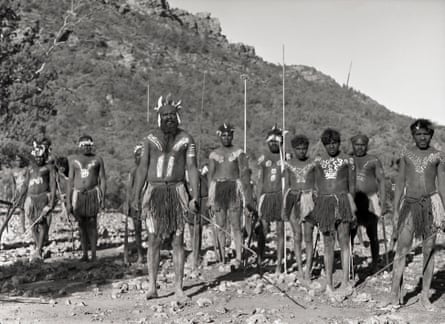
Osborne says the translation project gives a “rare insight into what [Anangu] people were thinking about and how they were contributing to that bigger story”.
Redress through rescreening
In 2024, while back in Quorn conducting more research about the film, Brady was introduced to Cindi Drennan, the founder and director of Illuminart, a company that projects art on to landmarks.
Drennan has since joined the project and effort to see the film translated in full, subtitled and shown at future Australian film festivals. In May, Illuminart produced and showcased a 30-minute documentary about the filming and production of Bitter Springs, and projected it on to grain silos in Quorn.
“When the film was played in Adelaide and it opened, there was a big hoo-ha fanfare but no Aboriginal actors were invited,” Drennan says, adding: “There was all this fanfare about the white actors in it but there was no recognition for the Aboriginal actors. They were just kind of like, black extras, even though they spent far more time speaking on screen I reckon then the white actors do.”
Together, Drennan and Brady are dreaming of a second chance at the film’s premiere, this time with the contribution of Anangu actors recognised.
“Maggie, she keeps coming back to, ‘We want to play this in Adelaide and we want to invite as many people as we can to that screening,’” Drennan says. “I think she justifiably feels like that would be, kind of a redress, or reparation for a lack of recognition over many years and I agree with her.”
KioskNews shows a cleaned-up reading view extracted from the publisher’s page — the original always lives on their site, not ours.