‘They paved paradise’: fighting back over the loss of green spaces in Cameroon’s capital
A little piece of paradise is buried under the asphalt that is now lined with parked cars. The romantic spot where Sosthène Hugues Ngono used to bring his first dates had been green and beautiful. “It wasn’t just a park,” he says, standing at the edge of what is now a private car park in Cameroon’s capital, Yaoundé.
“It was where I came to clear my head when things felt confused,” he says. “Where I met people; where I fell in love, more than once.”
Ngono, 36, a mathematics teacher, watched in dismay as the public park in Essos, a densely populated neighbourhood of Yaoundé, was razed in February last year, but his loss was only a small, personal version of a larger one playing out across the city.
Green space in Yaoundé is under mounting pressure from unregulated urban expansion. Yaoundé covered nearly 33 sq miles (85 sq km) in 1984. By 2024 it had spread to cover 181 sq miles , according to a study by the University of Yaoundé.
Over the same period, the share of wooded areas in the city’s land cover dropped from 28.6% to just 5.4%.
Yaoundé’s rapid development reflects growing demand for housing and infrastructure as its population expands. The UN put the capital’s population at 5.1 million in 2025. Cameroon’s housing ministry estimated a national housing deficit of 2.5m units in 2020, most acutely felt in the city.
With formal housing supply falling far short of demand, much of Yaoundé’s growth has taken the form of informal settlements and slums, often built without permits over the valleys, wetlands and hillsides of its green belt.
However, its disappearance has given rise to a quiet counter-movement. Jean-Baptiste Tchengang, a 34-year-old self-taught gardener, grows mostly ornamental plants, decorative foliage and small shrubs suited to Yaoundé’s climate, chosen because they multiply easily and fit into small yards.
“Their value is as much practical as it is beautiful,” he says. “They bring colour and coolness, but they also give people a simple way to rebuild small green spaces where the big gardens are disappearing.”
Since 2022, Tchengang has run community workshops on composting and preserving local plant species from his own plot in Nkolbisson, a district on Yaoundé’s outskirts that researchers identify as one of the city’s historic areas of urban expansion, dating from 1984.
“I have trained or helped about 300 people since I started,” he says. Ten of his trainees have gone on to build their own gardens on abandoned plots, providing vegetables, medicinal plants and social spaces.
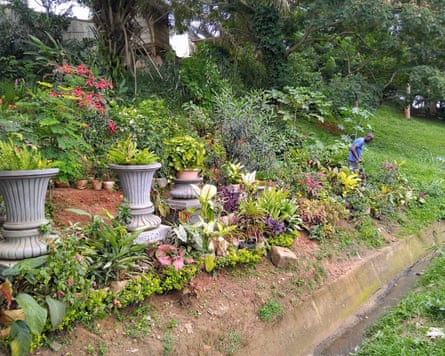
“Getting access to land is the hardest part,” Tchengang says. “There’s no funding, plants get stolen, and the ones you can buy are scarce and expensive. But somehow, I make it work.”
When funds allow, Yaoundé city council buys shrubs and gets him to plant and maintain them, but it is not regular work. In July, Tchengang brought together about 50 young nature conservation volunteers who wanted to learn his methods to make their own case to the authorities. Trees especially have been suffering, disappearing from the urban landscape.
“Trees are not there simply to make Yaoundé more beautiful,” says Jean-Marie Essoh, a climate specialist in the city. “They absorb rainwater, slow runoff and help hold the soil together.
“They also cool a city where concrete keeps spreading,” he says. “When they disappear, it weakens far more than the landscape.”
As trees are carbon sinks, absorbing CO2, their disappearance makes climate adaptation harder in a city regularly hit by heavy rains and flooding; when they are felled, that carbon is released back into the atmosphere.
A 2023 report on urban forests by the UN’s Food and Agriculture Organization (FAO) found that trees and green spaces play a vital role in climate resilience and warned that their benefits are increasingly under threat as cities expand.
after newsletter promotion
Knowing where those benefits are being lost is the starting point for Mireille Nonga’s work. A 33-year-old urban-planning student at the University of Yaoundé I, she has mapped the city’s green spaces with 20 classmates since 2023, identifying 10 potential sites for reforestation.
“There are several criteria,” says Nonga. “First, the position of the plot in relation to urban development in the area, its availability and its land status, whether it belongs to the state.
Other points to consider, she says, are “accessibility, access to water and the flow of people around it”.
Today, the Sainte-Anastasie wood and the nearby garden at Place Charles Atangana are among the few green spaces remaining in Yaoundé. According to Nonga, even these central spaces are inconsistently maintained.
Yaoundé’s authorities do recognise the problem. The MoVe Yaoundé project, launched in January 2024, includes a four-year urban renewal plan for the city centre, with about 1,000 sq metres (10,800 sq ft) of green space planned, including tree-lined avenues.
In September, the council published a call for tenders that included landscaping works, new parks, tree-lined avenues and permeable paving.
But until the green spaces promised under MoVe Yaoundé take shape, the work of preserving what is left falls to people such as Nonga. “If we don’t know what we’re losing, we can’t defend it,” she says.
The Guardian contacted the Yaoundé urban council about the loss of Essos park and the authorisation of the private car park. The council referred the questions to the official in charge of the MoVe Yaoundé project, who did not respond to requests for comment.
KioskNews shows a cleaned-up reading view extracted from the publisher’s page — the original always lives on their site, not ours.