Time review – David Tennant’s furious drama is as important as Adolescence

Jimmy McGovern has said that this new, third instalment of his prison anthology drama Time will be the last. For the sake of audiences’ emotional equilibrium, you have to hope so. For the sake of scripted drama, for the sake of art that has a hope of stirring the conscience of authorities and effecting change, you have to hope not.
This time, Time is inside a young offender institution. It is crammed with under-18-year-old males, locked up often for 23 hours a day, all subject to the relatively new “keep apart” system whereby prisoners deemed likely to be violent towards each other are not allowed out of their cells at the same time. Naturally, this leads to a lot more boys being banged up for a lot more of the day and suits the officers a lot better. It is a facet of modern YOIs that McGovern and his co-writer Sam Bailey, a man evidently cut from the same socially conscious cloth, are clearly intent on bringing to wider attention. Their script, and the direction by Paul Whittington, do a wonderful, terrifying job of conveying the kinetic energy pent up and desperate for release, and the seething fury ever threatening to erupt, in every scene.
And what scenes. This is McGovern (and Bailey) at his finest – stripped of sentimentality, always furious and driven by an agenda but never descending into agitprop, and giving us stories of suffering, of moral struggle, of the damage and the glory that people are capable of, the burdens they bear and the gifts they can give.
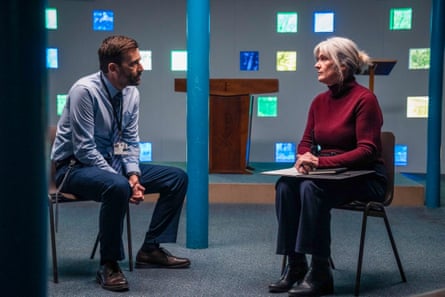
A restrained David Tennant, in one of his best ever performances, plays corrections officer Bobby Bailey, wearied by the job but not entirely devoid of compassion for the lads in his care. Alongside him is his colleague Freddie Jennings (Daniel Ryan), of whom much the same can be said. At least until we see him gut-punch James (Louis McCartney), a mouthy smart alec, suddenly gasping for breath on the floor after one wisecrack too many.
Into the prison comes chaplain Marie-Louise (the inimitable Siobhan Finneran), who has been in all parts of the triptych and is – blissfully – given more to do here. She has lost her faith, after a relationship ending and a marked lack of Christian charity from expected sources in its wake. She expects to be fired from the new post when she confesses it, but the elder chaplain tells her they need her now more than ever. So they do, but she is a straw in the howling wind of need within the system. And she knows it. But she keeps on and keeps on and this, in McGovern’s theology, is where all hope of redemption resides.
We get to know the boys – or young men, but the drama limns them so clearly as boys within, inarticulate, insecure, capable of sweetness and softness but hardening by the minute – gradually. McGovern and Bailey don’t shy away from the fact that offenders are (unlike the women in the second series, say, the pettiness of whose crimes was part of the point) incarcerated for “proper” reasons. James has killed his brother, a group of Liverpudlian boys murdered a man in the street, and the sense is that the rest of them have all committed, or been involved with, similar levels of violence. Most of the actors – including Ollie McNulty as Peter, the conscience-stricken part of the murderous gang, and Chukwubuikem Molokwu as Christopher/Ushindi, whose avoidable tragedy powers much of the narrative – are making their debuts, and the quality of their performances (and Molokwu must also navigate his character’s painful stammer, which he does without losing a moment’s focus) is just astonishing. Kudos to them all and to the woman who found them, casting director Amy Hubbard.
All of McGovern’s customary concerns are on display as Bobby’s sins, major and minor, accumulate, temptations encourage straying from the path of righteousness, and guilt becomes a prison of its own. The boys show us how grief, abuse and a lack of language with which to express any of it manifest in simple violence and how little a gut punch – actual, from an individual, or metaphorical from the state – will do to quash let alone solve it.
Love is offered, slightly more overtly than elsewhere in the series, as an answer. Not a panacea, just … an opportunity. To be better, feel better, live better. Eventually, after three of the most harrowing and acutely moving hours, we are allowed some hope.
For myriad reasons, including its very complexity and the dreadfulness of the truths it holds, this portrait of masculinity and the misery it brings probably won’t garner the attention and momentum that Jack Thorne’s Adolescence did. But it should. Our boys need it.
KioskNews shows a cleaned-up reading view extracted from the publisher’s page — the original always lives on their site, not ours.