Last chance saloon: EU presses China for a sign to prove trade talks can work
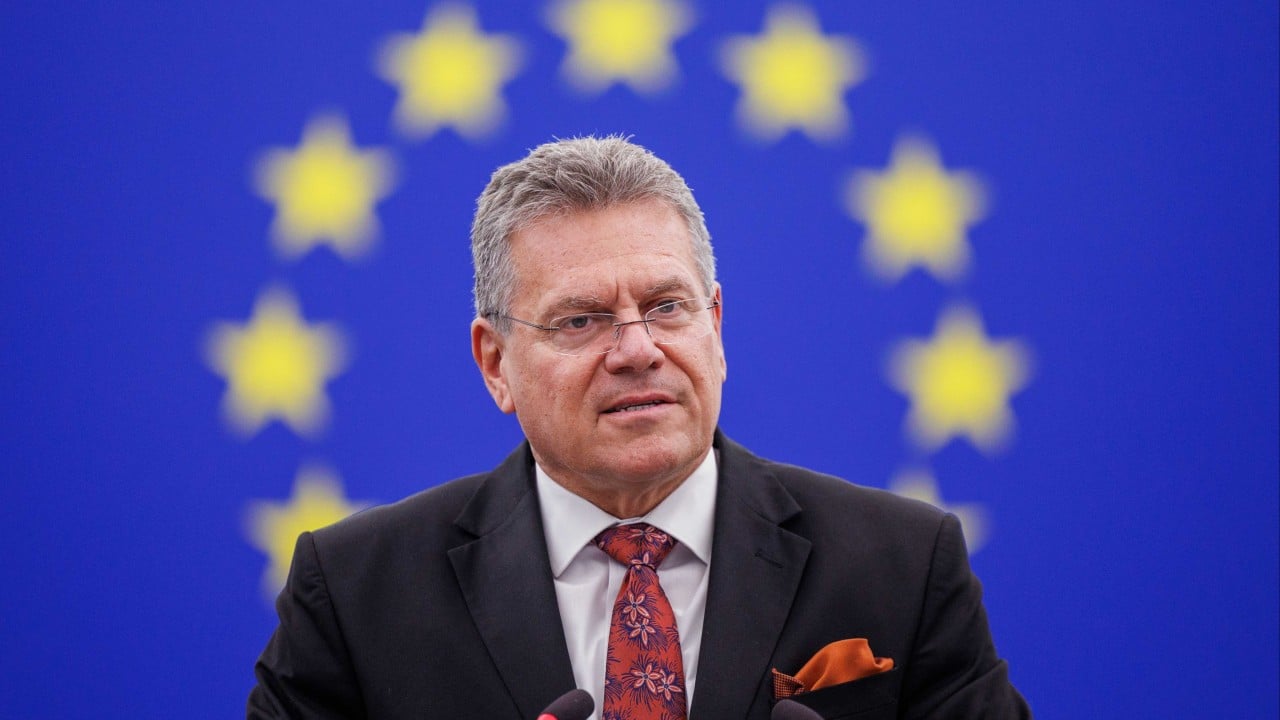
The European Union’s top trade mandarins depart for Beijing on Wednesday for two days of intensive negotiations but expectations in Brussels are measured as to what the talks will deliver.
Maros Sefcovic, the EU’s trade chief, will meet his Chinese counterpart Wang Wentao on Thursday and Friday – three months after their last encounter in Brussels, when the Europeans set an October deadline for signs of a rebalancing in the trading relationship.
Non-stop working-level talks have proven difficult, with the lopsided trade balance showing little sign of narrowing. Indeed, Beijing’s enormous trading surplus with the 27-member bloc has expanded further in the intervening quarter.
However, Beijing is believed to no longer outright reject the suggestion that there are problems in its trade ties with Europe.
Brussels hopes that by the end of Friday, China’s commerce ministry will agree to moderate its exports in a single sector, in a “proof of concept” arrangement that could be extended to further sectors, according to people familiar with the talks.
02:14
Foie gras output surges in China as producers eye the European market
Even a narrow outcome such as this would allow both sides to declare the early rounds of what has been named the Trade and Investment Consultations a success.
“The Sefcovic talks in Beijing will determine whether China is willing to put sufficiently serious offers on the table, and whether those offers are substantial enough to change the underlying dynamics,” said Andrew Small, director of the Asia programme at the European Council on Foreign Relations.
Beijing could hope to retain broader access to the lucrative European market at a time when its economic reliance on exports is growing. Nonetheless, minor progress is unlikely to deter the EU from taking the task of rebalancing into its own hands later this year.
The bloc is convinced that China’s model of state capitalism and subsidised competition is putting its own manufacturing sector in jeopardy.
Surges in cheap imports from China in key sectors are blamed for the loss of thousands of factory jobs across Europe’s industrial heartlands, particularly in Germany. Chinese firms that were valued customers and suppliers for German manufacturers have hurtled up the value chain to become ruthless competitors.
German officials are convinced that behind the cutthroat competitiveness lie undeclared Chinese state subsidies, an undervalued currency and other forms of support. The dynamic has led to an unprecedented Franco-German alliance on China policy that seems set to push the EU in a much more hawkish direction.
“The consensus for European action on China is finally in place after Germany’s caution had long held back a more robust EU approach,” Small said.
SCMP Plus is a new premium news platform that gives you an
all-inclusive edge to stay ahead on China news.
To access our exclusive content you’ll need to subscribe.
Already a subscriber?
LOG IN
On Monday, Paris and Berlin co-signed a paper calling for, among other things, a new trade weapon that would allow the EU to cut China out of its market immediately – a dramatic step-change from a German government that has for years been reluctant to take Beijing to task on trade for fear of retribution.
A letter signed by German Chancellor Friedrich Merz and French President Emmanuel Macron, addressed to European Commission President Ursula von der Leyen, laid out the reasoning behind the move.
“We need a credible instrument in the hands of the Commission to allow for decisive and systemic reaction, i.e. activation by reversed qualified majority, and for powerful measures up to an immediate cut-off from the internal market if needed,” it read.
11:33
Balancing trade and economic rivalry: the future of Sino-German relations
The letter marks an unlikely alliance: Paris has for years been the cheerleader for more protectionism and industrial policy, with Berlin often the biggest obstacle.
According to Bernd Lange, the European Parliament’s top trade lawmaker, “the European Council has finally woken up”.
With Germany and France, two heavyweights have recognised that we need a change of course when it comes to trade defence instruments. They must be quicker and easier to deploy to protect against unfair market distortions,” he said.
The new instrument would be in addition to a tool aimed at forcing EU firms in key sectors to broaden their supplier base to avoid becoming further dependent on imports that can be weaponised.
This second new instrument is likely to be laid out, along with a solidarity fund to compensate firms hit by trade retaliation, in early December.
China’s commerce ministry said on Tuesday it hoped “France and Germany … refrain from encouraging the EU to frequently resort to protectionist tools, and certainly not politicise or over-securitise economic and trade issues, so as to avoid taking the wrong path in the wrong way and ultimately harming themselves”.
Leaders from the 27 EU members will meet next week in Brussels where they will be debriefed on the Beijing talks.
At the last such meeting in June, only Spanish Prime Minister Pedro Sanchez spoke up against a tougher trade policy. With the socialist leader calling a snap election in November and trailing in the polls, China could soon find it has few defenders at Europe’s top table.
“Today, everyone is on high alert,” Pascal Lamy, former chief of the World Trade Organization, told Le Monde on Tuesday.
“We need a Plan A to deal with China: that’s what Sefcovic is doing. He’s trying to negotiate measures with the Chinese that they themselves would take to curb their exports or their dumping in certain sectors,” he said.
“But it’s doubtful that this will be enough. So we also need a Plan B.”
KioskNews shows a cleaned-up reading view extracted from the publisher’s page — the original always lives on their site, not ours.