‘Chaotic’ Asian Games hurt Japan’s image of order
Japan is traditionally seen as a reliable host for major sporting events, but an Asian Games dogged by organizational woes has tarnished that image and raised questions over future bids, experts said.
The Games in Aichi-Nagoya saw a catalogue of mishaps, from athletes bussed to the wrong venues to the North Korean national anthem played for the South Korean hockey team.
There were not enough beds for the more than 17,000 athletes and officials, a bigger number than the Olympics.
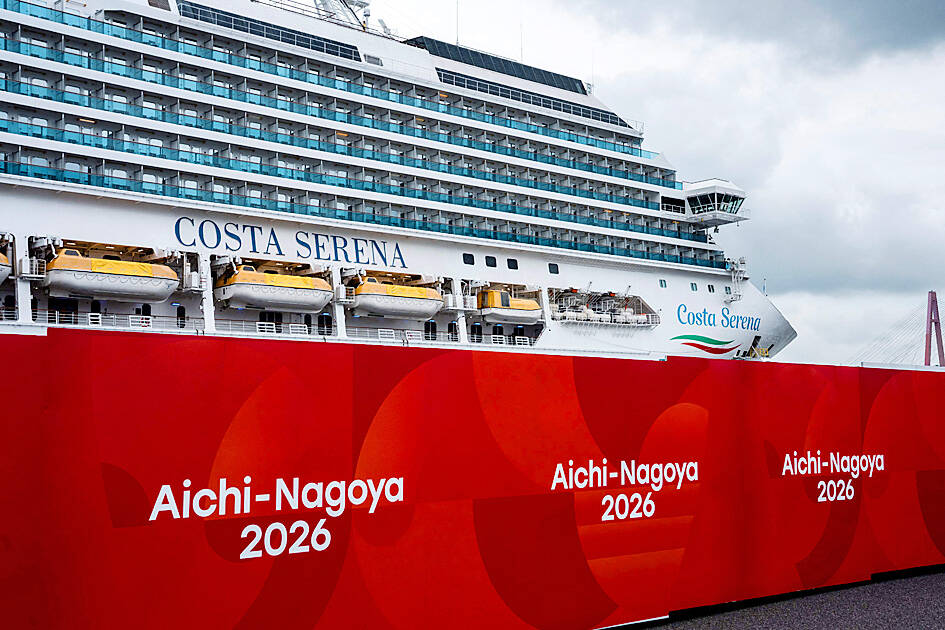
The Costa Serena cruise ship, which was used as an accommodation facility for athletes and officials during the Aichi-Nagoya Asian Games, is pictured at the Port of Nagoya in Japan on Sept. 15.
Photo: AFP
Countries complained of being stranded for up to six hours at the airport on arrival.
Teams were not shy in criticizing the local organizers.
Korean Sport and Olympic Committee president Ryu Seung-min said: “If I were to give them a grade, it would be an F.”
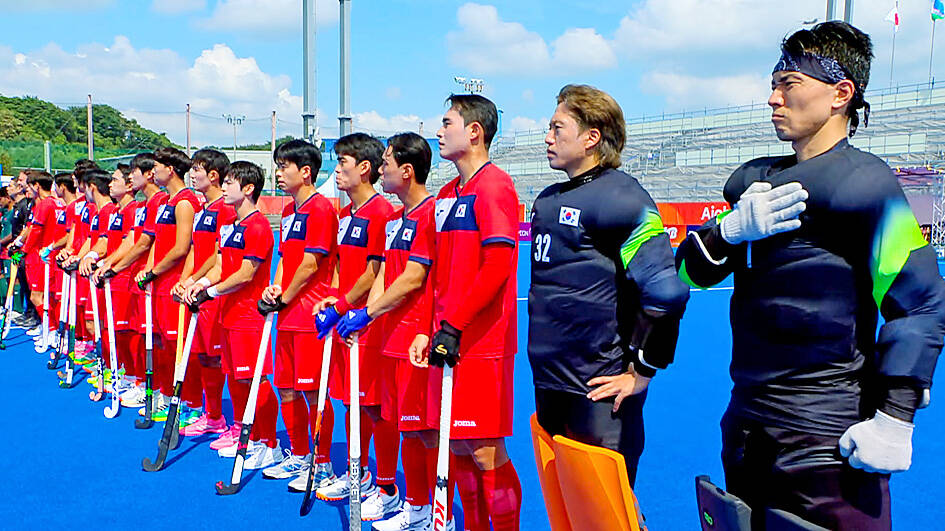
South Korean men’s field hockey players react as the North Korean national anthem is played ahead of their game against Bangladesh at the Asian Games in Kakamigahara, Japan, on Sept. 18.
Photo: SNTV via AP
Japanese Olympic Committee president Seiko Hashimoto admitted that “there were many problems,” but said the country wants to host more international events.
Japan might struggle to escape the shadow of the Asian Games for some time to come, said Hirokazu Arai, a professor specializing in sports psychology.
“If Japan were to bid for the Olympics again, trust in Japan may have fallen, and it might be harder to win a bid,” he said. “And within Japan, people may take the view that if these kinds of things are going to happen, we don’t need the Olympics.”
Many in Japan have questioned the value of hosting major sporting events as they grapple with the fallout from the graft-stained and COVID-19 pandemic-delayed Tokyo Olympics.
Cost overruns, corruption and COVID-19 all tainted the public’s memory of the Olympic Games, which took place largely behind closed doors in 2021, a year later than planned.
However, Japan was praised by some for getting the Games on in unprecedented circumstances.
The country subsequently dropped the idea of hosting the Winter Olympics in the northern city of Sapporo because of a lack of public support.
Hashimoto, who also served as president of the Tokyo Olympics organizing committee, has said Sapporo’s bid could be revived.
She said the Asian Games had “reaffirmed my belief in the value of hosting international sporting events in our country.”
“We also received harsh criticism because of the challenges we faced — I am fully aware of that,” she said. “This is all part of the Games, but we need to analyze those issues so we can tackle them for the next future opportunity.”
Asian Games organizers were presented with a headache when the number of athletes and officials that was initially expected ballooned by about 2,000.
Unlike at past Games, there was no traditional athletes’ village, to save money.
Participants instead stayed on a cruise ship, in hotel rooms and in temporary wooden huts.
Some teams complained about the wooden units, saying they were too cramped and the beds were too short.
After a troubled build-up, organizers hoped the attention would switch to sport when the action got under way.
However, still the problems continued, with transport and accommodation difficulties and further mix-ups with anthems and flags.
“It’s like musical chairs,” a Thai official said, adding that organization at the Games had been “chaotic.”
The Nagoya mayor apologized to athletes for “inconveniences,” saying that organizers would “sincerely reflect on the mishandling that occurred.”
There were sparse crowds at some events, starting with thousands of empty seats at the opening ceremony.
Organizers blamed the bad weather.
Arai said he believes the Games have damaged Japan’s international reputation as a safe pair of hands.
“The previous [Asian] Games were in China, and I’m sure there were athletes who came here expecting Japan to put on a better event than China,” he said. “But I don’t think you can say that’s how it’s turned out.”
Anger that had faded in the years since the Tokyo Olympics could flare up again, Arai said.
“The people at the top of Japan’s sporting world are moving towards trying to bring the Olympics here again,” he said. “From their perspective, they may have felt that criticism had started to die down, but this situation could cause that criticism to intensify again.”
KioskNews shows a cleaned-up reading view extracted from the publisher’s page — the original always lives on their site, not ours.