Agency urges prompt installation of Java patch
BE CAUTIOUS: The cybersecurity agency warned the public that hackers can break into items at home, such as cameras and TVS, and reminded them not to use default passwords
By Shelley Shan / Staff reporter


The Administration for Cybersecurity yesterday urged government agencies and businesses to promptly install an emergency security update released by Oracle to fix a critical vulnerability in its Java Development Kit (JDK), warning that attackers could take control of systems or disrupt services without authentication if the issue is not patched.
The kit is used for software development and system maintenance, and provides tools for developing and compiling Java code used in Web technologies such as JavaServer Pages and Servlets.
The vulnerability, dubbed Java4Shell, was rated 9.2 out of 10 under version 4.0 of the Common Vulnerability Scoring System, indicating a critical level of severity.
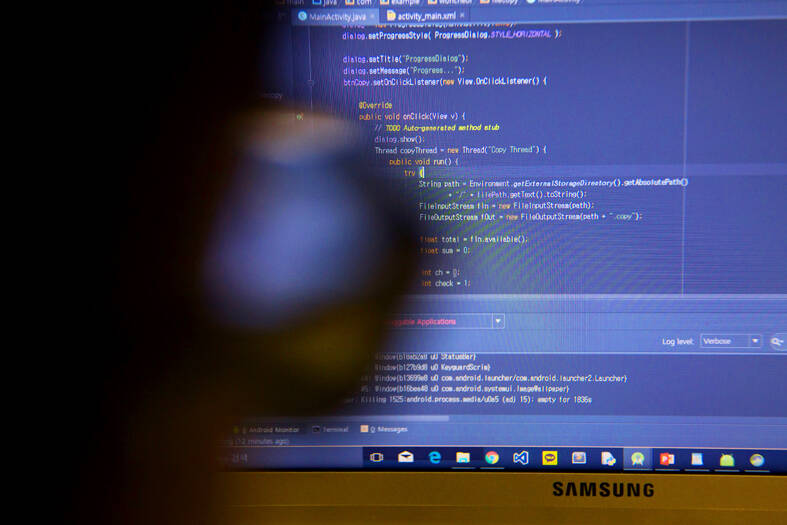
A student looks at lines of code in the programming language Java displayed on a Samsung laptop computer during a cyberdefense programming class in the “War Room” at Korea University in Seoul on Nov. 26, 2015.
Photo: Bloomberg
The agency has issued a cybersecurity alert requiring government agencies at all levels and critical infrastructure operators to promptly install the emergency update or implement other mitigation measures to prevent potential cyberattacks.
Even after installing the update, organizations should review system logs and monitor unexpected Java Virtual Machine (JVM) restarts and unusual outbound network connections, the agency said, adding that they should also check the security of accounts and credentials if suspicious online activity is detected.
The vulnerability lies in JVM’s Base64 decoding function, which converts encoded data into its original form.
It could allow attackers to use specially crafted input to trigger an out-of-bounds write operation in the memory heap, potentially exposing sensitive information and enabling remote code execution without authentication, the agency said.
Affected products include OpenJDK versions 8u511b33-perf, 17.0.21.0.3, 21.0.13.0.3, 25.0.5.0.3 and 27.0.1.0.3, as well as earlier releases, it added.
The agency also warned the public that Internet-connected devices, including home security cameras, smart TVs and smartwatches, could expose personal data and provide hackers with entry points into their networks.
A report jointly published by Bitdefender and Netgear found that households own an average of 22 Internet-connected devices.
Households with such devices are subject to an average of 29 probing network scans per day, the report said.
“These probing scans are like a thief turning door knobs from house to house to find unlocked doors. Hackers might be tempted to break into a system if it lacks adequate protection,” the agency said.
Common cybersecurity risks associated with smart devices include weak passwords, vulnerabilities in specific product versions and inadequate privacy protections.
Hackers do not need sophisticated technology to break into Internet-connected home security cameras if users retain default passwords, choose weak passwords or use devices with known security vulnerabilities, the agency said.
Such breaches could expose users’ private images and turn compromised cameras into launch points for attacks on other systems, it said.
Location data, voice recordings and information about home layouts could also be leaked through smartwatches, smart speakers and robot vacuum cleaners, it added.
To reduce cybersecurity risks associated with smart devices, the public should choose products from reputable brands that provide regular security updates, keep devices and their mobile apps up to date, replace default passwords with long and difficult-to-guess versions and enable two-factor authentication, the agency said.
Users should also choose products that allow them to delete stored personal data, regularly clear their usage histories and reset devices before giving them away or reselling them, it said.
Parents should teach children not to share passwords or personal information with strangers and to report suspicious messages, the agency added.
KioskNews shows a cleaned-up reading view extracted from the publisher’s page — the original always lives on their site, not ours.