John Ivison: Carney pipeline boosting hasn’t yet convinced investors that Canada has changed
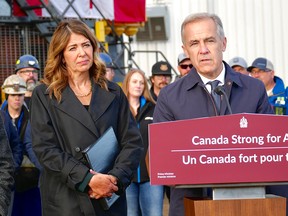
Mark Carney spoke to two distinct audiences in Fort McMurray, Alta., on Thursday, where he announced that the proposed West Coast oil pipeline — now known as Pacific Link — has been officially listed as a project of national interest.
Sign In or Create an Account
The first was the people of Alberta, who will be asked on Oct. 19 to vote on whether the province should remain in Canada, or whether it should negotiate to hold a binding referendum on independence.
The prime minister said that the confirmation that the project has Ottawa’s support and will now move into the formal consultation phase “demonstrates the power of Canada.”

Columnist Jesse Kline keeps you up to date with what’s happening in Israel and the effects of antisemitism on life here in Canada. Friday mornings.
By signing up you consent to receive the above newsletter from Postmedia Network Inc.
A welcome email is on its way. If you don't see it, please check your junk folder.
The next issue of Channel Israel will soon be in your inbox.
We encountered an issue signing you up. Please try again
He said the pipeline presents a generational opportunity to become one of the world’s trusted oil suppliers.
The prospect of exporting an additional one million barrels a day to Asia would help reduce a price differential on U.S. exports that the Alberta government estimates has cost the Canadian oil sector US$49 billion since 2010.
Premier Danielle Smith credited Carney’s predecessor, Justin Trudeau, with creating the demand for independence with his “litany of bad laws.”
She said the brand of co-operative federalism that Carney has practised has persuaded her that Canada can work. “The government of Canada genuinely wants to identify problems and genuinely wants to solve them,” she said, confirming that she will vote for Alberta to remain in Canada.
There has been little change in provincial support for independence in recent months, which remains mired at around 22 per cent.
But the sight of the country’s prime minister in the heart of the oilpatch may sway the small number of undecided voters, particularly those who have been convinced that he is intent on killing the industry.
“Oil demand will be significant for decades to come, even under any plausible net-zero scenarios,” Carney said. “The question is: who will emerge as the world’s most trusted suppliers? It must be Canada.”
The prospect of 140,000 jobs linked to the new pipeline likely won’t hurt either.
Carney’s other message was directed at potential investors, who have adopted a wait-and-see approach to committing capital.
“Investors should know that when Canada wants something built, Canada will get it built,” he said.
When he was asked whether taxpayers will be on the hook for the estimated $35 billion to $43 billion cost of the pipeline, he bridled. “Canadian taxpayers are going to make a lot of money off this pipeline,” he said.
The response reinforced the fact that, to this point, the private sector has been virtually absent from both the Pacific Link and the linked Pathways Alliance carbon capture and storage project, in terms of binding financial commitments.
Pembina Pipeline has agreed to help develop Pacific Link, in return for a 10 per cent stake, but has not committed a specific dollar amount.
The rest of the equity will be divided between the government of Alberta and Trans Mountain Corp., which is federally owned. The prime minister said that another 10 per cent stake will be reserved for Indigenous ownership and funded by federal loan guarantees, but provided no details on how the shares might be allocated.
On the carbon-capture project, Ottawa and the five companies behind Pathways reached a non-binding agreement earlier this year, under which the federal government committed to investment tax credits of 50 per cent. But no capital commitments have been made, with producers targeting a final investment decision late next year. Costs are said to have doubled from earlier estimates to around $30 billion, which is putting additional pressure on negotiations.
The mutual dependence between Pacific Link and Pathways means that the whole grand bargain could come apart at the seams, even though the federal government has made its position clear at the start of the process.
The point of Thursday’s announcement, besides firming up the political status quo, was to make the point that Ottawa has now done pretty much all it can do to bring this project to fruition.
When it was announced by Carney and Smith last year, it was greeted with skepticism.
The Alberta-federal memorandum of understanding contemplated an oil pipeline to the West Coast, financed by the private sector, that included Indigenous ownership, developed in tandem with the Pathways carbon capture project.
Ottawa cancelled the threatened oil and gas emissions cap and suspended clean energy regulations that would have blocked the construction of gas-fired power generation in a province blessed with cheap natural gas.
It is remarkable that a grand design with so many potential pitfalls has come this far
In return, Alberta agreed to increase its industrial carbon tax to around $130 a tonne, a level at which carbon capture becomes more viable.
But the hurdles remained considerable. Conservative Leader Pierre Poilievre said that Carney was only pretending he wanted a pipeline, while telling the progressive members of his caucus that he intended to keep the oil in the ground.
B.C. Energy Minister Adrian Dix dismissed Alberta’s efforts at the time, saying Smith had “no route, no plan and no market.”
Since then, the province has unveiled a plan to build a pipeline that follows the route of the Trans Mountain Expansion to B.C.’s Lower Mainland, terminating at the Roberts Bank terminal in Delta, where the very largest tankers could dock.
That weakened the resistance of David Eby’s B.C. government, since it avoided the need to repeal the Oil Tanker Moratorium Act that banned tankers from the province’s northern coast.
The B.C. premier was then brought on-board by the “prosperity partnership” agreement signed in July that traded Ottawa’s financial and regulatory support for a number of infrastructure projects, in return for Eby’s consent for the pipeline.
There may yet be trouble ahead. The southern route crosses 11 First Nations, who will now be formally consulted on their views.
The prime minister will rely on the head of his Major Projects Office, Dawn Farrell, to use the knowledge gleaned as the former chief executive of Trans Mountain to help smooth that process.
But it is remarkable that a grand design with so many potential pitfalls has come this far.
By designating Pacific Link as being in the national interest, the federal government has not only said it believes the project strengthens Canada’s resilience and provides clear economic benefits; it explicitly implies that it believes there is a high likelihood of it being completed.
It remains to be seen whether private sector investors agree.
National Post
Join the Conversation
This website uses cookies to personalize your content (including ads), and allows us to analyze our traffic. Read more about cookies here. By continuing to use our site, you agree to our Terms of Use and Privacy Policy.
KioskNews shows a cleaned-up reading view extracted from the publisher’s page — the original always lives on their site, not ours.