With war project, US tech ecosystem is beginning to look a lot like China’s
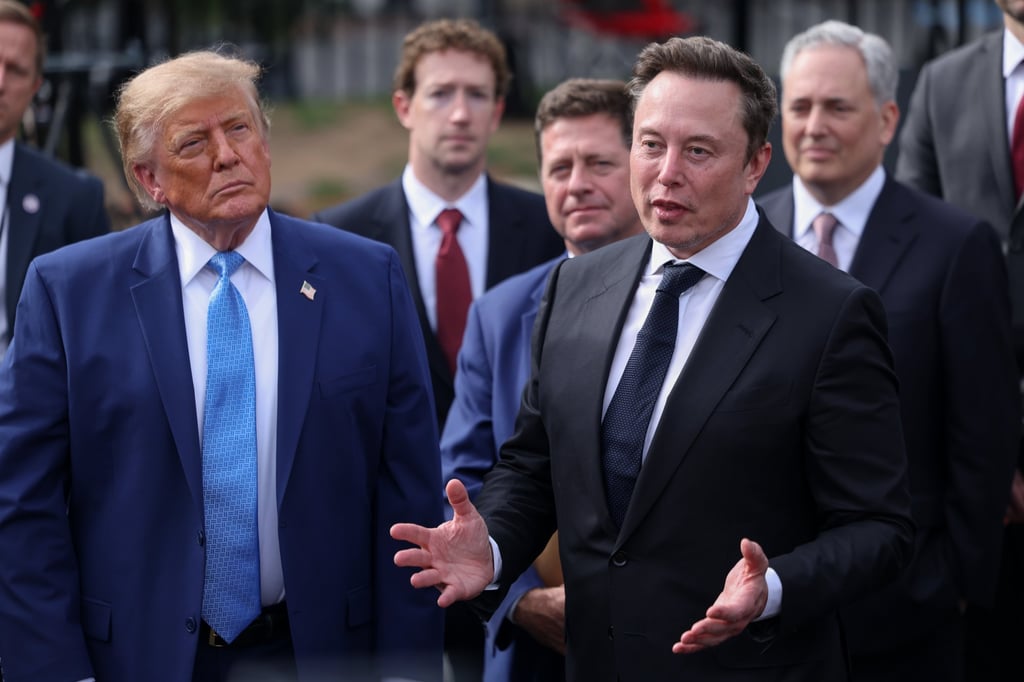
The world’s wealthiest man has just been appointed to a Pentagon commission that will help decide what the future of warfare looks like. Elon Musk, alongside Anduril Industries co-founder Palmer Luckey and former House speaker Newt Gingrich, is to lead “Project Meridian”. It follows a strategy by this White House that moves government and the tech sector ever closer.
Project Meridian goes much further than the influence of defence contractors in Washington. It marks the beginning of Silicon Valley arriving at the halls of power, where the future of warfare itself is being imagined.
The post-war years have been marked by an ever-closer relationship between American defence contractors and the government. This was exactly the convergence president Dwight Eisenhower warned against in his 1961 farewell address.
Even with the revolving door between industry and government, and billion-dollar lobbying efforts, the structure of the relationship was clear: government would set the direction and contractors would bid to enact it.
The founding political ideology of Silicon Valley was deeply libertarian. Despite its early ties to the military, the Valley imagined itself as a counterweight to Washington’s political power. By building new technology and tearing down old conventions, the Valley’s leading lights would reimagine and reinvigorate the spirit of democracy, or at least that was the story they told themselves. Consequently, they saw any attempt to regulate their business as a threat to that civilisational mission.
The dawn of the age of artificial intelligence (AI) created a new part of the global defence economy, a booming sector of companies that carry as much DNA from Silicon Valley as from traditional weapons manufacturers.

These neoprimes create the platforms on which weaponry can be automated and simplified. They have openly rejected the old model, in which contractors create systems for a future defined by the Pentagon. They are building the software – AI-enabled, as is the demand of the 2020s – through which that future can become real.
At this intersection, they find the old dependence on state contracts for their growth clashes with Silicon Valley’s belief that they should be the ones building the future. As Palantir co-founder Peter Thiel put it: anyone opposing these “disrupters” view of the future of AI is tantamount to the Antichrist. To him, it is a mortal sin to put guardrails on the new world being built.
In the pursuit of ambition, this new sector has shed its old libertarian ethos and instead doubled down on its belief that rapid, unencumbered advancement should override any checks on its power.
With Project Meridian, that has been given force. Two tech leaders whose companies hold billions of dollars in Pentagon contracts are now tasked with defining what the future of warfare will require – and thus stand to benefit from it.
Here, the American relationship between technology and the state is beginning to look a lot like its Chinese counterpart, albeit from different directions.
01:18
Chinese President Xi Jinping holds rare meeting with China’s top entrepreneurs amid US tech rivalry
Historically, China’s tech sector has seen itself as part of the national project of its emergence as a great power. Beijing sets the strategic direction, and with many companies having set up Communist Party committees, the phone works both ways.
That is especially true for AI, which Beijing sees as the vanguard of its economic transformation in the unfolding century. The People’s Liberation Army has been relying heavily on civilian AI vendors and research institutions as it attempts to leverage China’s well-educated society to build the region’s dominant military.
The distinction between the two matters as they engage in a great power conflict. Chinese and American technology are increasingly a proxy for the kind of power they project into the world. Beijing offers a version in which there is little meaningful difference between the state and industry. Washington, at least in theory, offers open space for private innovation.
That distinction still matters, but less and less. If the most important American AI firms are now the ones deciding the future of war, then the myth of neutrality emerging from the private ownership of these companies is gone. Relying on the leaders of these companies to make important decisions will shape the state that sponsors the process.
The Chinese model of technological development has long been one in which private innovation happens inside a political system that sets its direction. The American version is now arriving at the same integration from the other side. The private sector, as it always has, is pulling the state towards its own incentives.
The result, accidentally, is that America’s tech ecosystem is beginning to resemble China’s, albeit from the opposite direction. Both systems are arriving at a fusion between the industry and the state while preserving their native pathologies.
That convergence leaves the world without a meaningful alternative to a technological system that operates as an arm of a political mandate.
KioskNews shows a cleaned-up reading view extracted from the publisher’s page — the original always lives on their site, not ours.